




Will a mini split save you more money than central air?
HVAC
Is a Mini Split or Central AC Cheaper? Here’s What Massachusetts Homeowners Need to Know
The mini split vs central ac cost comparison comes down to one question above all else: does your home already have ductwork?
Here’s a quick breakdown to help you decide:
| Factor | Mini Split | Central AC |
|---|---|---|
| Best for homes with existing ducts | No | Yes |
| Best for homes without ducts | Yes | No |
| Heating included | Yes (heat pump) | No (separate system needed) |
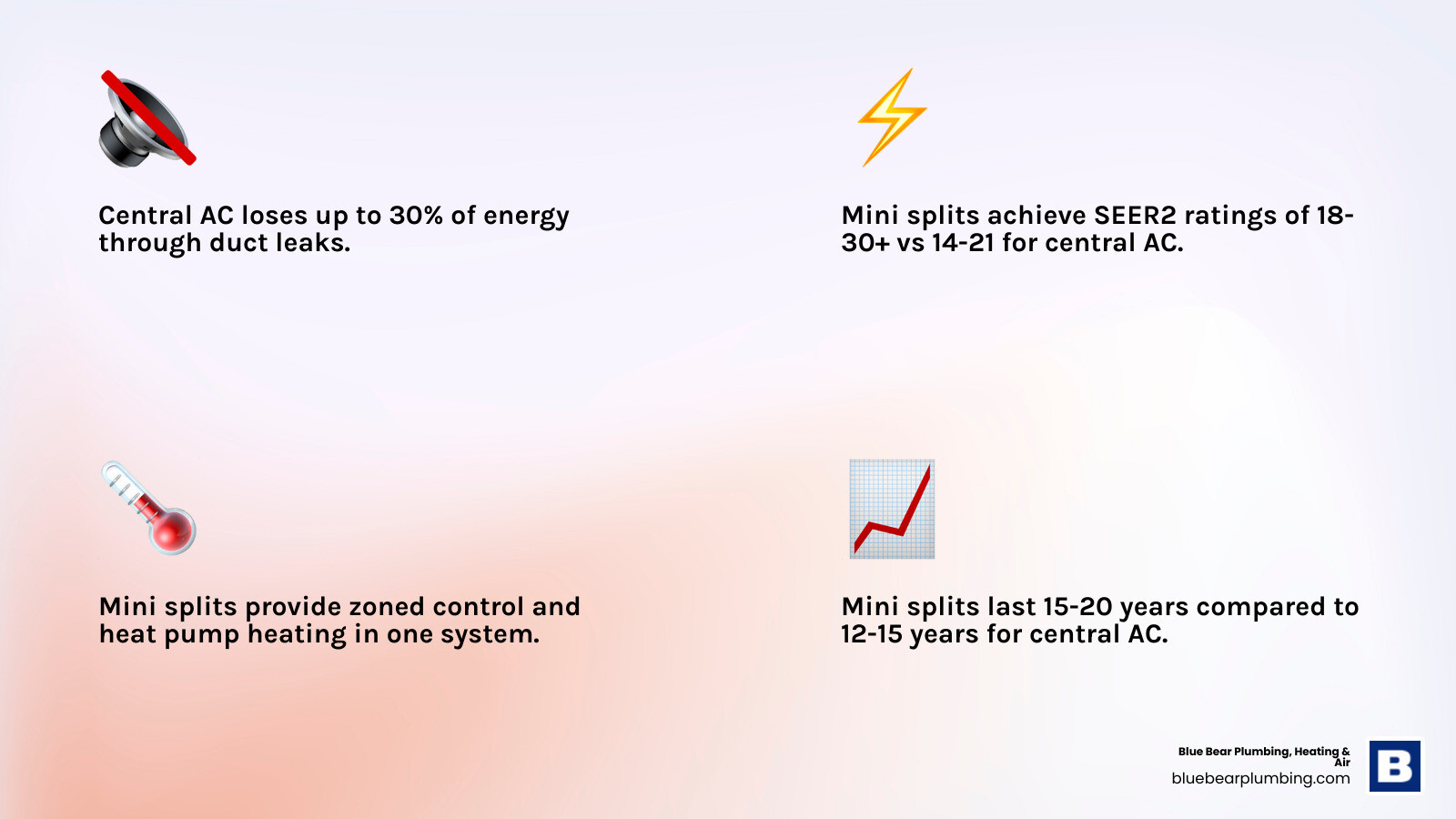
| Energy efficiency (SEER2) | 18-30+ | 14-21 |
| Duct energy loss | None | Up to 30% |
| Lifespan | 15-20 years | 12-15 years |
| Zoned temperature control | Yes | Limited |
| Federal tax credit eligible (2026) | Up to $2,000 | Up to $600 |
Most homeowners focus only on the sticker price of each system — and that’s where they go wrong. The real cost picture includes energy use, heating needs, duct condition, and how long you plan to stay in your home. A central AC unit might look cheaper upfront, but if your ducts are leaky or nonexistent, that advantage disappears fast. On the flip side, a whole-home mini split setup can rival or exceed central AC costs when you already have solid ductwork in place.
For South Shore homeowners especially, where homes range from century-old colonials to modern builds, the right answer genuinely depends on what’s already inside your walls.
I’m Marc Provenzano, Marketing Manager at Blue Bear Plumbing, Heating & Air, and I’ve spent years helping Massachusetts homeowners cut through the noise on decisions like this mini split vs central ac cost comparison — connecting them with the right information and the right local experts. Let’s break down what actually matters so you can make a confident, informed choice.
Evaluating the mini split vs central ac cost comparison for Massachusetts homes

When we look at the mini split vs central ac cost comparison for a home in Quincy or Natick, we have to look past the equipment sitting in the box. The complexity of the installation and the labor required to get the system running are the biggest variables in your initial investment.
Central air conditioning relies on a single, powerful outdoor condenser connected to an indoor evaporator coil, usually tucked away in a basement or attic. It moves air through a network of ducts. If those ducts are already there and in good shape, the labor is relatively straightforward. However, if we have to cut through plaster walls or sacrifice closet space to run new metal or flex ducts, the labor requirements skyrocket.
Ductless mini splits take a different approach. They consist of an outdoor unit connected to one or more indoor “heads” via small refrigerant lines. Because we only need to drill a small three-inch hole to connect the two, the installation is much less invasive. This makes them a favorite for historic homes across the South Shore.
When Finding A Reliable Ac Installation Company In Quincy Ma, it’s important to consider how your home’s infrastructure dictates the work. A multi-zone mini split might require more equipment—several indoor units—but it avoids the massive construction project of a duct retrofit. On the other hand, if you’re looking at How To Pick The Best Ac Installation In Quincy Ma for a newer home that already has a furnace and ductwork, central AC often offers a lower entry point for whole-home cooling.
How existing ductwork influences your investment
Ductwork is often the “hidden cost monster” in the mini split vs central ac cost comparison. In many older Massachusetts homes, the existing ducts were designed only for heating. Cool air is heavier and denser than warm air; if your ducts are too small or poorly routed, a central AC system will struggle, leading to higher energy bills and frequent repairs.
Furthermore, air leakage is a massive drain on your wallet. According to the Department of Energy, the average ducted system loses 20% to 30% of its conditioned air through leaks, holes, and poor connections. That is essentially money flying out of your attic or crawlspace. Mini splits eliminate this waste entirely because there are no ducts to leak.
If you are looking for The Quincy Guide To Affordable Ac Installation, you have to factor in the cost of duct repair or replacement. Here are a few ductwork considerations we always discuss with our neighbors:
- Duct Integrity: Are the joints sealed with mastic, or is old tape peeling off?
- Insulation: Are ducts in unconditioned spaces like attics properly wrapped?
- Thermal Loss: Metal ducts can absorb heat from a hot attic, warming the air before it even reaches your bedroom.
- Airflow Balance: Does the system provide enough return air to keep the pressure stable?
For those researching Natick Ac Installation How To Stay Cool Without Breaking A Sweat, if your ducts need a total overhaul, the financial scale often tips toward a ductless mini split system.
Energy efficiency and monthly utility savings
Once the system is installed, the mini split vs central ac cost comparison shifts to your monthly utility bills. This is where mini splits usually win the long game.
Mini splits utilize inverter technology and variable-speed compressors. Unlike traditional central AC units that cycle on and off like a light switch—wasting a surge of energy every time they start—mini splits operate more like a dimmer switch. They ramp up to reach the desired temperature and then “sip” energy at a low speed to maintain it. This precision can lead to cooling costs that are 20% to 40% lower than standard central air.
Zoned cooling is another major advantage. With central AC, you usually cool the whole house, even empty guest rooms or the dining room at midnight. Mini splits allow you to turn off units in rooms you aren’t using. By only cooling the spaces you’re actually in, you can see a dramatic drop in your summer electric bills.
To keep these savings high, proper care is essential. Knowing How To Master Ac Maintenance In Natick Ma ensures your system doesn’t have to work harder than necessary. Simple steps like learning How To Clean Your Ac filters can prevent dust buildup from choking your efficiency.
Understanding SEER2 in a mini split vs central ac cost comparison
Efficiency in 2026 is measured by SEER2 (Seasonal Energy Efficiency Ratio 2). These ratings tell you how much cooling you get for every watt of electricity used.
- Central AC: Most modern units range from 14 to 21 SEER2.
- Mini Splits: These systems often achieve 18 to 30+ SEER2.
A higher SEER2 rating means lower operational overhead. While a high-efficiency central system is a great choice, a high-SEER2 mini split is often the most efficient way to move heat out of your home. We recommend checking out Keep Your Cool A Homeowners Guide To Norwell Ac Maintenance to understand how regular service keeps these efficiency benchmarks from slipping over time.
Heating capabilities and year-round mini split vs central ac cost comparison
One of the most under-discussed parts of the mini split vs central ac cost comparison is that most mini splits are actually heat pumps. They don’t just cool; they can reverse the process to provide highly efficient electric heating.
In our Massachusetts climate, “cold-climate” mini splits are a game-changer. Modern units can maintain their heating capacity even when temperatures drop well below zero. This dual-purpose value means you might be able to supplement or even replace an aging, expensive oil or propane furnace.
Central AC units are strictly for cooling. To get heat, you need a separate furnace or boiler. When you factor in the cost of maintaining and eventually replacing two separate systems, the “two-for-one” nature of a mini split heat pump provides incredible long-term value. To ensure your system is ready for both the summer humidity and the winter chill, it helps to work with The Best Ac Maintenance Experts Natick Has To Offer.
Long-term value and total cost of ownership
When we calculate the total cost of ownership over 15 years, we have to look at how long the equipment lasts and how often it breaks down.
| System Type | Typical Lifespan | Maintenance Needs | Repair Frequency |
|---|---|---|---|
| Central AC | 12-15 Years | Annual coil/duct checks | Moderate (moving parts) |
| Mini Split | 15-20+ Years | Monthly filter cleaning | Low (inverter tech) |
Mini splits often have a longer lifespan because inverter technology reduces the “wear and tear” caused by frequent on/off cycling. However, they do require you to stay on top of filter cleaning to prevent mold and dust buildup. If you’re asking yourself, “Do I Need A New Ac?”, consider the age of your current system. If your central AC is 12 years old and needs a major component replacement, the money might be better spent transitioning to a more efficient mini split.
Maintaining a ductless system is different but not necessarily harder. You’ll need to Maintain Aircon Wall Unit components by keeping the indoor blowers clean and the outdoor unit clear of snow and debris.
Long-term value factors include:
- Resale Value: Central air is often preferred by traditional buyers, but high-efficiency mini splits are increasingly valued by energy-conscious homeowners.
- System Redundancy: If one mini split head has an issue, the others usually keep working. If a central AC compressor fails, the whole house gets hot.
- Energy Inflation: As electricity rates rise, the 30% efficiency advantage of mini splits becomes even more valuable.
Which system is better for older homes without ducts?
If you live in a historic home in Hingham or Scituate that currently relies on window units, the mini split vs central ac cost comparison is almost always a win for the mini split.
Retrofitting ducts into a 100-year-old home is a massive undertaking. It often involves building “soffits” (bulkheads) that drop the ceiling height and can ruin the aesthetic of crown molding and high ceilings. Mini splits allow for a non-invasive installation that preserves the historic character of your home.
Furthermore, we often find that Window Units Outdated for modern comfort. They are loud, block your view, and provide a security risk. A mini split provides targeted cooling that is whisper-quiet—perfect for home offices where you need to focus on Zoom calls without a rattling window unit in the background.
Are there tax credits or incentives available in 2026?
In 2026, the financial math for mini splits is better than ever thanks to federal and state incentives. Under the Inflation Reduction Act, qualifying heat pump mini splits can earn you a federal tax credit of 30% of the project cost, capped at $2,000 per year. Central AC units that only provide cooling are typically capped at a much lower $600 credit.
Additionally, Massachusetts utility programs often offer substantial rebates for homeowners who switch from fossil fuel heating (like oil or propane) to high-efficiency heat pumps. These incentives can significantly lower the net cost of a mini split installation, making it much more competitive with a standard central AC replacement.
How does maintenance affect the mini split vs central ac cost comparison?
Regular maintenance is the only way to protect your investment. A central AC system needs its ducts inspected for leaks and its outdoor coils cleaned annually. A mini split needs its indoor filters washed every few weeks—a simple task you can do yourself—and a professional deep cleaning every year or two to keep the blower wheels efficient.
Knowing When To Get Ac Tuned Up In Massachusetts is key. We recommend a spring tune-up for any cooling system. If you skip maintenance, your SEER2 rating will effectively drop as the system struggles to pull air through dirty filters or coils, erasing the energy savings you bought the system for in the first place.
Conclusion
Choosing between a mini split and central air isn’t just about the lowest quote; it’s about finding the best fit for your specific home in the South Shore. Whether you are looking for a whole-home solution for a new build or trying to make an older home more comfortable without tearing down walls, the team at Blue Bear Plumbing, Heating & Air is here to help.
Our licensed technicians understand the unique challenges of Massachusetts weather and architecture. We pride ourselves on providing honest, upfront information to help you navigate the mini split vs central ac cost comparison with confidence. From Natick to Norwell, we are committed to high-quality workmanship and attentive customer care.
If you’re ready to stop sweating through the summer and start saving on your energy bills, we invite you to reach out. We can provide a personalized consultation to see which system will provide the best long-term value for your family. Chill Out With The Best Ac Installation In Norwell Ma by calling us today—we look forward to making your home the most comfortable place it can be!



Contact Us Today

Routine maintenance is vital for the longevity of your plumbing, heating, and air conditioning systems. Sign up for our Blue Care Maintenance Plan for annual service and exclusive membership benefits, including:
- Priority scheduling
- Waived service fee during normal business hours
- 10% discount on service calls
- 3% discount on new installations
- Two-year parts and labor warranty on new equipment