




Why Tree Debris Around Your Condenser Spikes Your July Electric Bill
general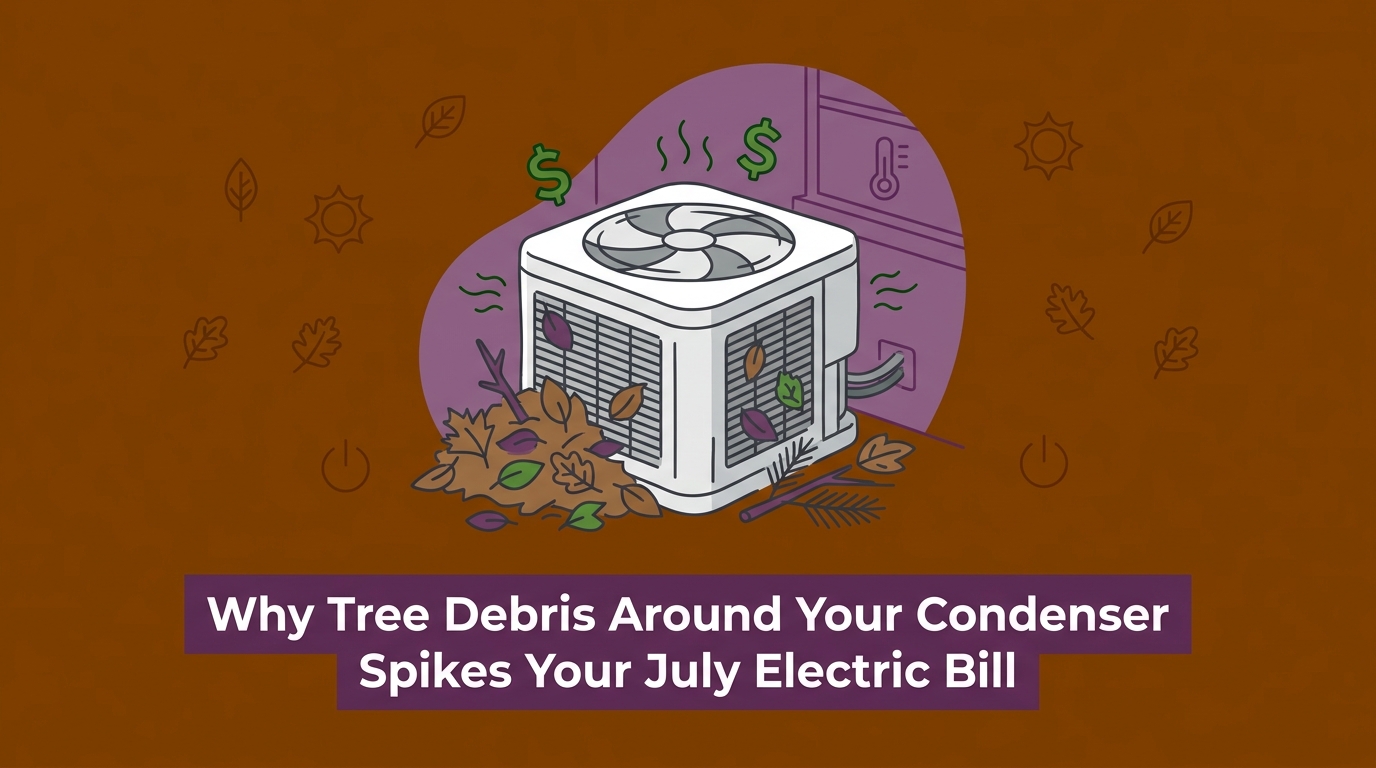
When Peak Summer Heat Meets Spring Yard Debris
At Blue Bear Plumbing Heating & Air, we find that if you are wondering exactly why tree debris around your condenser spikes your July electric bill, the answer usually starts forming long before the hottest days of summer actually arrive. The arrival of summer brings those sweltering stretches of weather where your air conditioner rarely shuts down. But when that first early-summer electric statement arrives in the mail, the sudden spike in energy consumption can be a genuine shock. Most homeowners assume their system is simply working harder because the temperature outside is rising, but that is only half of the story.
The concrete problem often lies right in your backyard: spring pollen, dropped seeds, and early summer tree debris choking the outdoor AC unit. As this organic matter accumulates, it creates a suffocating barrier that restricts your system’s ability to release heat. You are now faced with a critical decision point. You must choose whether to accept a constantly running AC unit and unusually high energy usage as just an unavoidable part of peak July summer heat, or recognize it as a mechanical symptom of debris-restricted heat transfer that requires immediate professional attention.
Ignoring the outdoor unit means paying for electricity your system is actively wasting. If you need a professional assessment of your system’s efficiency, exploring expert HVAC services is the smartest first step to take.
The Hidden Culprit Behind Your Spiking Summer Bills
It is incredibly common to look at a high energy statement and blame the weather. After all, when the sun is beating down on your roof, your air conditioner has to run longer cycles to keep the indoor temperature comfortable. However, increased energy consumption is often a direct symptom of unseen micro-debris rather than just unavoidable seasonal weather patterns.
In Massachusetts residential neighborhoods with heavy tree canopies, our team consistently observes that the transition from spring to summer creates a perfect storm for air conditioning systems. These areas experience massive spring pollen drops—especially from oak, pine, and birch trees—that perfectly coat outdoor units right before the heavy July AC usage begins. This coating acts as a literal blanket wrapped around your equipment.
- The insulation effect: Unseen debris acts as a thermal insulator, destroying the system’s ability to transfer heat from inside your home to the outside air.
- The overworking compressor: Because the heat cannot escape efficiently, the compressor is forced to work overtime, drawing significantly more electrical current to do the exact same amount of cooling.
- The false breakdown: The system becomes highly inefficient long before a complete mechanical breakdown occurs, quietly driving up your energy usage while still technically blowing cool air.
Differentiating between normal operation and a system struggling against environmental blockages is crucial. A clean system running in hot weather will cycle on and off predictably. A system choked by yard waste and pollen will run continuously, struggling to satisfy the thermostat while pulling maximum amperage the entire time.
The Physics of Heat Transfer: Why Your AC is Suffocating
To understand why a dirty unit costs so much to operate, you have to look at the basic mechanics of how your air conditioner actually cools your home. Your AC does not technically “create” cold air; instead, it absorbs heat from inside your house and pumps it outside. The outdoor unit, known as the condenser, is responsible for releasing that absorbed heat into the outdoor air.
The Problem: Airflow is absolutely critical to this heat exchange process. The outdoor condenser coil fins are designed to maximize surface area so that the fan can pull large volumes of ambient air across the hot refrigerant tubes. When a layer of debris covers these delicate metal fins, the air cannot make contact with the metal.
The Cause: The organic matter acts as a thermal blanket, trapping the heat inside the unit. Because the heat cannot be released into the yard, the refrigerant returns to the house still carrying thermal energy. The system realizes the indoor temperature is not dropping fast enough, so it forces the compressor to keep pumping.
The Solution: Restoring the metal-to-air contact by professionally removing the suffocating layer allows the heat transfer process to resume its normal, efficient cycle, immediately reducing the electrical load on the system.
How Debris Acts as an Insulator
Organic matter layered on metal creates a highly effective, yet highly destructive, insulating barrier. When pollen, sap, and dust bake onto the aluminum fins, they form a hardened crust. This restricted airflow forces the system to consume up to 30% more energy just to achieve the same indoor temperature you enjoyed last year. The compressor motor has to work against higher internal pressures, which directly translates to a higher amp draw every single minute the system is running.


Micro-Debris vs. Macro-Debris: The Invisible Threat
When most people think of a dirty air conditioner, they picture large branches or piles of autumn leaves leaning against the metal casing. While these certainly cause problems, they are only part of the equation. Distinguishing between easily visible yard waste and the insidious micro-debris that requires professional attention is key to understanding your energy usage.
| Debris Category | Common Examples | Impact on the Condenser | Visibility to Homeowners |
|---|---|---|---|
| Macro-Debris | Leaves, twigs, large branches, tall grass, shrubs | Blocks general airflow around the exterior of the cabinet. | Highly visible; easily cleared by hand or rake. |
| Micro-Debris | Caked-on pollen, tree sap, pine needles, dirt dust | Embeds deep within the coil fins, creating a thermal paste. | Nearly invisible from a distance; requires close inspection. |
Clearing a two-foot perimeter around your outdoor unit is an excellent first step for dealing with macro-debris. However, this is entirely insufficient if micro-debris has already formed a paste on the internal coils. This is a specific challenge in our region. Our technicians know firsthand that the combination of heavy Massachusetts spring pollen, New England tree debris like fine pine needles and sticky maple seeds, and intense July humidity creates a suffocating layer that binds to the metal.
The humidity acts as an adhesive, turning dry yellow pollen dust into a sticky sludge that bakes onto the coils under the summer sun. You might have a perfectly manicured lawn and a clear perimeter around your AC unit, but if the microscopic spaces between the aluminum fins are packed with hardened sap and pollen, your system is still suffocating.
The Domino Effect of a Choked Condenser
A dirty outdoor unit rarely causes a sudden, catastrophic failure overnight. Instead, it triggers a slow, cascading series of consequences that drain your wallet and shorten the lifespan of your equipment. Tracing this domino effect helps explain why proactive maintenance is so vital.
The immediate effect is always increased electrical consumption. As the system runs constantly but struggles to cool the home, the meter spins faster. Because the compressor is the heart of the system—and the component that uses the most electricity—any strain placed on it directly impacts your monthly utility statement.
The secondary effect is excessive wear and tear on the internal components due to overheating. Compressors are designed to be cooled by the refrigerant returning to them. When the heat transfer process is disrupted by debris, the compressor runs hotter than its design parameters allow. This thermal stress degrades the lubricating oils inside the compressor, increasing friction and causing internal damage over time.
This strain compounds exponentially during the hottest days of the year when the system is already operating under maximum load. For instance, the cost of running a single-stage AC on 95-degree days is already substantial; adding a suffocating layer of debris to the mix forces the system past its limits. Ignoring the problem transitions a simple efficiency issue into a highly complex, expensive repair issue as motors burn out and capacitors fail from the excessive heat.
Why DIY Cleaning Can Cost You More Than the Electric Bill
We often field emergency repair calls from well-meaning customers who attempted a quick fix. When homeowners realize their outdoor unit is dirty, the first instinct is often to grab the garden hose or, worse, a pressure washer. However, as our team regularly warns, improper DIY cleaning methods can permanently damage the unit, reinforcing the need for professional, licensed service.
- Fragile aluminum fins: The condenser coil is made of hundreds of paper-thin aluminum fins. These fins are extremely delicate and can be crushed with just the press of a finger.
- The danger of pressure washers: Using a pressure washer will instantly bend these fins flat. Once the fins are flattened, airflow is permanently restricted, completely ruining the coil and requiring a massive system repair.
- Ineffective water hoses: Standard garden hoses simply do not have the right kind of pressure or chemical makeup to dissolve baked-on sap and pollen paste. You might wash away the loose dust, but the insulating crust remains firmly attached to the metal.
Proper cleaning requires specialized, non-corrosive chemical cleaners that foam up and push the debris out from the inside. It also requires professional disassembly of the outer cabinet to clean the system from the inside out. Attempting to spray water from the outside in often just pushes the micro-debris deeper into the center of the unit, compacting it further and making the problem worse.
Professional Coil Clearing: Restoring Your System’s Efficiency
Restoring your system to its peak performance requires more than just a quick visual inspection. A professional maintenance visit entails a comprehensive approach to safely removing deep-seated debris and pollen, restoring the original heat transfer efficiency without risking damage to the delicate internal components.
During a proper service call, technicians carefully remove the outer protective grilles and safely apply specialized foaming agents that break down the sticky bond of tree sap and baked-on pollen. This allows the debris to be gently rinsed away, opening up the microscopic airways between the aluminum fins. Blue Bear Plumbing Heating & Air provides a comprehensive maintenance approach that safely removes this deep-seated debris to restore your original heat transfer efficiency, ensuring your system runs exactly as the manufacturer intended.
Our technicians also take the time to educate homeowners on how to protect their investment. One local customer recently reached out for a system checkup when they noticed their unit struggling during a heatwave. After thoroughly clearing the compromised system, our technician walked them through the exact care tips needed to keep the perimeter clear, providing valuable advice for ongoing AC maintenance to prevent the issue from recurring.
Professional cleaning is an investment that pays off rapidly by preventing wasted electricity and extending the life of your equipment. If you are tired of watching your energy usage climb, contact us for AC maintenance today. Understanding the mechanical link between yard debris and your system’s electrical draw is the first step; taking action to restore that efficiency is what will ultimately keep your home perfectly comfortable all summer long.
Frequently Asked Questions
Can a dirty outside AC unit cause high electric bills?
Yes, a dirty outside AC unit is one of the leading causes of high electric bills during the summer. When debris coats the condenser coils, it acts as an insulator that traps heat inside the system. This forces the compressor to work much harder and draw significantly more electricity to achieve the desired indoor temperature. Regular cleaning restores the system’s efficiency and normalizes energy consumption.
Why is my AC running constantly in July?
Your AC is likely running constantly because it is struggling to transfer heat efficiently due to restricted airflow or extreme outdoor temperatures. If the outdoor unit is choked by pollen or yard debris, the system cannot release the heat it absorbs from your home. Consequently, the thermostat is never satisfied, and the unit runs continuous cycles in a desperate attempt to cool the space.
How does debris affect AC performance?
Debris affects AC performance by blocking the vital airflow needed to cool the hot refrigerant lines inside the outdoor condenser. Without proper airflow, the refrigerant retains its heat and returns to the house warm, drastically reducing the system’s cooling capacity. This not only makes your home less comfortable but also puts immense mechanical strain on the compressor motor.
Does cleaning the AC condenser improve cooling?
Cleaning the AC condenser directly and immediately improves cooling performance by restoring the metal-to-air contact on the coil fins. Once the insulating layer of dirt and sap is removed, the system can efficiently dump absorbed heat into the outdoor air. You will typically notice faster cooling cycles, stronger airflow, and a more consistent indoor temperature right after a professional cleaning.
Why is my electric bill so high in July?
Your electric bill spikes in July because your air conditioning system is handling its maximum seasonal workload, and any underlying inefficiency is magnified. If your system is battling a layer of spring pollen or overgrown vegetation, it requires far more electricity to run than a clean system would. The combination of peak heat and a suffocated condenser creates a perfect storm for heavy energy usage.
How often should an outdoor AC unit be professionally cleaned?
An outdoor AC unit should be professionally cleaned at least once a year, ideally in the late spring or early summer before the peak cooling season begins. Homes located in areas with heavy tree canopies, high pollen counts, or excessive dust may benefit from more frequent checks. Annual professional maintenance ensures that micro-debris is safely removed before it can harden and damage the delicate internal fins.

Contact Us Today

Routine maintenance is vital for the longevity of your plumbing, heating, and air conditioning systems. Sign up for our Blue Care Maintenance Plan for annual service and exclusive membership benefits, including:
- Priority scheduling
- Waived service fee during normal business hours
- 10% discount on service calls
- 3% discount on new installations
- Two-year parts and labor warranty on new equipment