


All About High Efficiency Furnace Benefits for Cold Winters
HVAC
Why High Efficiency Furnace Benefits for Cold Winters Are Worth Understanding Before the Temperature Drops
The high efficiency furnace benefits for cold winters are real, measurable, and especially meaningful if you live somewhere like Massachusetts, where heating season can stretch from October well into April. If you’re trying to decide whether upgrading your furnace is the right call, here’s the short answer:
Top benefits of a high-efficiency furnace in cold climates:
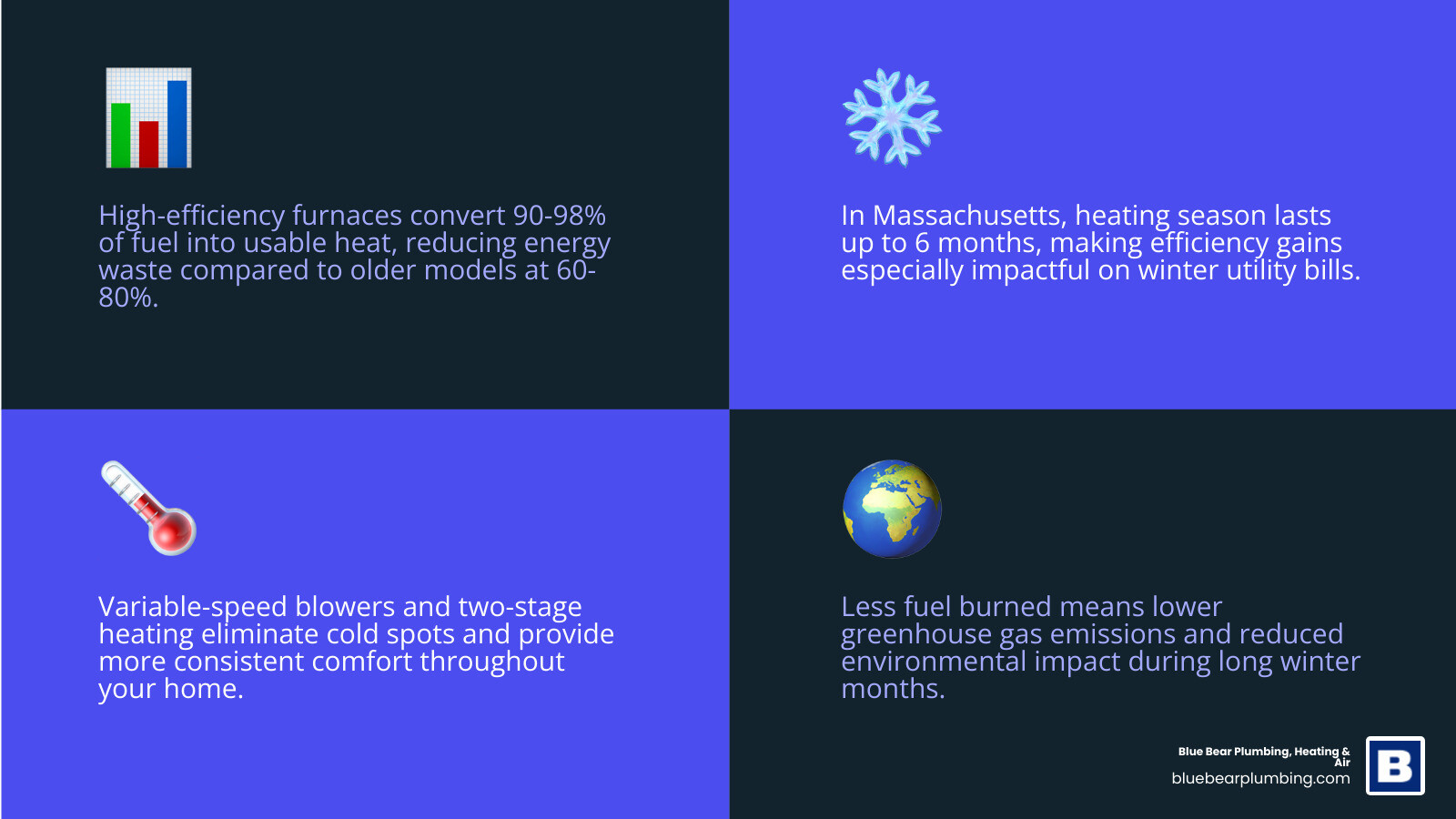
- Lower energy bills – High-efficiency furnaces convert 90-98% of fuel into usable heat, compared to just 60-80% in older models, which can cut heating costs by up to 30%
- More consistent comfort – Variable-speed blowers and two-stage heating eliminate cold spots and temperature swings throughout your home
- Quieter operation – Advanced motors and sound-dampening technology make modern high-efficiency units noticeably quieter than older furnaces
- Better indoor air quality – Sealed combustion and upgraded filtration reduce backdraft risks and airborne particles
- Reduced environmental impact – Less fuel burned means lower greenhouse gas emissions
- Longer lifespan – With proper maintenance, high-efficiency furnaces can last 20 years or more
- Financial incentives – Federal tax credits and utility rebates can help offset the upfront investment
When your furnace runs for five or six months out of the year — which is a normal expectation across much of New England — even a modest improvement in efficiency adds up fast. Older furnaces that waste 20 to 40 cents of every heating dollar become a much bigger problem when that furnace is running around the clock through a cold snap.
This guide breaks down everything you need to know: how efficiency is measured, which features actually move the needle on comfort and savings, and when upgrading genuinely makes sense for your home.
I’m Marc Provenzano, Marketing Manager at Blue Bear Plumbing, Heating & Air, and I’ve spent years helping Massachusetts homeowners cut through the noise when it comes to home comfort decisions — including understanding the real-world high efficiency furnace benefits for cold winters. Whether you’re deep in a South Shore winter or just planning ahead, this guide will help you make a confident, informed decision.
High Efficiency Furnace Benefits for Cold Winters: A Deep Dive into Performance
When the biting cold of a Massachusetts winter strikes, there is nothing more inviting than stepping into a home wrapped in steady, reliable warmth. For those of us living in Norwell, Quincy, or Natick, we know that our heating systems aren’t just a luxury—they are a mechanical necessity for survival and comfort during those long stretches of sub-zero wind chills.
What is a high-efficiency furnace and how does it differ from standard models?
A high-efficiency furnace is technically defined as a unit with an Annual Fuel Utilization Efficiency (AFUE) rating of 90% or higher. While standard furnaces (often rated at 80% AFUE) have been the industry baseline for years, high-efficiency models utilize advanced technology to squeeze more heat out of every therm of gas.
The primary difference lies in the heat exchanger. A standard furnace has one heat exchanger that captures heat from combustion and vents the remaining exhaust—and a significant amount of heat—out through a chimney. A high-efficiency model features a secondary heat exchanger. This second stage captures latent heat that would otherwise be lost, cooling the exhaust gases until the water vapor condenses into liquid. This is why these units are often called “condensing furnaces.”
How is furnace efficiency measured (AFUE ratings) and what do the numbers mean?
AFUE stands for Annual Fuel Utilization Efficiency. Think of it as “cents on the dollar.”
- An 80% AFUE furnace returns 80 cents of heat for every dollar spent, while 20 cents escapes through the flue.
- A 95% AFUE furnace returns 95 cents of heat, wasting only 5 cents.
- The most advanced models can reach up to 98.5% AFUE, meaning they are nearly perfect at converting fuel into warmth.
Why is upgrading to a high-efficiency furnace especially beneficial in cold climates?
In milder regions, a furnace might only kick on a few times a day. In Massachusetts, our furnaces run for 5-6 months annually. Because the system is under extreme stress for half the year, the efficiency gap becomes magnified. A 15% difference in efficiency might not seem like much in October, but during a frigid January in Braintree or Newton, that difference represents a massive amount of fuel—and money—saved.
The Biggest Winter Benefits Homeowners Notice First
Beyond the technical specs, the high efficiency furnace benefits for cold winters translate into real-world improvements in your daily life.
Energy Savings: Keeping More Money in Your Pocket
Upgrading from an older 70% AFUE furnace to a 95% AFUE model can cut your fuel usage by as much as 25%. Homeowners often report savings of up to 30% on their heating costs. When you consider the length of our winters, these savings can help offset the initial investment of the unit within just a few years.
Unmatched Comfort and Consistency
One of the most common complaints with older furnaces is the “on-off” cycle that creates hot and cold spots. High-efficiency units often feature two-stage heating or modulating gas valves. Instead of running at 100% capacity or being completely off, they can run at lower speeds to maintain a steady, even temperature. This eliminates that “chilly” feeling that happens right before a standard furnace kicks back on.
Peace and Quiet
The absence of noise from a high-efficiency furnace becomes just as comforting as the warmth itself. These units are built with insulated cabinets and precision motors. Because they often run for longer cycles at lower speeds, you don’t get that loud “whoosh” of air every time the thermostat calls for heat.
| Feature | Standard Furnace (80% AFUE) | High-Efficiency Furnace (95%+ AFUE) |
|---|---|---|
| Fuel Conversion | 80¢ per $1 is heat | 95¢ – 98¢ per $1 is heat |
| Blower Motor | Single-speed (Loud) | Variable-speed (Quiet) |
| Venting | Metal chimney flue | PVC pipe through the wall |
| Heat Exchanger | Single | Dual (Condensing) |
| Temperature Control | Fluctuating (Hot/Cold spots) | Consistent and steady |
Features That Improve Performance in Harsh Winter Conditions
To achieve these high ratings, manufacturers include several advanced components that are specifically designed to handle the heavy workload of a cold climate.
Variable-Speed Blowers and Modulating Valves
Standard furnaces are binary; they are either on or off. A high-efficiency unit with a variable-speed blower can adjust the amount of air it moves to match the heating needs of your home precisely. Modulating gas valves can operate at any point between 40% and 100% capacity. This precision ensures that your home in Hingham or Weymouth stays at exactly 70 degrees, regardless of how fast the temperature is dropping outside.
Secondary Heat Exchangers
As mentioned, this is the “secret sauce” of efficiency. By capturing the heat from the condensation process, the furnace extracts nearly all the energy from the fuel. This technology is what allows the unit to reach those 90%+ AFUE ratings.
Sealed Combustion for Safety and Air Quality
Older furnaces draw air from the room for combustion, which can lead to backdrafting or dry, dusty air. High-efficiency models use sealed combustion, drawing fresh air from outside via a dedicated pipe. This significantly reduces the risk of carbon monoxide issues and improves indoor air quality—a major plus when your home is sealed tight for the winter.
To ensure your system is ready for these features to perform, check out our 10 Steps to Prepare Your Heating System for the Cold Season.
Savings, Lifespan, and Maintenance Expectations
Investing in a high-efficiency furnace is a long-term play. While the technology is more advanced, these systems are built to last when cared for properly.
Expected Lifespan
With professional installation and routine care, a high-efficiency furnace can have a lifespan of 20+ years. Because they often run at lower speeds, there is less “start-stop” strain on the mechanical components compared to older, standard units.
Essential Maintenance
Because these furnaces produce condensation, they require a bit of specialized maintenance that standard units do not.
- Condensate Drain Cleaning: Ensuring the water produced by the secondary heat exchanger can drain freely.
- Filter Changes: High-efficiency blowers are sensitive to airflow; keeping filters clean is vital.
- Annual Inspections: Checking the secondary heat exchanger and sealed combustion intake for any obstructions.
For more tips on keeping your system running smoothly, see our Tips for Reducing Your Fall Heating Bills or our South Shore Winter Heating Checklist.
When Upgrading Makes Sense in a Massachusetts Home
Is it always worth it to go high-efficiency? Not necessarily, but for most homeowners in our service area, the answer is a resounding yes.
Signs It’s Time to Upgrade
- Your furnace is 15+ years old: Technology has moved leaps and bounds in the last decade.
- Frequent repairs: If you’re calling us every winter for a new part, that money is better spent on a new system.
- Rising utility bills: If your gas usage is climbing but your habits haven’t changed, your heat exchanger may be failing.
- Uneven heating: If the living room is a sauna but the bedrooms are iceboxes, your old blower can’t keep up.
If you are struggling to decide, read our guide on How to Decide Between HVAC Repair and Replacement Without Losing Your Cool.
Rebates and Incentives in 2026
One of the best high efficiency furnace benefits for cold winters is that the government and utility companies often help you pay for it!
- Federal Tax Credits: Under the Inflation Reduction Act, homeowners can often claim up to $600 for qualifying high-efficiency gas furnaces.
- Mass Save® Rebates: Massachusetts residents often have access to significant rebates for upgrading to ENERGY STAR® certified equipment.
- Utility Incentives: Local providers in the South Shore area frequently offer seasonal rebates to encourage energy conservation.
Frequently Asked Questions About High Efficiency Furnace Benefits for Cold Winters
Will a high-efficiency furnace solve all my cold spot problems?
While a variable-speed blower helps immensely, it can’t fix poor insulation or leaky windows. We always recommend a holistic look at your home’s “envelope.” Check out our Seasonal Heating Guide Massachusetts for more on home preparation.
Is the installation process different?
Yes. Because these units condense, they require a drain line for water and PVC venting instead of a traditional chimney liner. This is why professional installation is non-negotiable for these units.
Are they more expensive to repair?
While parts for high-efficiency units can be more specialized, they are generally backed by much better warranties (often 10 years on parts and 20+ years on the heat exchanger) than standard units.
Conclusion: Making the Move to Modern Comfort
Choosing the right heating system is one of the most important decisions you’ll make for your home. The high efficiency furnace benefits for cold winters go far beyond just saving a few dollars on a gas bill—it’s about the peace of mind that comes from knowing your family will be warm and safe, even during the harshest New England Nor’easter.
At Blue Bear Plumbing, Heating & Air, we take pride in helping our neighbors in Norwell, Natick, Quincy, and throughout the South Shore find the perfect balance of efficiency and performance. Our friendly, local team is committed to high-quality workmanship and integrity, ensuring your new furnace is sized correctly and installed to the highest standards.
Ready to experience the difference that a high-efficiency system can make? Whether you need an expert consultation or a seasonal tune-up, we are here to help.
Contact Blue Bear Plumbing, Heating & Air today to explore your options!
Contact Us Today
Routine maintenance is vital for the longevity of your plumbing, heating, and air conditioning systems. Sign up for our Blue Care Maintenance Plan for annual service and exclusive membership benefits, including:
- Priority scheduling
- Waived service fee during normal business hours
- 10% discount on service calls
- 3% discount on new installations
- Two-year parts and labor warranty on new equipment