




How to Decide Between HVAC Repair and Replacement Without Losing Your Cool
HVAC
Why Your HVAC Repair vs. Replace Decision Matters in Norwell, MA
Every homeowner in Norwell, MA eventually faces a tough choice when their heating or cooling system acts up: repair it or replace it? This isn’t just about fixing a broken part; it’s about your home’s comfort, your energy bills, and making a smart investment. When your HVAC system falters, it can feel like a high-stakes guessing game. Understanding the factors involved can save you stress and money in the long run.
Ready to make a confident choice? Explore our HVAC services to find the right solution for you. Or, contact us today for expert advice and a personalized assessment.
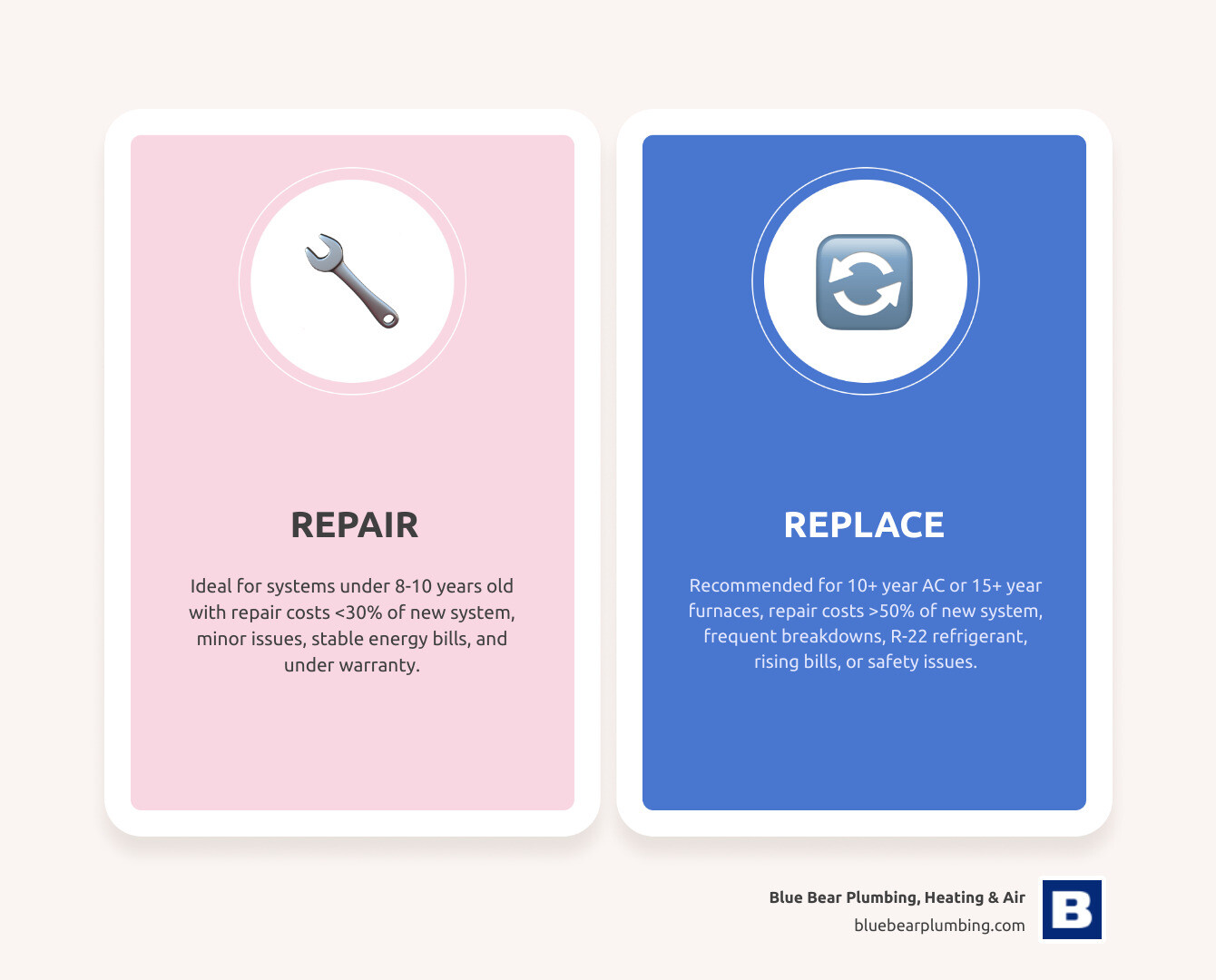
To help you decide between repair and replacement, here’s a quick guide:
Repair if:
- Your system is under 8-10 years old.
- The repair cost is less than 30% of a new system.
- It’s a minor, isolated issue (e.g., a simple electrical problem).
- You’ve had less than 3 repairs in the last 3 years.
- The unit is still under its manufacturer’s warranty.
- Your energy bills are stable.
Replace if:
- Your AC is 10+ years old or furnace is 15+ years old (per ENERGY STAR).
- The repair cost exceeds 50% of a new system.
- You have frequent, costly breakdowns (3+ repairs in 3 years).
- Your system uses R-22 refrigerant and needs a major repair or recharge.
- You notice significant safety concerns (e.g., cracked heat exchanger).
- Your energy bills are rising without a change in usage.
- Your home has uneven temperatures or poor humidity control.
- You plan to stay in your home for 5+ more years.
Making the right choice can seem complicated, especially when you’re under pressure. For example, imagine your AC breaks down in the middle of a hot July, and a repair quote comes in at $1,400 for a 13-year-old system. Do you pay for the repair, or is it time for a new unit? This repair vs replace your hvac decision guide will walk you through the key considerations, helping you weigh your options with confidence.
I’m Marc Provenzano, and as the Marketing Manager at Blue Bear Plumbing, Heating & Air, I’ve seen how important a clear repair vs replace your hvac decision guide is for homeowners. My goal is to make complex home services decisions simple and transparent, helping you find the best solution for your comfort and budget.
The $5,000 Rule: A Repair vs Replace Your HVAC Decision Guide
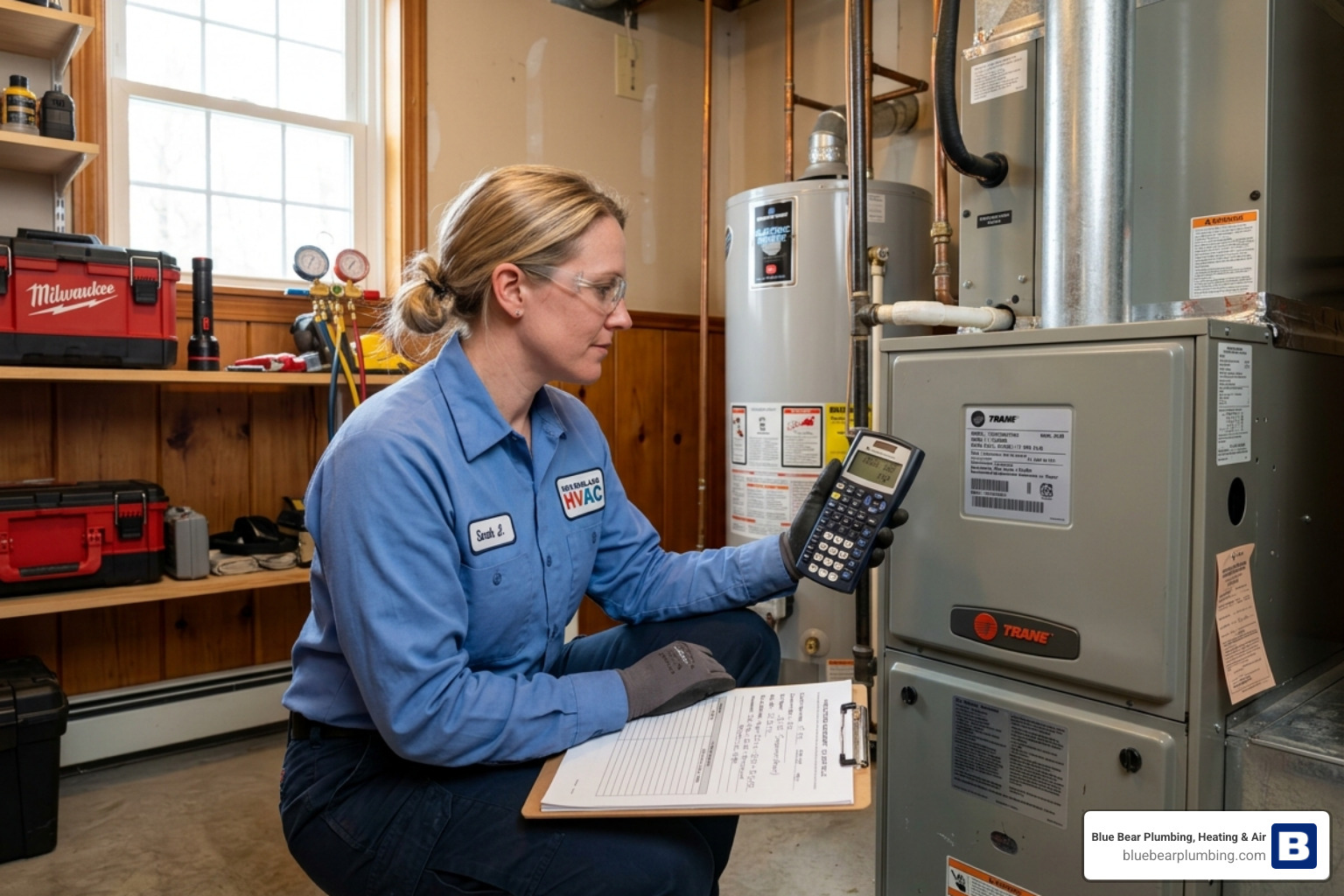
When we visit homes in Quincy or Braintree, we often find homeowners struggling to balance the immediate cost of a fix against the long-term benefit of an upgrade. To remove the guesswork, the industry uses a mathematical shortcut known as the $5,000 Rule.
The rule is simple: Multiply the age of your system (in years) by the cost of the repair. If the result is more than $5,000, you should strongly consider replacement. If the total is less than $5,000, a repair is usually the more financially defensible path.
For example, if you have a 12-year-old AC unit in Natick that needs a $500 repair, the math is 12 x 500 = 6,000. Since 6,000 is greater than 5,000, it is time to think about a Hvac System Age Replacement. Conversely, a 5-year-old unit needing the same $500 repair (5 x 500 = 2,500) is a clear candidate for fixing.
Another helpful metric is the 50% Rule. If the cost of a single repair exceeds 50% of the value of a brand-new system, we almost always recommend replacement. Investing heavily in a system that is halfway through its lifespan can lead to a “repair spiral,” where you find yourself paying for one fix after another as the system enters a phase of systemic fatigue.
Applying the Age Multiplier in Your Repair vs Replace Your HVAC Decision Guide
Understanding the typical lifespan of your equipment is vital for this calculation. In our Massachusetts climate—where systems work hard through humid summers and freezing winters—lifespans generally fall into these ranges:
- Central Air Conditioners: 10–15 years.
- Furnaces (Gas/Electric): 15–20 years.
- Heat Pumps: 10–15 years.
- Boilers: 20–25 years.
If your system is nearing the end of these windows, the “age multiplier” carries more weight. A system that has required three or more repairs in the last three years is signaling that its internal components are wearing out simultaneously. In these cases, even a small repair might be the “last straw” before a major failure occurs.
Evaluating Major Component Failure in Your Repair vs Replace Your HVAC Decision Guide
Not all repairs are created equal. Some parts are like the tires on your car—they are meant to be replaced. Others are like the engine. When core components fail, it’s a major red flag.
There are several Things To Think About When You Want To Replace Your Hvac System when a major part breaks:
- The Compressor: This is the “heart” of your AC. If it fails on a unit older than 10 years, the cost of labor and refrigerant often makes replacement the smarter choice.
- The Evaporator Coil: Replacing a leaking coil is expensive and often requires a full system recharge.
- The Heat Exchanger: If this component in your furnace cracks, it poses a serious safety risk. Because a heat exchanger cannot be reliably “patched,” you must either replace the component (which is nearly the cost of a new furnace) or replace the entire system.
When to Choose Repair: Signs Your System Still Has Life
Just because your system stops blowing cold air doesn’t mean you need to start shopping for a new one. If your system is under eight years old and has been well-maintained, it likely has plenty of life left. Many common issues are relatively simple to resolve.
Minor electrical issues, such as a failed capacitor or a worn contactor, are routine wear-and-tear items. Similarly, a thermostat that needs recalibration or a clogged condensate drain line are “isolated” problems that don’t indicate the whole system is failing. If your unit is still under the manufacturer’s 10-year warranty, the cost of parts will likely be covered, making repair the obvious choice. We recommend a High Mileage Hvac Checkup for systems that are middle-aged to ensure these small issues don’t snowball.
Benefits of Routine Maintenance
The best way to stay on the “repair” side of this guide is through consistent care. Regular maintenance can significantly extend the life of your system and delay the need for a massive investment.
When we perform seasonal tune-ups, we focus on:
- Airflow Optimization: Cleaning coils and checking blowers to ensure the system doesn’t overwork.
- Electrical Inspections: Tightening connections to prevent component burnout.
- Safety Checks: Ensuring gas lines and heat exchangers are secure.
For homeowners in the South Shore, understanding the balance between Repair Replace Hvac Massachusetts often comes down to how well the system was cared for in its first decade.
Warning Signs That Replacement is the Smarter Investment
Sometimes, continuing to repair an old system is like pouring water into a leaky bucket. One of the biggest catalysts for replacement in April 2026 is the R-22 refrigerant phase-out. If your system was manufactured before 2010, it likely uses R-22 (Freon), which has been banned by the EPA for its environmental impact. Because the supply is now extremely limited, a simple refrigerant recharge can cost as much as a monthly mortgage payment.
You might be asking, “Do I Need A New Ac?” if you notice your utility bills creeping up every month despite similar weather patterns. This is often a sign that your system’s efficiency has plummeted. A unit that was rated at 13 SEER when it was installed 12 years ago might only be operating at a SEER of 8 or 9 today due to age and wear.
Critical Safety and Performance Red Flags
Comfort issues are often the first sign of a failing system. Have you noticed that your home feels “sticky” or humid even when the AC is running? Or perhaps your upstairs bedrooms in a Weymouth Colonial are sweltering while the living room is freezing? These are signs that your system can no longer manage airflow or humidity effectively.
More importantly, safety must always come first. If you notice soot around your registers, a yellow flickering burner flame (instead of a steady blue one), or if your carbon monoxide detector goes off, shut the system down immediately. A cracked heat exchanger allows deadly gases to enter your home’s air supply.
| Feature | Older Systems (Pre-2015) | Modern Systems (2026 Standards) |
|---|---|---|
| Efficiency Rating | 8 – 13 SEER | 14.3 – 20+ SEER2 |
| Refrigerant Type | R-22 (Obsolete/Expensive) | R-410A or R-454B (Current) |
| Blower Motor | Single-Stage (On/Off) | Variable-Speed (Precise) |
| Humidity Control | Basic | Advanced/Built-in |
Efficiency and Financial Incentives in 2026
The landscape of HVAC technology has changed drastically. Today, efficiency is measured by SEER2 (for cooling), AFUE (for gas furnaces), and HSPF2 (for heat pumps). Upgrading to a new, standard model can often save you 20% to 40% on your monthly energy costs. When you consider What Does A New Hvac Installation Include, you aren’t just getting a new box outside; you’re getting a system designed to meet modern environmental and performance standards.
Maximizing Rebates and Tax Credits
As of April 2026, there are more financial incentives available than ever before to help Massachusetts homeowners bridge the gap between repair and replacement.
- Federal Tax Credits: Under the Inflation Reduction Act, homeowners can claim significant credits for installing ENERGY STAR® certified heat pumps or high-efficiency central AC units.
- Local Utility Rebates: Many local providers in the South Shore offer instant rebates for switching to high-efficiency equipment.
- Financing Options: We offer flexible financing plans that allow you to spread the cost of a new system over time, often with monthly payments that are offset by the energy savings you’ll see on your bill.
Frequently Asked Questions about HVAC Decisions
What is the $5,000 rule for HVAC systems?
The $5,000 rule is a decision-making formula: Multiply the age of your HVAC unit by the estimated repair cost. If the total exceeds $5,000, replacement is typically the better financial choice. If it is less, repairing the unit is usually justified.
When should I stop repairing an R-22 refrigerant system?
You should consider stopping repairs on an R-22 system immediately if it requires a refrigerant recharge or a major part like a compressor. Because R-22 is no longer produced, the cost of the refrigerant alone can make even minor leaks prohibitively expensive to fix.
How does a new HVAC system impact my home resale value?
A new, high-efficiency HVAC system is a major selling point. Prospective buyers in the South Shore often look for “big-ticket” items that have already been addressed. Having a system under warranty with lower operating costs can increase your home’s appeal and overall value.
Conclusion
Deciding between repair and replacement doesn’t have to be a stressful experience. By using the $5,000 rule, considering the age of your system, and weighing the long-term energy savings of modern technology, you can make a choice that protects both your comfort and your wallet.
At Blue Bear Plumbing, Heating & Air, we are proud to serve our neighbors from Norwell and Natick to Quincy and the entire South Shore. We believe in integrity and transparency, providing you with the data you need to make the right call for your home. Whether you need a quick fix or a full system upgrade, our team is here to help you stay comfortable all year round.
If you’re still unsure which path is right for you, we invite you to schedule a High Mileage Hvac Checkup. We’ll give your system a thorough evaluation and help you run the math for your specific situation. Contact us today to get started!
Contact Us Today

Routine maintenance is vital for the longevity of your plumbing, heating, and air conditioning systems. Sign up for our Blue Care Maintenance Plan for annual service and exclusive membership benefits, including:
- Priority scheduling
- Waived service fee during normal business hours
- 10% discount on service calls
- 3% discount on new installations
- Two-year parts and labor warranty on new equipment