




Manual J: The Secret to Perfect HVAC Sizing
HVAC
Why Understanding How HVAC Load Calculations Work Could Save Your Home’s Comfort
How HVAC load calculations work is one of those topics that most homeowners never think about — until they’re sweating through a Massachusetts summer with an AC that just can’t keep up, or paying sky-high energy bills because their system is working twice as hard as it should.
Here’s the short answer:
HVAC load calculations determine exactly how much heating or cooling your home needs — measured in BTUs — by analyzing your home’s specific characteristics rather than guessing based on square footage alone.
The process works like this:
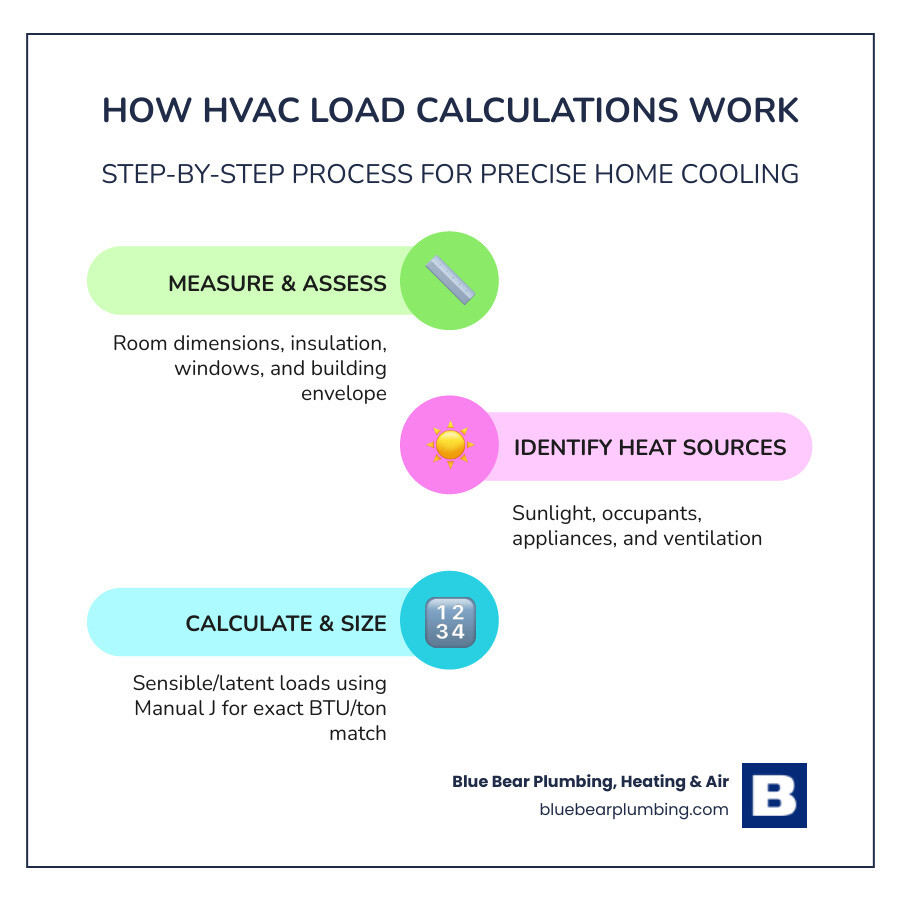
- Measure the space – Collect room dimensions, ceiling heights, and total square footage
- Assess the building envelope – Evaluate insulation levels, window types, wall construction, and roof materials
- Identify heat sources – Account for sunlight exposure, appliances, occupants, and ventilation
- Apply design conditions – Factor in local outdoor temperature and humidity data for your specific climate
- Calculate sensible and latent loads – Separate the heat that raises temperature from the moisture that needs to be removed
- Total the load – Add every heat gain or loss source to arrive at a precise BTU requirement
- Size the equipment – Match that BTU number to the right system capacity, typically expressed in tons (1 ton = 12,000 BTU/h)
The industry-standard method for doing all of this is called Manual J — a calculation protocol developed by the Air Conditioning Contractors of America (ACCA) that takes every one of those factors into account for a precise, room-by-room result.
Without it, contractors often fall back on rough square footage rules of thumb that can leave your system oversized by 50% or more — causing short cycling, poor humidity control, and premature wear. Or undersized, leaving your home stuffy and uncomfortable on the hottest South Shore days.
Getting this right matters more than most people realize. And that’s exactly what this guide is here to help you understand.
I’m Marc Provenzano, Marketing Manager at Blue Bear Plumbing, Heating & Air, and while my background is in brand strategy and customer engagement, I’ve spent years working alongside our licensed HVAC technicians and learning why how HVAC load calculations work is the single most important question homeowners should be asking before any new system goes in. Let’s walk through it together.
What is an HVAC Load Calculation and Why is it Essential?
An HVAC load calculation is a detailed estimate of how much heating or cooling a home needs to stay comfortable under local design conditions. In plain English, it tells us how much heat your home gains in summer and loses in winter so we can match the equipment to the house.
For cooling, capacity is usually discussed in BTUs per hour. BTU stands for British Thermal Unit, and in HVAC it is simply a way to measure how much heat an air conditioner can remove. Equipment is also commonly sized in tons, where 1 ton of refrigeration equals 12,000 BTU/h.
That means:
- 2 tons = 24,000 BTU/h
- 3 tons = 36,000 BTU/h
- 4 tons = 48,000 BTU/h
- 5 tons = 60,000 BTU/h
Those numbers are useful, but they only matter if they match the actual home.
This is why load calculations are essential:
- They prevent oversizing and undersizing
- They improve energy efficiency
- They support better humidity control
- They reduce wear on major components
- They help each room receive the airflow it needs
- They create more even comfort across the house
If you’re replacing an older system, this step is especially important. The old unit may have been oversized from day one, or your home may have changed through insulation upgrades, new windows, air sealing, additions, or lifestyle changes. Our article on HVAC system age replacement explains why replacement decisions should be based on current home conditions, not just equipment age.
Understanding How HVAC Load Calculations Work for Cooling
For cooling, the goal is to calculate total heat gain. That includes heat coming through walls, roofs, and windows, plus heat created inside the home by people, appliances, lighting, and outside air leaking or being brought indoors.
In South Boston, Quincy, Norwell, Natick, and throughout the South Shore, summer design conditions matter a lot. We do not just plan for a pleasant 78 degree day with a breeze. We size for realistic peak summer conditions, including outdoor heat and humidity, because that is when comfort problems show up.
Cooling calculations look at:
- Outdoor design temperature
- Outdoor humidity
- Indoor target temperature
- Indoor target humidity
- Solar gain from sun exposure
- Air leakage and ventilation
- Duct losses, especially in hot attics or unconditioned spaces
This is one reason what a new HVAC installation includes should always include proper sizing work, not just swapping boxes.
And yes, bigger is not always better. In HVAC, bigger can mean worse comfort. A unit that is too large may satisfy the thermostat too quickly, shut off too soon, and leave the home cool but clammy. That is not comfort. That is a sweatshirt-and-dehumidifier situation.
How HVAC Load Calculations Work: The Manual J Standard
Manual J is the standard residential method used to calculate heating and cooling loads. It was developed by ACCA and is designed to produce a room-by-room result rather than a rough whole-house guess.
A proper Manual J starts with home-specific information such as:
- Room dimensions and ceiling heights
- Window sizes, types, orientation, and shading
- Wall, floor, and ceiling insulation levels
- Construction materials
- Air leakage levels
- Number of occupants
- Appliance and lighting loads
- Duct location and leakage assumptions
- Local climate and design conditions
Once those inputs are entered, the calculation estimates heat gain and heat loss for each space. That matters because comfort is not only about total tonnage. It is also about distribution. One sunny upstairs bedroom may need very different airflow than a shaded first-floor office.
Manual J is often paired with related design steps:
- Manual S for selecting the right equipment based on the load
- Manual D for sizing ductwork and airflow
That room-by-room detail is how we move from “the house needs cooling” to “this room needs this much air.” Without that step, balancing comfort throughout the home becomes much harder.
A common airflow reference is about 400 CFM per ton of air conditioning. So a 3-ton system may move about 1,200 CFM. But where that air goes and how well the duct system delivers it still depends on the calculation and design.
Beyond Square Footage Approximations
Square footage rules of thumb are popular because they are fast. They are also blunt instruments.
You may have heard rough guidelines like:
- 1,000 square feet = about 2 tons
- 1,500 square feet = about 3 tons
- 2,000 square feet = about 4 tons
- 2,500 square feet = about 5 tons
These can provide a ballpark. They should not be used as final sizing.
| Method | What it Uses | Pros | Major Problems |
|---|---|---|---|
| Square footage rule of thumb | Home size only | Quick starting point | Ignores windows, insulation, ceiling height, shading, infiltration, occupancy, and humidity |
| Manual J | Detailed room-by-room home data | Accurate, climate-based, supports comfort and efficiency | Takes more time and requires proper inputs |
Two homes with the same square footage can need very different system sizes. A well-sealed, shaded home with upgraded insulation may need much less cooling than an older house with leaky windows, dark roofing, and west-facing glass.
That is why how HVAC load calculations work cannot be reduced to “X square feet equals Y tons.” Modern high-efficiency systems are less forgiving of guesswork, and arbitrary safety factors often make things worse instead of better.
Sensible vs. Latent Heat: Balancing Temperature and Humidity
Cooling load has two main parts:
- Sensible load – heat that raises air temperature
- Latent load – moisture in the air that must be removed
Sensible heat is what your thermostat notices first. If indoor temperature rises, sensible load is part of the reason.
Latent heat is about humidity. This is a huge issue in Massachusetts summers, especially near the coast. If your system lowers temperature but does not remove enough moisture, the home can feel sticky even when the thermostat says the temperature is fine.
A practical comfort zone in summer is often around 70 to 76 degrees dry bulb with roughly 45% to 65% relative humidity. Good sizing helps the system handle both parts of the load.
Some common formulas used in airflow-based cooling calculations are:
- Sensible heat: Q = 1.08 x CFM x temperature difference
- Latent heat: Q = 4,840 x CFM x humidity ratio difference
Homeowners do not need to memorize those formulas, but they help explain why humidity deserves equal attention. If the latent load is ignored, equipment can be selected that looks correct on paper but performs poorly in real life.
If you are trying to decide whether an existing comfort issue points toward service, redesign, or replacement, our guide on how to decide between HVAC repair and replacement without losing your cool can help.
The Science of Home Comfort
Internal heat gain matters more than many people expect. Houses do not just absorb heat from outside. They make heat inside, too.
Examples include:
- People
- Cooking
- Showers
- Laundry
- Lighting
- Electronics
- Refrigerators and ovens
A typical person adds roughly 200 BTU/h of sensible heat and 180 BTU/h of latent heat. So occupancy is not just a head count on paper. It changes the moisture load as well.
This is one reason a home office, finished basement, kitchen, or bonus room may feel different from the rest of the house. More people and more activity usually mean more load. Manual J accounts for that so the system can support your real lifestyle, not an imaginary average house.
The Consequences of Improper System Sizing
Improper sizing creates problems at both ends.
An oversized system can cause:
- Short cycling
- Poor humidity removal
- Uneven temperatures
- Higher wear from frequent starts and stops
- Reduced efficiency at part load
- Noisy operation
An undersized system can cause:
- Long or nonstop run times during peak weather
- Trouble reaching the thermostat setting
- Higher utility use from constant operation
- More strain on components
- Hot and cold spots
- Reduced comfort on the hottest days
Oversized systems are especially tricky because they can seem powerful at first. The home cools quickly, so it feels like the system is doing a great job. But because it shuts off too soon, it often does not run long enough to wring moisture out of the air. The result is that familiar cool-but-clammy feeling.
Undersized systems have the opposite problem. They may run constantly and still lag behind.
In some cases, poor sizing can even contribute to issues like coil icing, airflow complaints, and chronic comfort imbalances. If you are weighing your next move, our repair or replace HVAC guide for Massachusetts homeowners is a useful next read.
Key Factors Influencing Your Home’s Thermal Load
Several big factors shape your home’s total thermal load, and this is where Manual J earns its reputation.
Building orientation and sun exposure
A west-facing room with large windows can take a serious solar beating in late afternoon. South-facing glass can also add substantial heat. Shade from trees, overhangs, porches, and neighboring buildings changes the load too.
Insulation levels
Attic insulation, wall insulation, and floor insulation all affect how quickly heat enters or leaves the home. A well-insulated home generally needs less capacity than a poorly insulated one.
Windows and doors
Window area, glass type, frame type, air leakage, and shading all matter. Solar gain through windows is often one of the biggest cooling load drivers, especially in sunny rooms.
Infiltration, ventilation, and duct leakage
Air that leaks into the house brings both sensible and latent load. Infiltration can represent 10% to 20% of total HVAC load in many homes. Mechanical ventilation adds outdoor air intentionally, which must also be conditioned.
Duct leakage is another hidden issue. If ducts run through an attic or other unconditioned space, leaks can dump cooled air where nobody benefits from it.
Roof and wall heat transfer
Heat moves through the building envelope by conduction. In more technical methods, wall and roof loads are often estimated using formulas based on U-value, area, and temperature difference or corrected temperature factors. Manual J handles this behind the scenes, but the takeaway is simple: materials and insulation quality matter.
Occupants and internal gains
People, lighting, appliances, and electronics all create load. Kitchens are especially important because cooking equipment can add meaningful sensible and latent heat.
Design conditions and location
Load calculations must use local weather assumptions. Outdoor temperature, humidity, and location influence the result. The same house built in Quincy and Natick may perform similarly, but a calculation still needs local climate data and proper indoor design targets.
Peak load procedure and average load procedure
You may also hear about peak load procedure and average load procedure.
- Peak Load Procedure, or PLP, sizes for the highest expected load condition
- Average Load Procedure, or ALP, smooths conditions over time
For comfort cooling equipment selection, peak conditions usually matter more because the system must handle the toughest design period, not just a seasonal average.
Psychrometric charts, without the headache
Psychrometric charts look intimidating at first glance. They are basically maps of air conditions showing temperature, moisture content, relative humidity, enthalpy, and more.
In HVAC design, they help us:
- See how outdoor air differs from indoor air
- Track sensible cooling versus dehumidification
- Understand air-mixing and coil performance
- Estimate sensible heat ratio, or SHR
You do not need to become best friends with a psychrometric chart to benefit from it. The practical point is that air conditioning is not only about temperature. It is about moving air from one condition to another in a controlled way.
If you’re planning a replacement, our article on things to think about when you want to replace your HVAC system covers several home-specific factors that affect final equipment choice.
Frequently Asked Questions about HVAC Load Calculations
Why can’t I just use the same size AC as my old one?
Because the old size may have been wrong. Also, your home may have changed since the last installation. New windows, air sealing, insulation upgrades, additions, occupancy changes, and even different comfort preferences can change the load. Equipment should be sized to the home as it exists now.
Can I perform my own load calculation using an online calculator?
You can use online tools for a rough starting point, but they have limits. Most rely on broad assumptions and cannot fully account for room-by-room details, local solar exposure, hidden air leakage, duct conditions, or actual insulation values. They are useful for education, not final equipment selection.
A true Manual J uses detailed inputs and approved software. The biggest risk with DIY tools is false confidence. A number that looks precise is not always a number that is accurate.
Why should I ask my contractor for a Manual J report before my Quincy AC installation?
Because it shows that the equipment size is being based on your home rather than a guess. A Manual J report helps you understand:
- The target BTU load
- How each room contributes to the total
- Which assumptions were used
- Whether humidity and airflow were considered
- Why the recommended size makes sense
It also gives you a better basis for discussing system options, especially if you are deciding between central air and ductless. For that topic, see The South Shore guide to choosing between central air and mini splits. If you’re exploring heat pumps, our article on Quincy heat pump installation is another helpful resource.
Conclusion
Manual J is not paperwork for paperwork’s sake. It is the foundation of proper HVAC sizing.
When we understand how HVAC load calculations work, we can make better decisions about comfort, humidity control, airflow, efficiency, and long-term system performance. We can avoid the trap of “close enough” sizing and choose a system that is actually right for the home.
At Blue Bear Plumbing, Heating & Air, we believe homeowners in Quincy, Norwell, Natick, South Boston, and throughout the South Shore deserve that level of care. Our local team is committed to high-quality workmanship, attentive service, integrity, and upfront communication from start to finish.
If you are replacing an AC, heat pump, or full comfort system, do not settle for a square-footage guess. Contact our team for a professional Manual J calculation today and let us help make sure your next system is sized for lasting comfort.



Contact Us Today

Routine maintenance is vital for the longevity of your plumbing, heating, and air conditioning systems. Sign up for our Blue Care Maintenance Plan for annual service and exclusive membership benefits, including:
- Priority scheduling
- Waived service fee during normal business hours
- 10% discount on service calls
- 3% discount on new installations
- Two-year parts and labor warranty on new equipment