




Tracing Ceiling Water Damage Back to a Misaligned Attic Drain Pan
general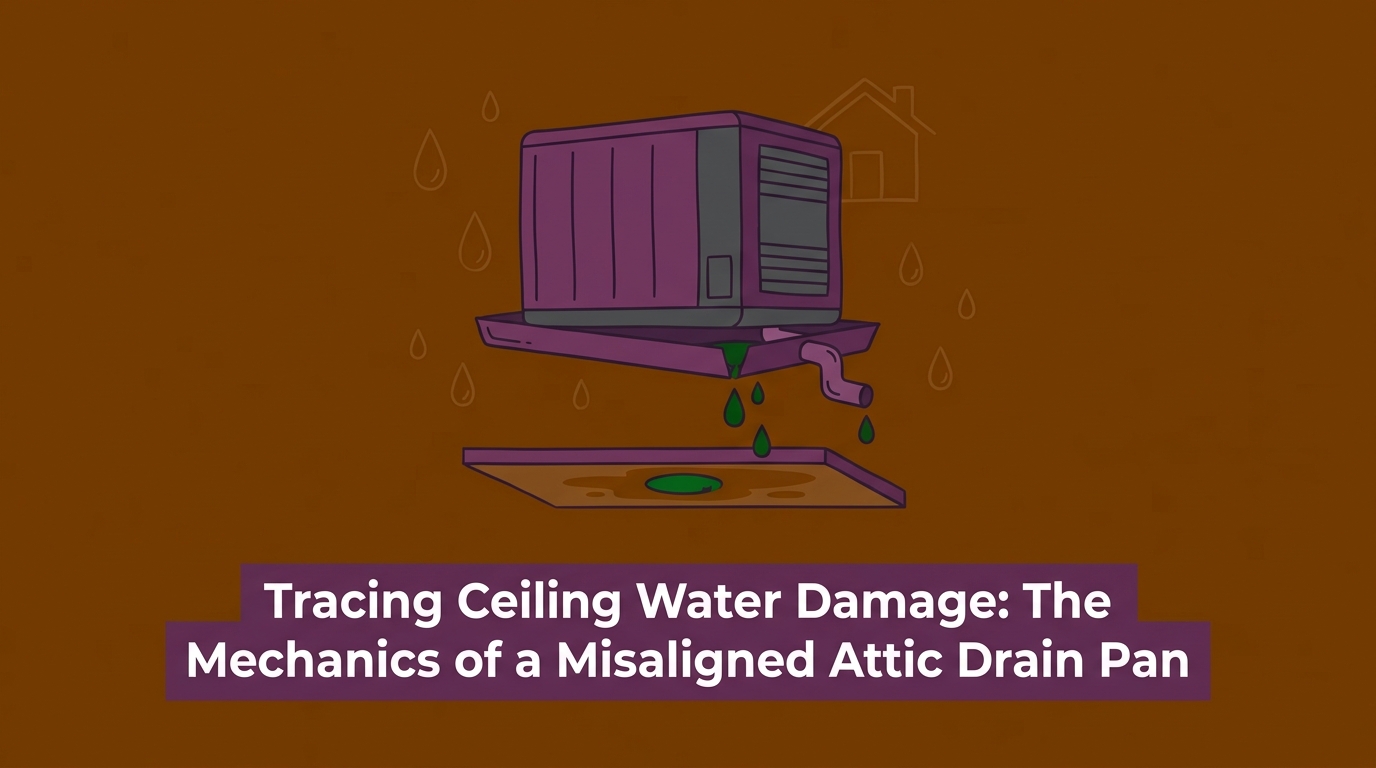
The Shock of a Sudden Ceiling Water Stain
If you find yourself tracing ceiling water damage back to a misaligned attic drain pan, the frustrating discovery usually begins with a sudden, growing brown spot on your drywall. Discovering a new water stain on your ceiling is always an alarming experience. When that ominous ring appears directly below the area where your attic HVAC unit sits, your first instinct is often to assume a catastrophic plumbing failure or a massive breakdown of your air conditioning system.
Here is the thing: the true culprit is frequently a subtle mechanical issue rather than a sudden, massive explosion of parts. Your cooling system manages a tremendous amount of water every single day. When the mechanisms designed to catch and route that water fail, gravity takes over. The water follows the path of least resistance, which unfortunately leads straight down through your attic floorboards, into your insulation, and eventually pooling on the top side of your ceiling drywall.
Understanding how condensation is managed in your attic is the very first step to diagnosing this leak. The water does not appear out of nowhere; it is a byproduct of the cooling process. When things are working correctly, you never see this water. But when a component like the attic air handler secondary drain pan shifts out of place, the results become visible in your living room. Before you assume the worst about your system, it helps to look at the mechanics of how your unit handles moisture. If you need help evaluating the extent of the issue, our comprehensive plumbing and HVAC services can provide the exact diagnostic clarity you need.
The Physics of Condensation in Summer Heat
To understand why a minor failure in your attic leads to major ceiling damage, you have to look at the massive volume of water your air conditioning system generates. A central air conditioner does not just cool the air in your home; it acts as a powerful, whole-house dehumidifier. As warm, humid air blows across the freezing cold evaporator coils inside your attic unit, the moisture in that air condenses into liquid water.
The sheer volume of water: During peak operation, a standard residential system can extract anywhere from 10 to 20 gallons of water per day from your indoor air. Think about carrying four heavy five-gallon buckets of water through your house every single day. That is the volume of liquid your attic air handler is quietly managing out of sight.
The climate factor: During Massachusetts’ peak July heat and humidity, air handlers operate at their absolute maximum dehumidification capacity. The air is thick with moisture, meaning your system generates the highest volume of condensation of the entire year. This moisture constantly drips off the evaporator coil and must be safely routed out of the home.
In a basement installation, a minor leak might just mean a small puddle on a concrete floor. However, in an attic installation, managing this volume of water is absolutely critical. Any overflow immediately threatens the structural integrity of the home below. The wood framing, the blown-in insulation, and the fragile paper backing of your ceiling drywall are entirely defenseless against a steady drip of 15 gallons of water a day. This is why the attic air handler secondary drain pan is a mandatory safety feature rather than an optional accessory.
Primary vs. Secondary Condensate Defenses
Because attic installations carry such a high risk for property damage, building codes require a strict, two-tiered defense system to manage condensation. Understanding the difference between these two systems helps explain why leaks still happen even when you change your filters regularly.
- The Primary Drain Line: This is the first line of defense. Inside the air handler, a small internal pan catches the water dripping off the coils. This internal pan connects directly to a PVC pipe—the primary drain line—which relies on gravity to carry the water out of your attic, down the side of your house, and safely into the yard or a dedicated drain.
- The Code Requirement: Building codes, specifically guidelines like IRC Section M1411.3, recognize that primary drain lines can and do clog with algae, dust, or debris. Because of this, they require a backup system for units installed in locations where overflow causes structural damage.
- The Secondary Drain Pan: This is your backup. The attic air handler secondary drain pan is a large, shallow metal or plastic tray that sits beneath the entire air handler unit. It is not meant to hold water during normal operation. It only catches water if the primary system fails, clogs, or sweats excessively.
This secondary pan is the final line of defense protecting your ceiling drywall. It is equipped with its own drain line, usually routed to a highly visible location (like above a window) so you can see it dripping and know there is a problem with the primary line. However, for this backup pan to work, its geometry must be absolutely perfect.
How a Slight Pitch Defeats the Drain Pan
A secondary drain pan is an incredibly simple device. It has no moving parts, no electrical sensors, and no pumps. It relies entirely on gravity. The pan is designed to sit perfectly flat, or with a microscopic, intentional tilt directing any collected water toward a specific backup drain port located in one corner or along one edge.
Over time, the environment inside your attic changes. The blower motor inside your air handler spins at high speeds, creating continuous, minor vibrations. Over months and years of operation, these vibrations can cause the unit, the wooden platform supporting it, or the pan itself to slowly shift. This is similar to why upgrading contractor-grade condenser pads is so important for outdoor units—stability degrades over time without proper reinforcement.
If the secondary pan develops even a slight pitch or tilt off-level away from the drain port, the entire safety system is compromised. The water dripping from the failing primary system hits the backup pan and, following gravity, pools in the wrong corner. The water level slowly rises in the blind corner of the pan, completely ignoring the drain port located on the higher side.
Once the pooling water reaches the shallow lip of the misaligned pan, it spills over the edge. It drops onto the attic floor, soaking into the joists and the drywall, bypassing the backup drain completely. A pan that is tilted by just a quarter of an inch is essentially useless.
Why a Clear Drain Line Isn’t Enough
Most homeowners assume that an AC leak automatically means a clogged line. They might even climb into the attic and pour vinegar down the backup pipe, hoping to clear a blockage. But if the pan has a slight pitch or tilt off-level, the secondary drain line could be perfectly clear and completely dry. The water will simply never reach the pipe. This makes chemical cleaners, wet vacuums, or DIY drain clearing completely ineffective for this specific mechanical issue. The problem is not a blockage; the problem is geometry.


Distinguishing HVAC Leaks from Roof Damage
When you spot a water stain on your ceiling, your first question is usually: “Is this from the roof, or is it from the AC?” Before calling a professional, you can act as a detective to gather clues. Helping visually confirm the source saves time and ensures you call the right specialist to evaluate your attic air handler secondary drain pan.
Location is the first major clue: HVAC leaks typically manifest directly beneath the attic air handler or its immediate ductwork. If you know your air handler sits above the hallway, and the stain is in the hallway, the AC is the prime suspect. Roof leaks, conversely, can travel down rafters and appear far from the actual hole in the shingles.
Timing matters significantly: Pay close attention to the weather. Roof leaks correlate heavily with heavy rainstorms or melting snow. AC drain pan overflows happen during hot, dry, highly humid days when the cooling system runs continuously. If it has not rained in a week but your ceiling is dripping, the roof is likely fine.
The nature of the stain: A continual dripping from a tilted pan often creates a steadily expanding, dark circular stain. It remains damp to the touch as long as the air conditioner is running. Roof leaks often dry out between storms, leaving a faded yellow or brown ring, whereas an active HVAC leak will feel cool and wet.
| Diagnostic Factor | Signs of an HVAC Drain Pan Leak | Signs of a Roof Leak |
|---|---|---|
| Weather Conditions | Hot, humid, dry days with heavy AC usage. | During or immediately following heavy rain. |
| Location of Stain | Directly beneath the attic air handler unit. | Near exterior walls, chimneys, or traveling along joists. |
| Moisture Level | Constantly damp while the AC is turned on. | Dries out when the weather clears up. |
| Visual Appearance | Rapidly expanding dark circle, sometimes bubbling paint. | Faded yellow or brown rings that grow over months. |
Professional Releveling and Securing
If you suspect a misaligned drain pan is ruining your ceiling, fixing it requires much more than just shoving a wooden shim under the corner of the unit. Correcting a slight pitch or tilt off-level requires precision, structural knowledge, and professional tools. Attempting a DIY fix on a massive, heavy air handler suspended over fragile drywall often leads to worse damage.
- Evaluating Structural Support: A professional technician will first evaluate the wooden decking or hanging brackets supporting the air handler. They need to ensure the vibration hasn’t compromised the duct connections or the structural integrity of the attic joists.
- Precision Releveling: Using specialized leveling tools, the technician will adjust the unit and the secondary pan so that they are perfectly pitched toward the emergency drain port. This ensures that even the smallest drop of water flows exactly where it needs to go.
- Permanent Securing: Once level, the system must be permanently secured to prevent future vibration-induced shifting. This often involves installing vibration isolation pads that absorb the mechanical shaking of the blower motor before it reaches the pan.
- Thorough Inspection for Cracks: Finally, the technician will inspect the pan itself. When a metal or plastic pan is held under uneven stress for a long time, it can develop hairline cracks. A cracked pan must be replaced entirely, as leveling it will not stop a leak through a fractured base.
This is where our commitment to thorough, detail-oriented inspections makes a massive difference. We focus on catching subtle mechanical issues—like a slightly tilted drain pan—before they lead to catastrophic and expensive home damage. A quick glance might miss a quarter-inch tilt, but a rigorous inspection will find it and correct it.
Frequently Asked Questions About Attic AC Leaks
Why is water leaking from my attic AC unit?
Water leaks from an attic AC unit when the condensation it produces cannot properly drain out of the house. This is typically caused by a clogged primary drain line, a cracked drain pan, or a frozen evaporator coil that melts rapidly. When the primary system fails, the water overflows into the secondary pan, which can also overflow if it is clogged or misaligned.
How do you know if your AC drain pan is bad or just misaligned?
A bad drain pan usually has visible rust, deep pitting, or hairline cracks that allow water to drip directly through the bottom of the tray. A misaligned pan may look completely intact and healthy, but water will pool heavily in one corner far away from the drain pipe. A professional technician can use a level and a water test to determine if the pan is structurally compromised or simply tilted.
Will ceiling drywall dry out after an AC leak, or does it need replacing?
If you catch the leak immediately and the drywall is only slightly damp, it can often dry out with the help of fans and dehumidifiers without losing structural integrity. However, if the drywall is sagging, crumbling to the touch, or severely stained, the water has destroyed the gypsum core. In these cases, the affected section must be cut out and replaced to prevent mold growth and structural collapse.
Who do I call for an AC leaking through the ceiling?
You should immediately turn off your air conditioner at the thermostat to stop the production of new condensation, and then call a licensed HVAC professional. While a plumber handles traditional water pipes, the condensate lines and the attic air handler secondary drain pan are integral parts of the cooling system. An HVAC technician is trained to diagnose the mechanical failure causing the overflow.
How much water is normal in a secondary drain pan?
Under normal, healthy operating conditions, your secondary drain pan should be completely bone dry. The primary drain line inside the unit should handle 100% of the condensation. If you see any standing water in the secondary backup pan, it is an immediate warning sign that the primary system has failed or is beginning to clog, and the system needs professional attention.
Protecting Your Home’s Ceilings from Future Leaks
A misaligned drain pan is an incredibly subtle issue that can cause significant, expensive drywall damage if left unaddressed. Because the slight pitch or tilt off-level happens slowly over time, out of sight in a dark attic, most homeowners never realize there is a problem until the ceiling begins to bubble and stain.
Routine professional maintenance and inspections are the absolute best way to ensure your pan remains perfectly level, your drain lines flow freely, and your home remains protected. During a comprehensive tune-up, a technician verifies the geometry of your backup systems, ensuring gravity is working for you, not against you.
If you have noticed water stains forming below your attic unit, do not wait for the drywall to collapse. A professional evaluation can pinpoint the exact mechanical failure and restore your system’s safety measures. Take action today and contact our HVAC technicians to get your system inspected, leveled, and secured for the season.



Contact Us Today

Routine maintenance is vital for the longevity of your plumbing, heating, and air conditioning systems. Sign up for our Blue Care Maintenance Plan for annual service and exclusive membership benefits, including:
- Priority scheduling
- Waived service fee during normal business hours
- 10% discount on service calls
- 3% discount on new installations
- Two-year parts and labor warranty on new equipment