




The Chimney-Free Guide to Adding AC Without Existing Vents
HVAC
Why So Many Massachusetts Homeowners Are Rethinking How They Cool Their Homes
Adding cooling without ductwork options compared is one of the most common questions we hear from homeowners across the South Shore — and it makes complete sense. Millions of older Massachusetts homes were built around boilers, radiators, and cast-iron baseboard heat. Nobody was thinking about central air when those houses went up. The result? Come July, the upstairs turns into a sauna, one room stays freezing, and the only “solution” gathering dust in the window is a rattling box unit that sounds like a lawnmower.
Here is a quick look at the main options available in 2026:
| Option | Best For | Key Advantage |
|---|---|---|
| Ductless Mini-Split | Whole-home or zoned cooling | Highest efficiency (up to 35 SEER2), quiet, heats too |
| High-Velocity Small-Duct | Historic homes, invisible install | Near-invisible vents, strong dehumidification |
| Window AC Unit | Single rooms, tight budgets | Low upfront cost, easy setup |
| Portable AC | Renters, temporary use | No installation required |
| PTAC / Through-the-Wall | Single rooms, additions | Self-contained, no outdoor unit needed |
The good news is that not having ductwork is no longer a dealbreaker. Modern cooling technology has come a long way, and there are real, permanent solutions that do not require tearing open your walls or sacrificing the character of your home.
I’m Marc Provenzano, Marketing Manager at Blue Bear Plumbing, Heating & Air, and after working closely with our team of HVAC experts serving the South Shore, I have seen how the right approach to adding cooling without ductwork options compared can completely transform an older home’s comfort — without the renovation nightmare. Let’s walk through what actually works.
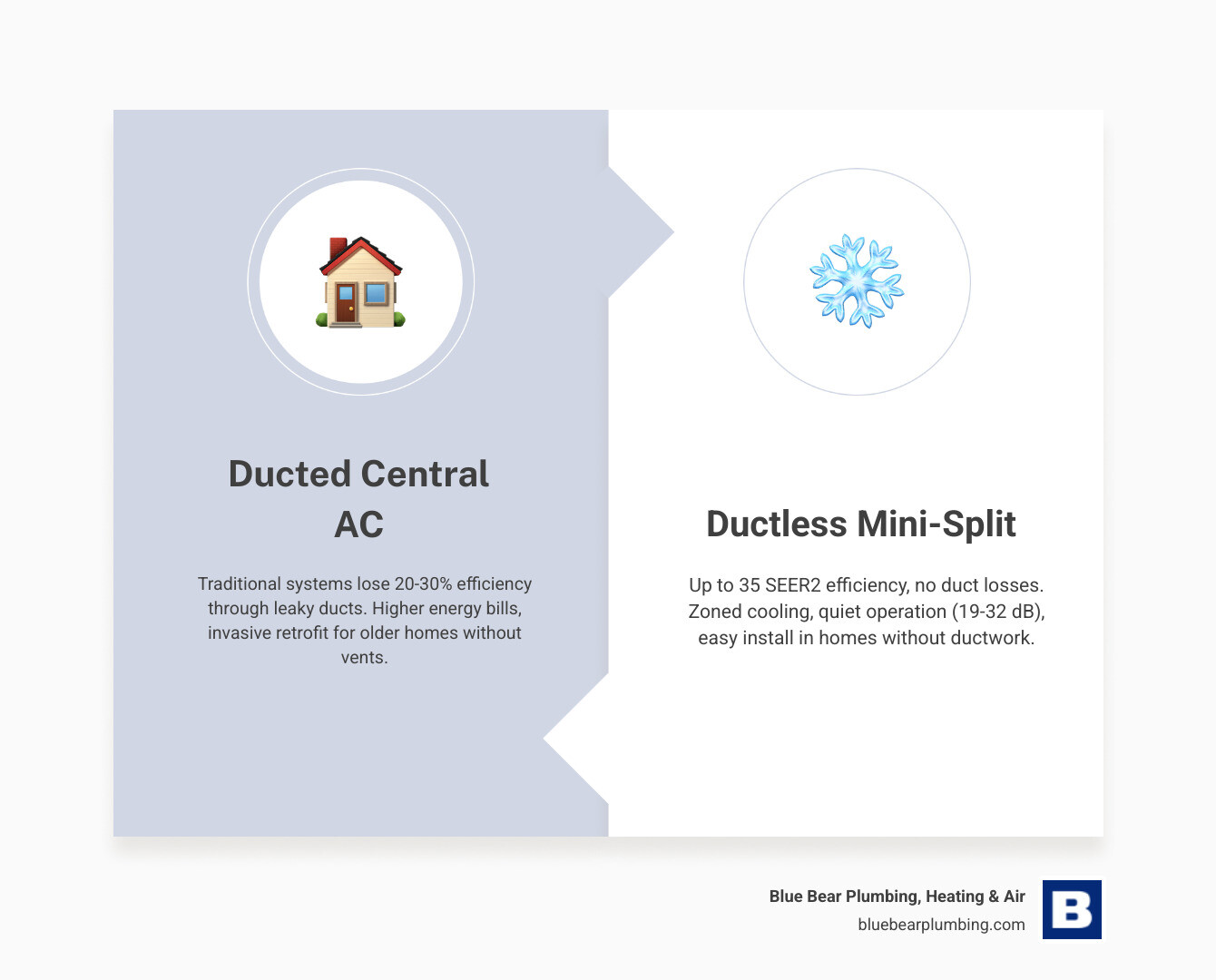
Adding Cooling Without Ductwork Options Compared: The Top Solutions for 2026
When we look at the landscape of cooling in 2026, the options for homes without existing vents have never been more diverse or efficient. For decades, homeowners in towns like Quincy or Braintree felt trapped between two extremes: expensive, invasive ductwork installation or the seasonal struggle of hauling heavy window units. Today, we have sophisticated alternatives that bridge that gap perfectly.
The primary contenders in the “no-duct” category include ductless mini-splits, high-velocity systems, window units, portable ACs, and PTAC (Packaged Terminal Air Conditioner) units. Each serves a specific purpose, but they are not created equal when it comes to long-term comfort or utility bills.
If you are currently asking yourself, “Do I Need A New Ac,” the answer often depends on how much you value efficiency and quiet operation. Traditional window units and portables are often considered “band-aid” fixes. They are loud, block natural light, and are notorious for energy leaks. On the other end of the spectrum, ductless mini-splits and high-velocity systems offer a permanent, “grown-up” solution to summer heat.
Ductless Mini-Splits: The Gold Standard for Massachusetts Homes
If there is a “gold standard” for adding cooling without ductwork options compared, it is undoubtedly the ductless mini-split. These systems consist of an outdoor compressor connected to one or more indoor air handlers via a small conduit.
What makes these units so special is inverter technology. Unlike traditional central AC that clicks “on” or “off” like a light switch, a mini-split works more like cruise control. It adjusts its speed to maintain a perfectly steady temperature, which eliminates those annoying cold blasts and hot spots. Furthermore, they are whisper-quiet. Most indoor units operate between 19 and 32 decibels—for context, that is quieter than a library or a soft whisper.
For those looking for Chill Out With The Best Ac Installation In Norwell Ma, mini-splits offer a level of control that central air simply cannot match. You can cool the kitchen while you’re cooking and keep the guest room at a different temperature entirely, all from one system.
Why adding cooling without ductwork options compared favors mini-splits
The biggest win for mini-splits is efficiency. Did you know that traditional ductwork can lose up to 30% of its cooling power through leaks, gaps, and poor insulation? Because mini-splits deliver air directly into the room, they avoid that “duct loss” entirely.
In fact, ductless mini-splits can achieve SEER2 ratings as high as 35. Compare that to the 14-26 SEER2 range of most central AC systems, and the savings start to add up quickly. Some studies show these systems use up to 60% less energy than standard heating and cooling setups. When Finding A Reliable Ac Installation Company In Quincy Ma, it’s important to look for experts who understand these efficiency metrics and can help you maximize your return on investment.
Cold climate performance and heating capabilities
In Massachusetts, we don’t just worry about the heat; we have to survive the winters. Modern mini-splits are actually heat pumps. This means they can reverse the cooling process to provide incredibly efficient heat during the “shoulder seasons” of spring and fall, and even through the dead of winter.
Many of the units we install today are “cold climate” models, capable of maintaining full heating capacity even when temperatures drop to 5°F, with some still providing warmth at -15°F. This makes them a perfect hybrid partner for homes that currently rely on oil or propane boilers, allowing you to save on fuel costs for a large portion of the year.
Minimal-Invasion Alternatives: High-Velocity and PTAC Systems

For homeowners who want the “feel” of central air but have a home that simply cannot accommodate standard 12-inch ducts, high-velocity systems are a game-changer. These systems use 2-inch flexible tubing—about the size of a vacuum hose—that can be snaked through existing wall cavities, closets, and floor joists without the need for major demolition.
High-velocity systems are also masters of dehumidification. Because they use smaller, colder coils, they remove up to 30% more moisture from the air than conventional systems. This is a huge benefit for humid Massachusetts summers, as drier air feels cooler even at a slightly higher thermostat setting. If you’re looking for Natick Ac Installation How To Stay Cool Without Breaking A Sweat, high-velocity is an option that preserves your home’s original plaster and woodwork.
Comparing high-velocity to traditional central air
The main draw of high-velocity is aesthetic preservation. If you live in a historic Victorian or a mid-century colonial, you likely don’t want a modern air handler mounted on your wall. High-velocity vents are small, circular, and can be matched to your ceiling or floor, making them nearly invisible.
On the other hand, PTAC units—the “hotel-style” units that sit under a window—are a self-contained alternative. While they are more permanent than a window unit, they require cutting a large hole through an exterior wall. They are excellent for new additions or sunrooms but are generally less efficient and noisier than mini-splits or high-velocity systems.
Preparing Your Older Home for Modern Cooling
Before we ever turn a wrench, we always recommend “Step Zero”: addressing your home’s envelope. Older homes (especially those built before 1940) can use up to 40% more energy per square foot than modern builds. Simple upgrades like attic insulation and air sealing can reduce your cooling load by 15% to 30%, which might even allow you to install a smaller, less expensive AC system.
You should also check your electrical panel. Many older homes in the South Shore still have 60-amp or 100-amp service. Modern heat pumps and mini-splits often require a dedicated circuit, and upgrading to a 200-amp panel ensures your home can handle the new load safely. Moving away from Window Units Outdated technology is a great time to modernize your home’s entire electrical backbone.
Sizing your system when adding cooling without ductwork options compared
One of the most expensive mistakes a homeowner can make is “eyeballing” the size of the unit. If a system is too small, it will run constantly and never get you cool. If it is too large, it will “short-cycle,” turning on and off so quickly that it never has a chance to remove humidity, leaving you feeling clammy.
We use a Manual J calculation, which is a scientific way to determine exactly how many BTUs your home needs. This calculation takes into account your square footage, the number of windows, the direction your house faces, and your insulation levels. Getting this right is the secret to The Quincy Guide To Affordable Ac Installation—it ensures you don’t pay for more power than you actually need.
Financial incentives and 2026 tax credits
The financial landscape for energy-efficient cooling has never been better for Massachusetts residents. Under current federal guidelines, you may be eligible for a tax credit that covers 30% of the equipment and installation costs for qualifying heat pumps, up to $2,000 per year.
Locally, the Mass Save program offers significant rebates—sometimes reaching into the thousands—for homeowners who switch to high-efficiency heat pump technology. These incentives are designed to make the “gold standard” of ductless cooling much more accessible for the average family.
Frequently Asked Questions about Ductless Cooling
How long do ductless mini-split systems typically last?
With proper care, a high-quality ductless mini-split system typically lasts between 15 and 20 years. This is a significantly better lifespan than window units (which usually tap out after 10 years) or portable units (which often only last 5 to 7 years). Because it is a permanent part of your home’s infrastructure, it also tends to increase your home’s resale value. Learning How To Clean Your Ac and keeping the outdoor unit clear of debris are the best ways to ensure your system hits that 20-year mark.
Can a mini-split system cool an entire multi-story home?
Yes, absolutely. This is done through “multi-zone” systems. A single outdoor condenser can power up to eight indoor air handlers. This means you can have a unit in every bedroom, the living room, and the kitchen, each with its own independent thermostat. It is the ultimate way to end “thermostat wars” in a multi-story house where the heat naturally rises to the top floor.
What maintenance is required for these systems?
Maintenance is surprisingly simple but very important. The indoor units have washable filters that should be checked and cleaned every 4 to 8 weeks during the peak cooling season. Dust and pet hair are the enemies of efficiency! Beyond that, we recommend an annual professional tune-up to check refrigerant levels, clear the condensate drain lines, and ensure the electrical connections are tight. This is the core of our Keep Your Cool A Homeowners Guide To Norwell Ac Maintenance.
Conclusion
When it comes to adding cooling without ductwork options compared, the evidence points toward ductless mini-splits as the most efficient, quiet, and versatile choice for the modern Massachusetts home. Whether you are looking to cool a single “hot spot” or provide comfort to an entire historic property, there is a solution that avoids the mess and expense of traditional ductwork.
At Blue Bear Plumbing, Heating & Air, we take pride in being the South Shore’s local experts. Our team is committed to high-quality workmanship and attentive customer care, ensuring that every installation is handled with integrity and transparent, upfront pricing. We live and work in the same communities you do—from Norwell to Natick to Quincy—and we understand the unique challenges of our local housing stock.
Don’t spend another summer “toughing it out” with loud, inefficient window units. Schedule your consultation with Blue Bear Plumbing, Heating & Air today and let us help you find the perfect chimney-free cooling solution for your home.



Contact Us Today

Routine maintenance is vital for the longevity of your plumbing, heating, and air conditioning systems. Sign up for our Blue Care Maintenance Plan for annual service and exclusive membership benefits, including:
- Priority scheduling
- Waived service fee during normal business hours
- 10% discount on service calls
- 3% discount on new installations
- Two-year parts and labor warranty on new equipment