




Signs Your Home Needs Water Treatment: Identify Home Water Issues
Plumbing
Is Your Home’s Water Trying to Tell You Something?
The signs your home needs water treatment are often hiding in plain sight — in the white crust around your faucet, the way your skin feels after a shower, or the faint smell coming from your tap. Most homeowners assume their water is fine as long as it flows clear. But water quality issues can build slowly, quietly damaging pipes, shortening appliance lifespans, and affecting daily comfort before anyone connects the dots.
Here’s a quick look at the most common warning signs:
| Sign | What It May Indicate |
|---|---|
| Strange taste or smell | Chlorine, sulfur, iron, or bacterial contamination |
| White crusty buildup on fixtures | Hard water (high calcium and magnesium) |
| Stiff laundry or dingy fabrics | Mineral interference with detergent |
| Dry skin, itchy scalp, dull hair | Hard water or excess chlorine stripping moisture |
| Cloudy water or visible particles | Sediment, turbidity, or suspended solids |
| Rust, blue-green, or dark stains | Iron, copper corrosion, or manganese in the water |
| Low water pressure or frequent leaks | Mineral scale narrowing pipes over time |
According to the U.S. Geological Survey, roughly 85% of American homes have hard water — and a 2023 USGS study found PFAS (so-called “forever chemicals”) in approximately 45% of U.S. tap water samples. That means poor water quality isn’t a rare problem. It’s likely already affecting your home in ways you haven’t noticed yet.
I’m Marc Provenzano, Marketing Manager at Blue Bear Plumbing, Heating & Air, and through my work with our team of licensed plumbers serving the South Shore, I’ve seen how overlooked signs your home needs water treatment can quietly turn into expensive plumbing repairs. In the sections below, we’ll walk through each warning sign clearly so you know exactly what to look for.
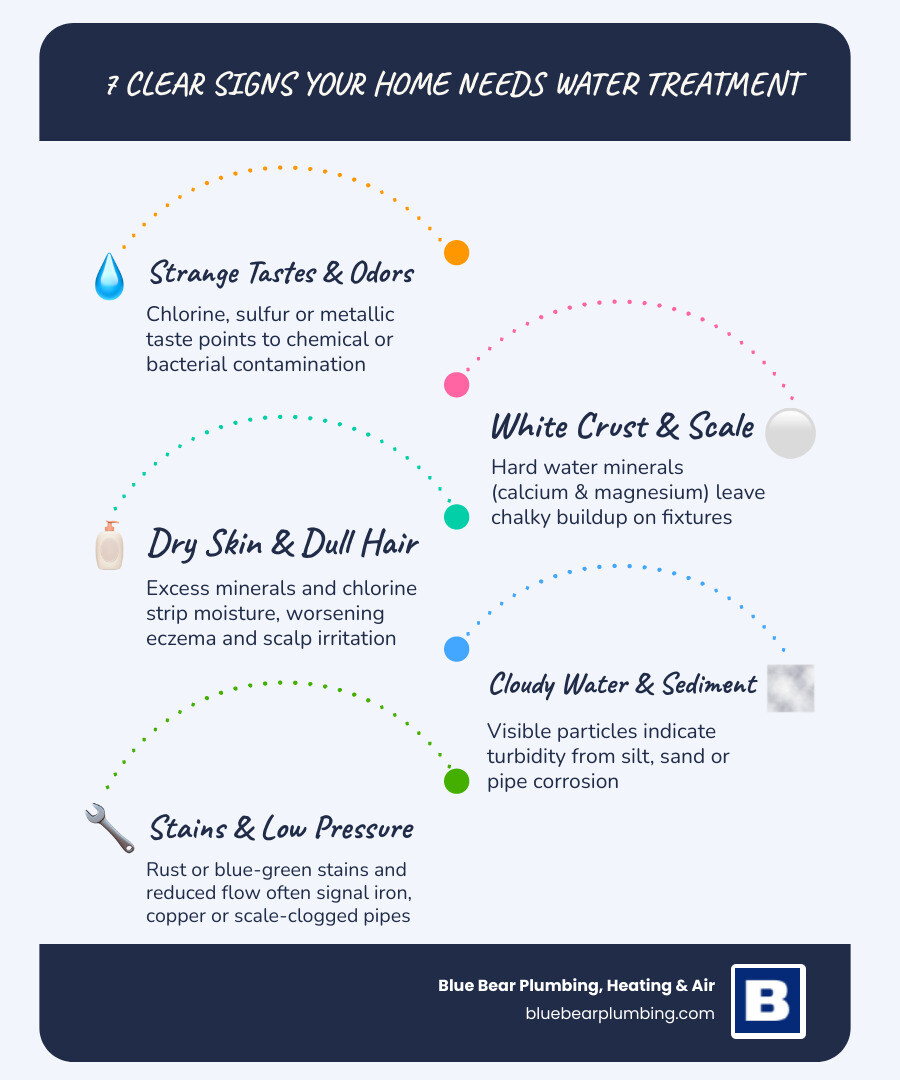
7 Clear Signs Your Home Needs Water Treatment
Whether your water comes from a municipal supply in Quincy or a private well in Norwell, water quality can vary significantly from one street to the next. While city plants treat water to meet federal minimum safety standards, contaminants can still enter your system through aging local infrastructure or your own home’s plumbing. For private well owners, the responsibility of monitoring and treating groundwater falls entirely on you.
Recognizing these seven daily household symptoms is the first step toward reclaiming clean, safe, and refreshing water.

1. Strange Tastes and Odors in Your Tap Water
Pure water should be completely odorless and tasteless. If you find yourself reaching for bottled water because your tap tastes or smells off, your water is signaling a contamination issue.
- Chlorine or Bleach Smell: This is highly common in municipal supplies. City plants use chlorine to disinfect water, but if it smells like a backyard swimming pool when you turn on the kitchen faucet, the levels are high enough to affect the taste of your food, coffee, and drinking water.
- Rotten Egg Odor: A distinct sulfur smell points to the presence of hydrogen sulfide gas. This can occur naturally in groundwater or develop inside your water heater due to a chemical reaction with a decaying anode rod.
- Metallic Taste: If your water tastes like pennies, it often indicates elevated levels of iron, manganese, or zinc. More critically, a metallic taste in older homes (built before 1986) can be a sign of lead leaching from older brass fixtures or lead solder.
- Musty, Grassy, or Fishy Smell: These organic odors are typically caused by algae blooms in surface water reservoirs or harmless bacterial growth in well systems. While usually not toxic, they make drinking tap water highly unpleasant.
2. Persistent Limescale and Mineral Buildup
Do you find yourself constantly scrubbing a stubborn, chalky white crust off your showerheads, faucets, and kettle? That white residue is limescale, and it is a classic indicator of hard water.
Hard water contains high concentrations of dissolved calcium and magnesium. When this water is heated or evaporates, it leaves behind solid mineral deposits. Over time, this scale acts like a slow-growing plaque inside your plumbing fixtures, restricting water flow and ruining the appearance of your high-end bathroom finishes. If you are tired of fighting this chalky buildup, learning How to Prevent Limescale in Your Home can save you hours of cleaning and protect your fixtures from permanent etching.
3. Stiff Laundry and Dingy Fabrics
The minerals in hard water don’t just stick to your metal fixtures; they also wreak havoc in your laundry room.
When calcium and magnesium mix with laundry detergent, they chemically react to form a sticky “soap scum” residue instead of creating a rich, cleansing lather. This residue gets trapped directly within the fibers of your clothes, towels, and sheets. As a result, your fabrics may feel stiff, scratchy, and rough against your skin. Furthermore, this mineral buildup prevents detergents from washing away completely, causing bright colors to fade prematurely and white fabrics to take on a dingy, yellowish-gray tint.
4. Dry Skin, Itchy Scalp, and Lifeless Hair
If you step out of the shower feeling like your skin is tight, itchy, and dry, your water quality is likely to blame.
The same soap scum that settles on your clothes also forms an invisible film over your skin and hair. This mineral barrier clogs your pores and strips away the natural oils your body produces to stay hydrated. If anyone in your family suffers from sensitive skin or conditions like eczema, hard water can severely worsen these irritations.
Additionally, excess chlorine in shower water acts as a harsh drying agent. It strips the natural moisture barrier from your scalp, leading to itching and dandruff, while leaving your hair feeling brittle, dry, and difficult to style. For those with color-treated or blonde hair, high mineral content can even cause your hair color to fade quickly or take on an unwanted brassy tone.
5. Cloudy Water or Visible Sediment
When you fill a clean glass with water, it should be sparkling and crystal clear. If it looks cloudy, milky, or has visible particles floating around, you have a turbidity problem.
- Air Bubbles vs. Sediment: To determine what is causing the cloudiness, fill a glass and set it on the counter. If the water slowly clears from the bottom up over the course of a minute, the cloudiness is simply harmless air bubbles caused by pressure changes in the pipes. If the water remains cloudy or particles settle to the bottom, you are dealing with physical contaminants like sand, silt, clay, or rust.
- Where It Comes From: Sediment can enter your water supply through a fractured well casing, water main breaks in city lines, or the natural degradation of older galvanized steel pipes in your home. These abrasive particles can clog faucet aerators, damage internal plumbing valves, and wear down your appliances.
6. Stubborn Stains on Sinks, Tubs, and Fixtures
If you are scrubbing your sinks, toilets, and bathtubs weekly only to watch mysterious, colorful stains reappear within days, your water contains specific dissolved minerals or chemical compounds.
- Reddish-Orange or Rust Stains: These stains are caused by excess iron. Iron is incredibly common in well water throughout Massachusetts. When dissolved iron in the water comes into contact with air in your toilet bowl or sink, it oxidizes (rusts), leaving behind dark orange or red rings that are notoriously difficult to clean.
- Brownish-Black Stains: If the staining is dark brown or black, it is typically a sign of manganese. Even in tiny concentrations, manganese leaves unsightly dark smudges on porcelain and can permanently ruin laundry.
- Blue-Green Stains: If you notice teal or blue-green staining on your white fixtures, your water is likely acidic (low pH). Acidic water is highly corrosive and slowly eats away at the copper pipes inside your walls. The blue-green color is actually copper residue leaching out of your plumbing and staining your drains.
7. Low Water Pressure and Frequent Plumbing Leaks
Are you noticing that your morning shower feels more like a gentle drizzle than a high-pressure spray? Or perhaps your kitchen faucet takes twice as long to fill a pot as it used to.
Over time, hard water scale builds up inside your water pipes, gradually narrowing the pathway through which water can flow. In severe cases, a pipe’s internal diameter can be reduced by half, severely restricting your home’s water pressure.
Even worse, the combination of mineral buildup and acidic water can cause your pipes to corrode from the inside out. This corrosion leads to pinhole leaks behind your walls. If you suspect your water quality is taking a toll on your plumbing, knowing How to Tell If You Have a Plumbing Leak can help you catch the issue early. If a corroded pipe suddenly gives way, it is critical to know What to Do in a Plumbing Emergency to protect your home from devastating water damage.
How Poor Water Quality Damages Your Plumbing and Appliances
While the aesthetic and health effects of untreated water are frustrating, the hidden damage to your home’s infrastructure can be incredibly costly. Mineral scale and corrosive elements act as a slow, destructive force on every water-using appliance in your home, including washing machines, dishwashers, and plumbing systems.
Water Heater Efficiency Loss
Your water heater is especially vulnerable to water quality issues. Because mineral scale precipitates out of water much faster at high temperatures, the heating elements or the bottom of your water heater tank quickly become coated in a thick layer of calcium scale.
This scale acts as an thermal insulator. Instead of directly heating the water, your water heater has to burn more energy to heat the thick layer of stone first. According to studies by the Water Quality Research Foundation, untreated hard water can reduce a water heater’s efficiency by up to 30% and cut its overall lifespan by 30% to 50%.
If you want to understand how these systems operate, check out our guide on All About Water Heaters: Types, Parts, and How They Work. If you are already hearing strange popping or rumbling noises from your utility closet, you may be experiencing the classic Symptoms of a Failing Water Heater caused by severe sediment accumulation.
Pipe Corrosion and Clogs
When water has a low pH (acidic) or contains high levels of dissolved gases, it becomes highly corrosive to metal. It slowly strips away copper from your home’s pipes, weakening the metal walls until tiny pinhole leaks develop.
On the opposite end of the spectrum, highly alkaline, hard water creates scale blockages that restrict flow and put extra physical stress on your plumbing joints. This can lead to strange rattling, ticking, or banging sounds behind your walls as pressure fluctuates. If you are wondering, “Does Your Plumbing Make These 11 Noises?“, mineral clogs and thermal expansion from scale buildup are very often the primary culprits.
Choosing the Right Water Treatment Solution for Your Massachusetts Home
Because water issues vary so widely, there is no single “magic” system that cures every water problem. The key to successful water treatment is selecting the right technology to target the specific issues present in your home’s supply.
To help you understand your options, here is a breakdown of the three most common home water treatment systems:
| Technology | Best For | How It Works | What It Removes |
|---|---|---|---|
| Water Softener | Hard water, limescale, soap scum | Uses ion exchange to swap calcium and magnesium ions with sodium | Calcium, magnesium, and low levels of iron |
| Whole-House Carbon Filter | Chlorine smell, organic tastes, chemical odors | Uses activated carbon media to trap impurities as water enters the home | Chlorine, chloramines, pesticides, bad tastes, and odors |
| Reverse Osmosis (RO) | Ultra-pure drinking water at the kitchen tap | Forces water through a semi-permeable membrane at high pressure | Lead, PFAS, arsenic, nitrates, fluoride, and 99% of dissolved solids |
Why Well Water and City Water Require Different Filtration
The origin of your water determines the types of contaminants you are likely to encounter:
- City Water: Municipal water in communities like Quincy, Natick, or Weymouth must comply with EPA standards. However, municipal treatment often leaves behind a strong chlorine or chloramine taste. Additionally, city water can pick up lead, copper, or rust as it travels through aging water mains and older residential service lines. City water users can review their local utility’s annual Consumer Confidence Report (CCR) to see exactly what contaminants are monitored.
- Private Well Water: Well water is completely unregulated by the EPA. Groundwater in the South Shore region commonly contains high levels of iron, manganese, and natural acidity. Well water is also highly susceptible to agricultural runoff (such as nitrates and pesticides) and local industrial contaminants like PFAS.
Signs Your Home Needs Water Treatment: When to Get a Professional Water Test
You should never guess when it comes to your water quality. Investing in a water treatment system without testing first is like taking medicine without a doctor’s diagnosis—you might end up with a system that doesn’t solve your actual problem.
We highly recommend getting a professional water test from a certified laboratory if:
- You are experiencing any of the seven signs outlined in this article.
- You rely on a private well (well water should be tested at least once a year).
- You notice sudden changes in the taste, color, or smell of your water.
- There has been recent heavy construction, flooding, or agricultural activity near your property.
A professional water test will provide a detailed breakdown of your water’s pH, hardness level (measured in grains per gallon), and the exact parts-per-million of specific contaminants like iron, lead, copper, and PFAS.
Signs Your Home Needs Water Treatment: Point-of-Entry vs. Point-of-Use Systems
Once you have your water test results, you can choose between two main configurations:
- Point-of-Entry (POE) Systems: These are whole-house systems installed where your main water line enters your home. They treat every drop of water that flows through your pipes, protecting your water heater, appliances, showers, and toilets. Water softeners and whole-house sediment or carbon filters are POE systems.
- Point-of-Use (POU) Systems: These are localized systems installed at specific taps, most commonly under the kitchen sink. They are designed to provide ultra-pure water for drinking and cooking. Reverse osmosis systems are the most popular POU solution, ensuring your drinking water is completely free of heavy metals, PFAS, and microscopic pathogens without the need to treat the water used for flushing toilets or watering the lawn.
Frequently Asked Questions About Home Water Quality
What is the difference between hard water and contaminated water?
Hard water refers specifically to water with high levels of dissolved calcium and magnesium. While hard water is highly destructive to plumbing and annoying for skin and laundry, it is generally safe to drink. Contaminated water, on the other hand, contains substances that violate health standards—such as lead, arsenic, PFAS, bacteria, or chemical runoff—which can cause long-term health issues and unexplained illnesses.
How often should I have my home’s water tested?
If you are on a private well, you should have your water tested annually for bacteria, nitrates, and local contaminants. If you are on city water, testing every 2 to 3 years is a good practice, especially if you live in an older home with mature plumbing where lead leaching is a risk.
Can poor water quality cause my water heater to fail early?
Yes, absolutely. Mineral scale acts as an insulating barrier on water heater elements and tank bottoms. This forces the system to run hotter and longer to heat your water, leading to metal fatigue, overheating, and tank corrosion. Untreated hard water is one of the leading causes of premature water heater failure.
Take Control of Your Home’s Water Quality Today
If you are noticing the signs your home needs water treatment in your daily routine, you don’t have to live with the frustration of hard water, stained fixtures, or strange tastes. At Blue Bear Plumbing, Heating & Air, our friendly, local team is committed to helping homeowners throughout Quincy, Norwell, Natick, and the surrounding South Shore communities find reliable, high-quality water solutions.
We can help you analyze your water, protect your plumbing, and keep your appliances running efficiently for years to come. Whether you need a professional water analysis, a whole-house water softener, or a new, high-efficiency water heater to replace a system damaged by hard water scale, we provide upfront pricing and dependable workmanship you can trust.
Ready to enjoy fresh, clean, and crystal-clear water from every tap? Contact us today to schedule your water quality consultation and learn more about our expert services for Water Heaters and home water systems!
Contact Us Today

Routine maintenance is vital for the longevity of your plumbing, heating, and air conditioning systems. Sign up for our Blue Care Maintenance Plan for annual service and exclusive membership benefits, including:
- Priority scheduling
- Waived service fee during normal business hours
- 10% discount on service calls
- 3% discount on new installations
- Two-year parts and labor warranty on new equipment