




The Truth About Closing Vents in Unused Rooms to Redirect Cold Air
general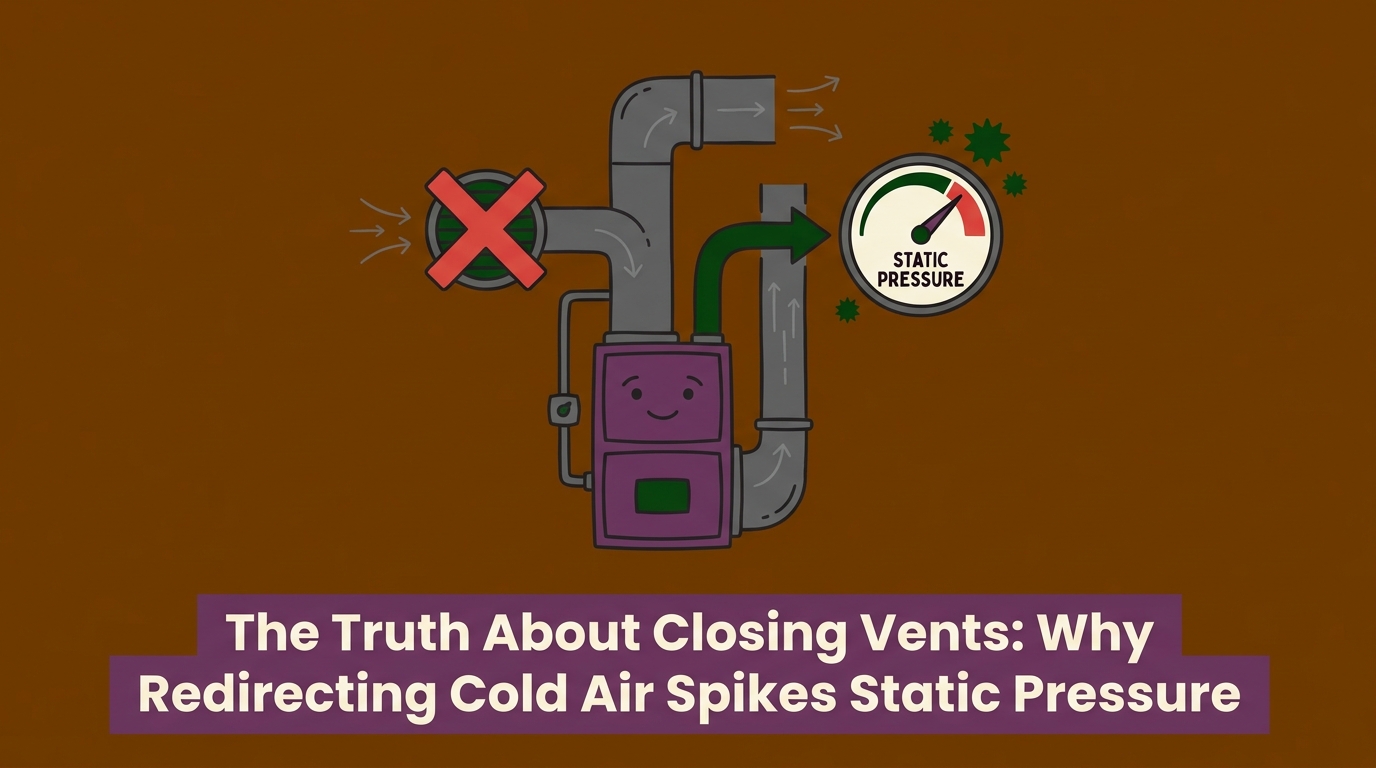
The Costly Illusion of Redirecting Cold Air
The truth about closing vents in unused rooms to redirect cold air is that this common household habit actually damages your HVAC system rather than improving its performance. In our years of servicing cooling systems across Massachusetts, our team typically sees this as one of the leading causes of preventable summer breakdowns. Your air conditioning is running continuously, yet the upstairs bedrooms still feel uncomfortably warm. As you walk past an empty guest room or a vacant basement, you notice perfectly good, frigid air pouring out of the supply register. The immediate, logical thought is to simply shut the vent. Why spend money cooling an empty space when that air could be forced into the master bedroom or the main living area where it is actually needed?
This decision point—choosing whether to shut supply registers in empty rooms to save money or leaving them open—is one of the most misunderstood aspects of home cooling. The misconception stems from treating an airflow network like a plumbing system. Homeowners assume that closing a vent acts exactly like turning off a water faucet, saving capacity and instantly redirecting the flow elsewhere. However, forced-air cooling relies on complex aerodynamics. By shutting that register, you are not saving energy or magically pushing air across the house. Instead, you are unintentionally creating a severe mechanical bottleneck.
During a humid Massachusetts summer, your cooling system is already operating under heavy stress to combat the peak July heat. Systems run long, demanding cycles under this heavy load, making any artificial airflow restriction particularly dangerous. Closing vents causes an immediate, dangerous spike in high static pressure within the ductwork. This pressure overworks the blower motor, disrupts the refrigeration cycle, and leads to severe equipment damage. Before you attempt to manually balance your home’s airflow by closing off rooms, it is critical to understand why proper duct balancing requires professional HVAC services rather than a quick DIY adjustment.
How Modern HVAC Systems Balance Airflow and Volume
To understand exactly why closing a vent is harmful, it is necessary to look at how modern central air conditioning systems are engineered. The foundational metric of any HVAC system is CFM, which stands for Cubic Feet per Minute. This measurement dictates the precise volume of air that the indoor equipment is designed to move.
When a central air system is installed, the blower motor is meticulously calibrated to push a specific CFM of air through the ductwork. This calculation is not arbitrary. It is based on the total square footage of your home, the cooling capacity of the outdoor condenser, and the diameter and length of the ducts. The system is engineered to operate as a complete, balanced whole for the entire house, not on a room-by-room basis.
Think of your home’s ductwork as a closed-loop respiratory system. The supply ducts distribute conditioned air into your living spaces, while the return ducts pull warm air back into the central unit to be cooled, dehumidified, and recirculated. For the system to “breathe” properly, the volume of air exiting the supply vents must exactly match the volume of air entering the return vents. Disrupting this balance immediately alters the internal pressure of the entire system.
| System Type | Operating Principle | Result of Closing a Valve/Vent |
|---|---|---|
| Plumbing System | Open system (water drains out and leaves the house). | Saves water; pressure drops or remains stable at the source. |
| HVAC System | Closed loop (air recirculates continuously). | Creates severe backpressure; high static pressure spikes. |
| Electrical System | On-demand consumption. | Saves electricity; load decreases safely. |
When you close a supply register, the blower motor does not detect the change and slow down. It continues trying to push the exact same CFM of air through the system. Because the total available exit area has suddenly shrunk, the air backs up inside the ductwork. This backup creates a massive increase in high static pressure, forcing the equipment to fight against its own airflow.
The Chain Reaction: What Happens When Static Pressure Spikes
Static pressure is simply defined as the resistance to airflow within your ductwork. A certain baseline amount of static pressure is normal and necessary—it is the force that allows the conditioned air to reach the furthest rooms in your home. However, when that resistance exceeds the manufacturer’s strict specifications, the system enters a dangerous state of mechanical stress.
A pattern we see often on peak-summer emergency calls is that closing vents triggers a rapid, four-step chain reaction that compromises the entire cooling system:
- Supply register closed: A homeowner shuts the louvered vent in an unused guest room, drastically reducing the total square inches of escape routes available for the conditioned air.
- Static pressure spikes: The blower motor continues to push the required volume of air into a smaller, heavily restricted space. The internal pressure of the ductwork skyrockets as the air hits a physical wall.
- Blower motor overworks: The motor strains against the increased resistance. It begins pulling more electricity and generating excess heat as it attempts to force the trapped air through the remaining open vents in the house.
- Evaporator coil freezes: Because the overall volume of air circulating through the home has dropped, less warm return air makes it back to the indoor unit. Without sufficient heat passing over the indoor coil, the refrigeration cycle drops below freezing, turning natural condensation into solid ice.
Comparing high static pressure to human respiration makes the concept easier to grasp. Imagine trying to run a marathon while breathing exclusively through a narrow cocktail straw. Your lungs are trying to pull in and push out a massive volume of air, but the restriction makes it impossibly difficult. Your heart rate spikes, your chest heaves, and you quickly become exhausted. Your HVAC blower motor experiences the exact same mechanical exhaustion when vents are closed.
The Myth of Pushing Air Further
A specific misconception drives the habit of closing vents: the belief that increasing pressure will force cold air to a distant, stubbornly warm room. Homeowners often picture putting their thumb over the end of a garden hose to make the water spray further across the yard.
Unfortunately, pressurized air in a duct system does not behave like water in a hose. Instead of pushing the air further down the line, the increased static pressure usually finds the path of least resistance. It forces the expensive, cold air out through tiny, microscopic leaks at the ductwork seams. This phenomenon, known as duct leakage, means you end up pumping perfectly good air conditioning into unconditioned spaces like your hot attic, a damp crawlspace, or inside your wall cavities.


Why Restricted Airflow Freezes Evaporator Coils
The most immediate and dramatic consequence of high static pressure is a completely frozen evaporator coil. To understand why a lack of airflow creates ice in the middle of summer, you have to look at the role of the coil itself. The evaporator coil sits inside your indoor air handler or furnace and is filled with highly pressurized, freezing-cold liquid refrigerant. Its sole job is to absorb heat from the warm indoor air as the blower motor pushes that air across the metal fins.
When you restrict airflow by closing vents, there simply is not enough warm air passing over the coil to transfer that heat. The refrigerant inside the coil is designed to absorb a specific amount of thermal energy. Without that constant supply of warmth from the return air, the temperature of the refrigerant drops rapidly, eventually plunging well below the freezing point.
This mechanical failure becomes highly volatile depending on the regional climate. Massachusetts experiences highly humid summers, and this excess indoor moisture acts as an accelerant for system failure. Humid air holds a massive amount of water vapor. As this moisture-heavy air passes over the freezing coil, it creates a high volume of condensation. Normally, this condensation drips harmlessly off the coil and into a drain pan. But when the coil is below freezing due to restricted airflow, that condensation instantly turns to solid ice.
During peak July heatwaves, our dispatch logs are filled with calls where, within hours of closing too many vents during a humid Massachusetts summer, the entire evaporator coil has become encased in a thick block of ice. Once the coil is frozen solid, it completely blocks all remaining airflow. Worse, it prevents the refrigerant from converting from a liquid to a gas. If liquid refrigerant travels back outside to the compressor, it can cause catastrophic, irreversible damage to the outdoor unit.
The Hidden Toll on Your Blower Motor
While the evaporator coil is freezing due to a lack of heat transfer, the indoor blower motor is fighting its own losing battle against high static pressure. The severity of the damage depends heavily on the type of motor installed in your system, but the end result is always accelerated wear and tear.
Older HVAC systems typically use standard PSC (Permanent Split Capacitor) motors. These motors operate at a single, fixed speed. When they encounter the high resistance caused by closed vents, they physically cannot push the air through. The airflow drops dramatically, the motor overheats from the strain, and the internal electrical windings bake until the motor eventually burns out.
Modern, high-efficiency systems utilize ECMs (Electronically Commutated Motors) or variable-speed blowers. These motors are intelligent; they are programmed to maintain a steady, specific CFM regardless of the conditions. When an ECM senses the increased resistance from a closed vent, it automatically ramps up its RPMs to compensate. It works harder, spins faster, and consumes significantly more electricity in a desperate attempt to overcome the blockage.
The energy penalty: This aggressive ramping completely negates any perceived energy savings from closing off the unused room. In fact, your monthly electricity bills will likely increase as the motor pulls maximum wattage. Over time, this constant strain causes the sophisticated electrical components to overheat and the bearings to wear out prematurely. Protecting the indoor blower motor from restricted airflow is just as critical as upgrading your AC condenser pad to protect the outdoor unit from sinking and vibration. Both require a clear, unobstructed environment to function properly.
Diagnosing Airflow Issues: Beyond Basic Part Replacements
When a blower motor fails or an evaporator coil repeatedly freezes, many homeowners assume the part itself was simply old or defective. However, in our experience working on hundreds of residential systems, we know that treating a symptom is very different from solving the root cause. If a technician simply swaps out a burnt motor or thaws a frozen coil without investigating why the failure occurred, the new replacement parts will suffer the exact same fate.
If the underlying cause is high static pressure—whether from closed vents, a heavily clogged air filter, or drastically undersized ductwork—the system will continue to destroy its own components. This is why professional airflow diagnostics are non-negotiable for long-term system health.
At Blue Bear Plumbing Heating & Air, a pattern we see often is components failing repeatedly because the underlying pressure issue was ignored. Our deep technical expertise in accurately diagnosing airflow and static pressure issues sets us apart from contractors who just swap parts. Professionals measure static pressure using specialized digital tools called manometers. By inserting static pressure probes into the ductwork—one just before the blower motor and one just after the evaporator coil—technicians can measure the Total External Static Pressure (TESP) of the system.
A manometer reading reveals exactly how much resistance the blower is fighting in real-time. By comparing the supply-side pressure to the return-side pressure, a trained technician can pinpoint exactly where the airflow bottleneck is occurring. Proper airflow diagnosis prevents recurring failures, ensures the system operates safely within manufacturer specifications, and guarantees that you get the full expected lifespan out of your cooling equipment.
Safe and Effective Alternatives for Cooling Unused Rooms
If closing vents is off the table, how can you manage temperatures in unused rooms without wasting energy or damaging your equipment? Fortunately, there are several safe, effective methods that work with your HVAC system’s design rather than fighting against it.
- Leave interior doors open: Proper return airflow is just as vital as supply airflow. Leaving the doors open in unused rooms allows the conditioned air to freely circulate back to the central return vents in the hallway or main living area, preventing pressure imbalances and keeping the air moving.
- Upgrade to a professionally installed HVAC zoning system: If you truly want room-by-room temperature control, a zoning system is the correct mechanical solution. Zoning uses electronic dampers inside the ductwork and bypass ducts to safely redirect air while automatically managing static pressure within safe limits.
- Utilize smart thermostats and remote room sensors: Modern smart thermostats can pair with wireless remote sensors placed throughout the house. The system can average the temperature across the home or prioritize specific occupied rooms, ensuring the main living areas stay comfortable without mechanically restricting the vents.
- Ensure return air vents remain completely unobstructed: Make sure no heavy furniture, large rugs, or thick drapes are blocking your return vents. A starved return plenum creates just as much high static pressure as a blocked supply register. The system must be able to pull air in easily.
- Manage radiant heat with window treatments: During a humid Massachusetts summer, the sun’s radiant heat can drastically warm up unused rooms, making the whole house harder to cool. Keep the blinds, shades, or blackout curtains closed in empty guest rooms to reduce the thermal load naturally without altering the ductwork.
Protect Your Cooling System from Preventable Strain
The desire to save money on summer energy bills is completely understandable. However, keeping your supply registers open is critical for maintaining healthy system pressure, preventing catastrophic coil freezes, and protecting your expensive blower motor from premature failure.
True energy savings come from a balanced, well-maintained system operating exactly as it was engineered to perform, not from closing off rooms and starving the equipment of the airflow it desperately needs. If your home suffers from uneven cooling, hot spots, or weak airflow that tempts you to shut vents, do not try to force the air yourself. Instead, contact our team for a professional static pressure diagnostic. We can identify the true source of the imbalance and restore your home’s comfort safely.
Frequently Asked Questions
Can closing vents damage my AC?
Yes, closing vents can cause severe damage to your air conditioning system. When you shut a register, you increase the static pressure inside the ductwork, which forces the blower motor to work much harder to move air. This added strain can cause the motor to overheat and burn out prematurely. Additionally, the restricted airflow can lead to frozen evaporator coils, which may ultimately cause liquid refrigerant to flood back and destroy the outdoor compressor.
Why does my AC freeze when I close vents?
Your AC freezes because closing vents drastically reduces the amount of warm air passing over the indoor evaporator coil. The coil relies on a constant, high-volume flow of warm indoor air to absorb heat and keep the highly pressurized refrigerant from dropping below freezing. Without enough airflow, the temperature plummets, and the natural condensation forming on the coil rapidly turns into a solid, impenetrable block of ice.
Does closing vents redirect air to other rooms?
No, closing vents does not effectively redirect air to other rooms in the house. Instead of pushing the air further down the ductwork to a distant bedroom, the increased pressure typically forces the cold air to escape through tiny leaks and seams in the ducts. This means you end up pumping expensive, conditioned air into unconditioned spaces like your attic, crawlspace, or wall cavities, wasting energy rather than redirecting it.
How many vents can I safely close in my house?
As a general rule, you should not close any vents in your house. Modern central air systems are engineered and balanced to push a specific volume of air based on the total square footage of the home and the size of the equipment. Closing even one or two vents alters the internal pressure and disrupts this delicate balance. If you absolutely must restrict airflow temporarily for a specific reason, never close off more than 10% of the total vents in the home.
What is static pressure in an HVAC system?
Static pressure is the measurement of resistance to airflow within your ductwork. Think of it like blood pressure for your HVAC system. A certain baseline amount of static pressure is necessary to push air through the ducts and reach the furthest rooms, but when resistance becomes too high—due to closed vents, dirty filters, or undersized ducts—the system has to work dangerously hard to circulate the air.
Contact Us Today

Routine maintenance is vital for the longevity of your plumbing, heating, and air conditioning systems. Sign up for our Blue Care Maintenance Plan for annual service and exclusive membership benefits, including:
- Priority scheduling
- Waived service fee during normal business hours
- 10% discount on service calls
- 3% discount on new installations
- Two-year parts and labor warranty on new equipment