



How a Failing Capacitor Sounds Compared to a Normal Compressor Startup
general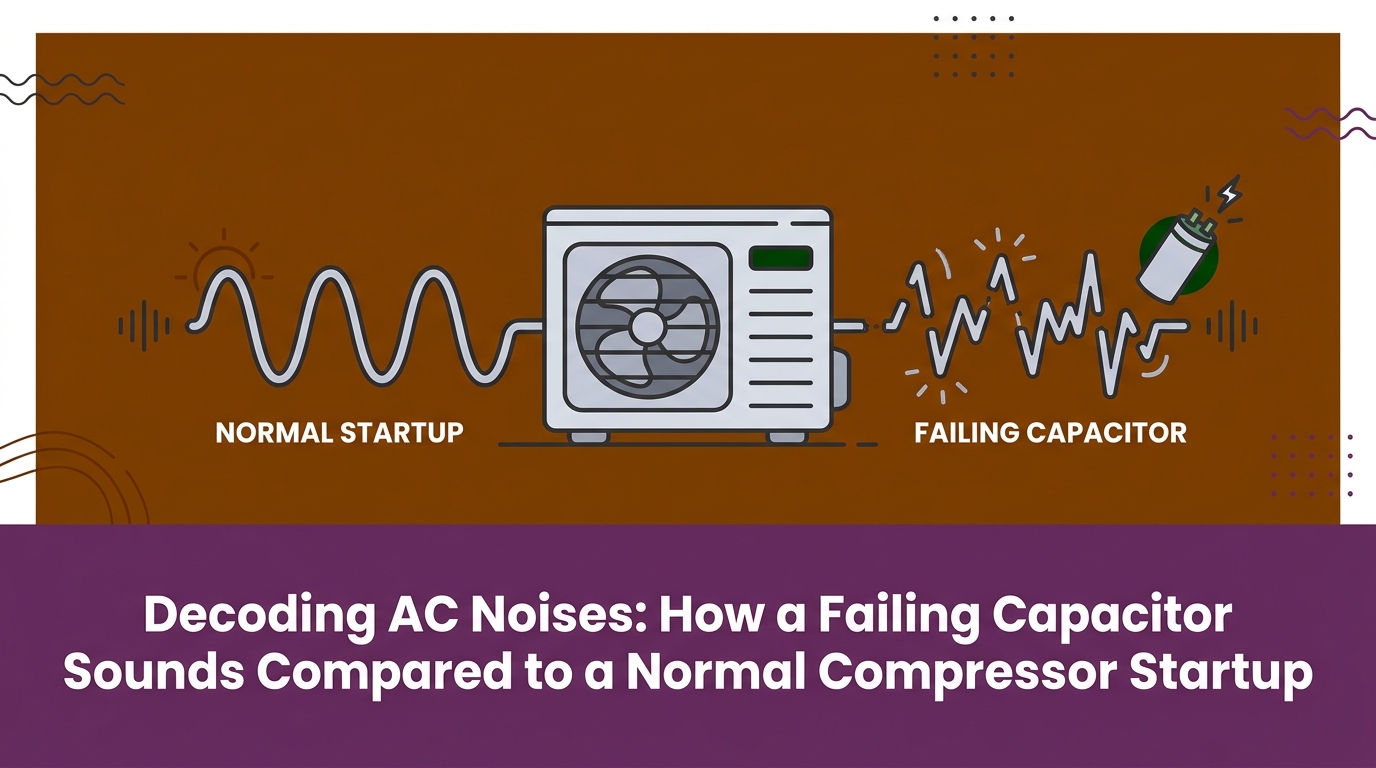
Why Is My AC Unit Making a Strange Noise Instead of Cooling?
If you are trying to figure out exactly how a failing capacitor sounds compared to a normal compressor startup, you have likely just walked outside to investigate a frustrating problem. You noticed that the air coming from your indoor vents is warm, your thermostat reading is slowly climbing, and there are distinct, continuous buzzing or humming noises from the outdoor unit. This specific auditory cue is one of the most common signs that your air conditioning system is struggling to engage.
When you hear this loud, vibrating hum rather than the smooth whir of a spinning fan, it usually means the compressor motor is trying to turn over but failing to draw the necessary electrical power. The system is essentially stuck in the startup phase. At this exact moment, you face a critical decision point: determining whether this noise points to a simple, inexpensive electrical component failure or a severe, costly mechanical breakdown within the compressor itself.
Before you do anything else, the absolute most important step you can take is shutting off the cooling cycle at your indoor thermostat. Leaving a struggling system running while it makes these noises can quickly turn a minor electrical issue into a catastrophic motor burnout. Once the power is safely cut, you can call in a technician for professional HVAC services to properly diagnose the root cause of the noise. Understanding the mechanical differences between a healthy startup and a failing one can help you communicate effectively with your technician and protect your equipment from further damage.
The Anatomy of a Normal Compressor Startup Sequence
To accurately identify when something is wrong with your outdoor condenser, you first need to establish a baseline for what a healthy system sounds like. A properly functioning air conditioner follows a very specific, sequential auditory pattern every time it receives a signal from your thermostat to begin cooling your home. When the system is running efficiently during the peak summer cooling season in MA, this entire sequence happens seamlessly in a matter of seconds.
Here is the exact sequence of events and sounds you should hear during a normal startup:
- The initial contactor click: The sequence begins with a sharp, distinct “click” from the electrical panel on the side of the outdoor unit. This is the contactor pulling in—a heavy-duty electromagnetic switch closing to allow high-voltage electricity to flow from your home’s breaker panel into the condenser’s internal components.
- The low-level electrical hum: Immediately following the click, you will hear a brief, low-pitched hum lasting only a fraction of a second. This is the sound of the dual-run capacitor discharging its stored energy, sending a massive jolt of voltage to both the compressor motor and the condenser fan motor simultaneously.
- The mechanical engagement: Almost instantly, the hum is overtaken by the mechanical sound of the motors turning over. You will hear the deep, rhythmic pumping sound of the compressor pressurizing the refrigerant, combined with the whoosh of the large fan blade beginning to spin.
- The smooth, continuous operation: Within two to three seconds, the sounds stabilize into a steady, continuous drone. The fan spins smoothly, pushing hot exhaust air out of the top of the unit, and the compressor settles into its normal operating cycle.
If your system takes longer than a few seconds to transition from the initial click to smooth operation, or if it seems to struggle and dim the lights in your home before finally starting, the electrical components may be weakening and approaching the end of their lifespan.
Identifying the Sounds of a Failing Capacitor
When the dual-run capacitor loses its ability to store and discharge electricity, the startup sequence derails immediately after the contactor closes. Without that crucial jolt of high voltage, the motors cannot overcome their own resting inertia. The resulting auditory profile is starkly different from a healthy system.
Instead of the brief hum followed by the smooth whoosh of the fan, you will hear persistent buzzing or humming noises from the outdoor unit. This sound is loud, aggressive, and continuous. It is the sound of raw electrical current vibrating through the stationary motor windings. If you look down through the top grate of the unit while this buzzing is happening, you will almost always see that the large fan blade is completely stationary.
| Auditory Cue | Normal Startup Sequence | Failing Capacitor Sequence |
|---|---|---|
| Initial Sound | Sharp, single “click” of the contactor. | Sharp, single “click” of the contactor. |
| Secondary Sound | Brief, sub-second low hum. | Loud, continuous, aggressive buzzing or humming. |
| Visual Indicator | Fan blade immediately begins spinning rapidly. | Fan blade remains completely stationary. |
| Resolution | Smooth, steady drone of cooling operation. | A secondary “click” followed by complete silence. |
The secondary click: If you leave the system running while it buzzes, you will eventually hear another distinct “click,” followed immediately by dead silence. This is not the sound of the problem resolving itself. That second click is the thermal overload protector—a vital safety switch inside the compressor—tripping to cut the power. The motor gets so dangerously hot while trying to start without the capacitor that it shuts itself down to prevent the internal wires from literally melting together.


The Mechanical Role of the Capacitor During Startup
To fully grasp why these buzzing or humming noises from the outdoor unit occur, it helps to understand the mechanical role the capacitor plays in your air conditioning system. You can think of a dual-run capacitor as a powerful, specialized battery. While your home’s electrical grid provides a steady 240 volts to the condenser, that standard voltage is not enough to get the heavy mechanical components moving from a dead stop.
The compressor is essentially a large pump that must push pressurized refrigerant gas through tight copper lines. Starting that pump requires a massive, instantaneous surge of power—often between 300 and 500 volts. The capacitor stores electricity from the grid while the system is off, and then dumps it all at once into the motor windings the moment the thermostat calls for cooling. This phase-shifted jolt provides the torque necessary to overcome the physical resistance of the pump and the inertia of the heavy fan blade.
When the capacitor degrades and fails, it can no longer deliver that torque. However, the contactor is still closed, meaning the standard 240 volts from your electrical panel are still pouring into the motor. This creates a dangerous condition known as Locked Rotor Amps (LRA). The motor is drawing maximum electrical current, trying desperately to turn, but it is physically locked in place due to the lack of startup torque. The loud buzzing sound you hear is the physical vibration of the internal motor coils as massive amounts of electricity surge through them with nowhere to go. Because capacitors deal with such extreme, lethal voltage levels—even after the main power is shut off—diagnosing and replacing them is strictly a job for licensed professionals with the proper discharge tools.
How Heat and Humidity Accelerate Capacitor Failure
Capacitors are incredibly sensitive to thermal strain, which is why they tend to fail at the worst possible times. During the intense heat of the summer cooling season in MA, the electrical components inside your outdoor unit are subjected to extreme environmental stress. A capacitor generates its own internal heat every time it charges and discharges. In mild weather, it can easily dissipate this heat into the surrounding air.
However, when Massachusetts’ hot, humid July weather sets in, the dynamics change entirely. High ambient temperatures bake the metal casing of the condenser unit. More importantly, high indoor humidity forces your air conditioner to run significantly longer cycles. An AC unit doesn’t just lower the air temperature; it must also extract latent heat (humidity) from the indoor air. When the air is thick with moisture, the compressor must run continuously for long stretches to properly dehumidify the house.
The compounding effect of thermal load: Because the system is running nearly non-stop, the capacitor never gets a chance to cool down. The internal dielectric fluid begins to boil and expand, eventually causing the top of the cylindrical capacitor to bulge outward or leak. This physical deformation destroys its ability to store a charge. Furthermore, environmental factors like an unlevel unit can cause excessive vibration, which physically damages the internal connections of the capacitor over time. Ensuring your system is stable by upgrading condenser pads can help reduce this mechanical vibration, allowing the fan to pull air efficiently and keeping the electrical panel slightly cooler.
Immediate Actions to Prevent Catastrophic Compressor Damage
If you walk outside and hear loud buzzing or humming noises from the outdoor unit, how you react in the next few minutes can be the difference between a minor service call and a catastrophic equipment replacement. The longer the system sits in a state of Locked Rotor Amps, the more damage is being done to the compressor’s internal windings.
Take the following steps immediately to protect your home and your equipment:
- Turn off the thermostat: Go inside and switch your thermostat from “Cool” to “Off.” Do not just raise the temperature setting; turn the system completely off so it stops sending the cooling signal to the outdoor unit.
- Do not rely on the thermal overload: While the compressor has a built-in thermal overload switch that will eventually trip and shut the motor down, you should never rely on this. Every time the overload trips, the motor has already reached dangerously high temperatures, degrading the internal insulation.
- Never try to push-start the fan: A common and highly dangerous myth suggests using a stick to manually push the fan blades to get them spinning. This puts you at risk of severe injury, risks damaging the fan motor, and does not solve the underlying issue that the compressor is also failing to start.
- Do not open the electrical access panel: Capacitors store lethal amounts of voltage, even when the main breaker is turned off. They must be safely discharged using specialized insulated tools before any testing can occur.
- Schedule professional service: Leave the system off and contact our repair team. A technician needs to test the capacitance levels and inspect the contactor for pitting or burn marks caused by the electrical strain.
The Importance of Accurate Professional Diagnostics
One of the most stressful aspects of a malfunctioning air conditioner is the uncertainty of the diagnosis. To an untrained ear, the symptoms of a relatively inexpensive dead capacitor and a completely seized, ruined compressor sound remarkably similar. Both scenarios result in a loud buzz, a stationary fan, and a tripped thermal overload switch. This is why Blue Bear Plumbing Heating & Air is deeply committed to reliable, expert diagnostics that ensure homeowners get the right repair without unnecessary anxiety or upselling.
When a professional technician arrives, they do not just listen to the unit and guess. They use specialized digital multimeters to measure the exact microfarad rating of the capacitor. If the capacitor tests well below its rated capacity, they can safely discharge and replace it. However, the diagnostic process does not stop there. A responsible technician will then measure the electrical draw (amperage) of the compressor as it starts with the new capacitor.
Protecting your investment: This thorough testing ensures that the buzzing sound wasn’t actually caused by a compressor that is mechanically locking up internally. By relying on precise electrical measurements rather than assumptions, expert diagnostics prevent homeowners from mistaking a minor electrical fix for a catastrophic mechanical failure. It provides peace of mind that the system is genuinely ready to handle the heavy demands of the summer cooling season in MA, rather than just receiving a temporary band-aid fix.
Frequently Asked Questions About AC Startup Sounds and Capacitor Failures
What does a bad AC capacitor sound like?
A bad AC capacitor typically sounds like a loud, continuous hum or aggressive buzzing coming directly from the outdoor condenser unit. Because the capacitor cannot deliver the electrical jolt needed to start the motors, the electricity vibrates through the stationary components. This buzzing is usually followed by a distinct “click” and then complete silence as the system’s thermal safety switch shuts the unit down to prevent overheating.
Will the AC fan run if the capacitor is bad?
Usually, the answer is no. Most modern air conditioners use a “dual-run” capacitor, which provides the starting voltage for both the compressor motor and the condenser fan motor simultaneously. If this component fails, the fan blade will typically sit completely stationary while the unit buzzes, unable to overcome its own resting inertia without that initial electrical boost.
Why is my outside AC unit buzzing and not turning on?
When your outside AC unit is buzzing but not turning on, the compressor is likely experiencing a condition called Locked Rotor Amps. The motor is receiving standard voltage from the house and trying to spin, but without the extra high-voltage torque from the capacitor, it is physically locked in place. The buzzing sound is the vibration of the electrical current surging through the stalled motor windings.
How do I know if my compressor or capacitor is bad?
Unfortunately, the auditory symptoms of a bad capacitor and a mechanically seized compressor overlap significantly, as both result in a loud buzz and a failure to start. The only way to definitively know which component has failed is through professional multimeter testing. A licensed technician must measure the microfarad output of the capacitor and the electrical resistance of the compressor windings to pinpoint the exact failure.
Can a bad capacitor cause permanent compressor damage?
Yes, a bad capacitor can cause permanent and highly expensive damage to the compressor if the system is left running. If the thermostat continues to call for cooling, the compressor will repeatedly try to start, draw massive amounts of current, overheat, and trip the thermal overload. Over time, this repeated overheating will melt the insulation around the internal motor wires, leading to a complete electrical short and permanent motor burnout.
Secure Your System’s Reliability Before the Next Heat Wave
Understanding exactly how a failing capacitor sounds compared to a normal compressor startup is one of the most valuable pieces of knowledge a homeowner can possess. By recognizing that a loud, continuous buzz means the system is stuck in a dangerous electrical stall, you can take immediate action. Shutting off the thermostat the moment you hear those buzzing or humming noises from the outdoor unit is the single best way to protect your compressor from permanent, catastrophic damage.
Electrical component failures are an unavoidable reality of the heavy thermal strain placed on HVAC systems during the hot summer cooling season in MA. However, an accurate, professional diagnostic can quickly separate a minor electrical hiccup from a major mechanical failure. If your outdoor unit is struggling to start, buzzing loudly, or repeatedly tripping its internal safety switches, do not wait for the problem to worsen. Schedule an expert evaluation to safely resolve the issue, restore your home’s cooling, and ensure your system is fully prepared to handle the next major heat wave with reliable efficiency.
Contact Us Today
Routine maintenance is vital for the longevity of your plumbing, heating, and air conditioning systems. Sign up for our Blue Care Maintenance Plan for annual service and exclusive membership benefits, including:
- Priority scheduling
- Waived service fee during normal business hours
- 10% discount on service calls
- 3% discount on new installations
- Two-year parts and labor warranty on new equipment