



Commercial vs. Residential Rooftop HVAC Units: Why Specialized Maintenance Matters
general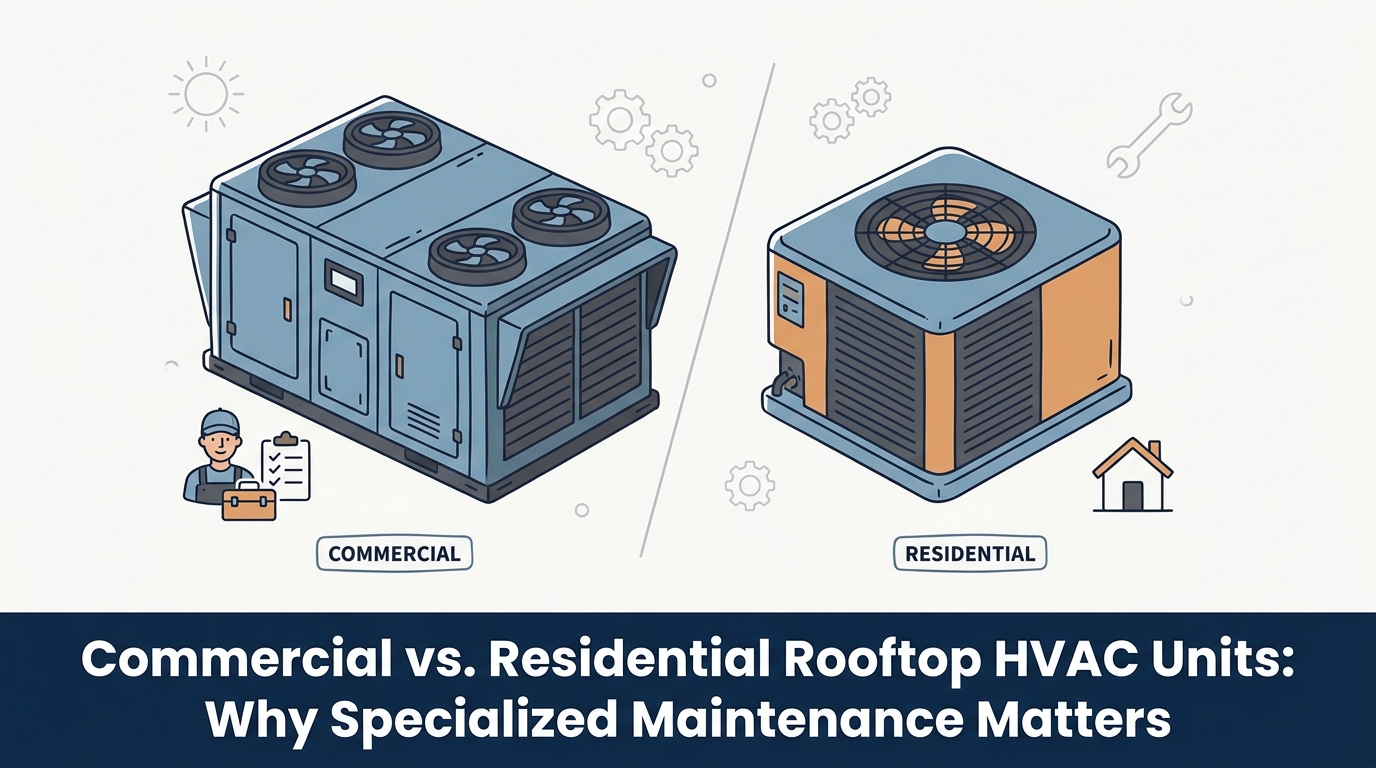
The Myth of Universal AC Care: Why Your Business Needs More Than Basic Maintenance
There is a persistent myth in property management that an air conditioner is just an air conditioner, regardless of where it is installed. But when examining Commercial vs. Residential Rooftop HVAC Units: Why Specialized Maintenance Matters, the reality is far more complex. In our years of servicing the local area, our team typically sees business owners facing a concrete problem: applying standard residential split-system maintenance schedules to small business packaged rooftop units (RTUs). For example, treating a 15-ton commercial RTU the same as a standard 3-ton home unit leads directly to inadequate servicing, accelerated wear, and inevitable system failure.
When you own or manage a commercial property, you face a critical decision point: do you hire a standard residential contractor to look after your building, or do you invest in a specialized commercial technician? Treating these distinct systems identically guarantees premature failure. A residential technician might understand the basic refrigeration cycle, but commercial hardware requires a completely different diagnostic framework.
The comparison between Packaged Rooftop Units (RTUs) vs. Residential Split Systems is not just about size or cooling capacity. It is about how the equipment is built, how it operates under pressure, and what it takes to keep it running safely. Relying on a basic residential checklist for a commercial building leaves major components uninspected, putting your entire operation at risk of sudden downtime.
Structural Differences: How Equipment Design Dictates Service Requirements
To understand why maintenance requirements differ so drastically, you have to look at how these systems are built. The physical architecture of commercial and residential HVAC equipment dictates every aspect of how a technician approaches the unit for service, repair, and preventative care.
When looking at Packaged Rooftop Units (RTUs) vs. Residential Split Systems, the most obvious difference is the layout. A standard residential system is “split” between an indoor air handler and an outdoor condenser. In contrast, commercial RTUs are entirely self-contained. Because commercial units are housed entirely on the roof, they are exposed to direct weather elements 365 days a year—including harsh rooftop temperatures that our technicians frequently see exceeding 120 degrees during peak July heat. This constant exposure requires specific weatherproofing checks, structural integrity assessments of the roof curb, and specialized drainage inspections that simply do not exist in residential maintenance.
Furthermore, commercial parts are inherently more complex. They feature larger blower motors, advanced multi-zone drainage systems, and modular designs that allow for building expansion. A technician cannot just walk up to a commercial unit with a standard tool belt; they must approach the equipment with a completely different diagnostic framework tailored to heavy-duty industrial components.
The Anatomy of a Packaged Rooftop Unit
Understanding the internal structure of an RTU highlights why specialized care is non-negotiable. These units are engineered for maximum efficiency in large spaces, often pushing 10,000 CFM (cubic feet per minute) of airflow, which requires a dense, highly integrated design.
- Self-contained housing: All major components—the compressor, condenser, and evaporator coils—are housed within a single, heavy-duty weatherized cabinet on the roof.
- Modular expansion capabilities: Commercial RTUs are designed to be modular. As a business grows or floor plans change, these systems can be adapted, requiring technicians who understand complex load balancing.
- Specialized access protocols: Servicing an RTU requires specialized lifting equipment, roof safety protocols, and heavy-duty rigging experience just to access and replace internal components safely.
Analyzing Load Demands: Intermittent Use vs. Continuous Operation
The operational demands placed on commercial units far exceed anything a residential system will ever experience. This fundamental difference in workload is the primary reason why commercial maintenance must be more rigorous, more frequent, and more technically precise.
The Problem: Residential systems typically cycle on and off based on intermittent occupancy. A home is often empty during the day, allowing the system to rest and averaging around 800 to 1,000 run hours per year. Commercial RTUs, however, face year-round continuous load demands, frequently logging over 3,000 run hours annually. They must constantly offset the immense heat generated by office equipment, industrial machinery, commercial lighting, and high human occupancy.
The Cause: Local seasonal temperature swings specifically stress commercial RTUs differently than residential units due to their continuous operation requirements. When a massive heat wave hits, a residential unit might run for a few extra hours. A commercial RTU, already running continuously to fight internal building heat, is pushed to its absolute mechanical limits by the external temperature spike. There is no downtime, no rest cycle, and no relief for the internal components.
The Solution: Because continuous operation accelerates wear and tear on belts, motors, and electrical components, maintenance schedules must be aggressive. A specialized commercial technician will calibrate the system to handle these year-round continuous load demands, adjusting belt tension, lubricating heavy-duty bearings, and testing motor amperage to ensure the unit does not fail when the building is at maximum capacity.
Power, Drainage, and Ventilation: The Technical Divide
Beyond structural layout and load demands, the technical requirements for powering and ventilating a commercial space create a massive divide between residential and commercial HVAC service.
Most residential homes run on 240-volt single-phase electrical power. It is straightforward and sufficient for standard appliances. Commercial systems, however, typically require 460-volt 3-phase power. This provides a smoother, more consistent flow of electricity to heavy-duty motors, but it requires highly specialized electrical knowledge to service safely. A technician trained only on single-phase systems can cause catastrophic electrical damage—or face severe injury—if they attempt to wire or diagnose a 3-phase commercial compressor without the proper certifications.
Ventilation standards further separate the two. Commercial RTUs must meet strict ASHRAE Standard 62.1 requirements for indoor air quality. This involves complex mechanical dampers and economizers that actively pull in fresh outside air to prevent “sick building syndrome.” Residential systems generally recirculate the same indoor air, relying on standard infiltration for freshness.
Finally, when evaluating Packaged Rooftop Units (RTUs) vs. Residential Split Systems, drainage complexity cannot be ignored. A home AC has a simple PVC condensate line dripping into a drain or yard. A commercial RTU features complex, multi-zone drainage systems that must safely route gallons of condensation across a flat roof without causing pooling, structural leaks, or water damage to the building below.
The Risks of Applying Residential Maintenance Checklists to Commercial RTUs
One of the most dangerous traps a property manager can fall into is assuming that a standard HVAC tune-up covers all the bases. Identifying the specific risk of applying standard residential split-system maintenance checklists to small business packaged rooftop units is crucial for protecting your investment.
Residential checklists are inherently limited. They cover filter changes, coil cleaning, and basic refrigerant checks. However, they completely miss critical commercial components. A residential checklist does not include testing an economizer, calibrating fresh air dampers, or verifying communication with a complex sensor array. If an economizer fails and gets stuck open during a sweltering August afternoon, your RTU will constantly pull in hot outside air, forcing the compressor to run endlessly until it burns out. A residential technician using a residential checklist will never even look at the economizer.
The danger of using a purely residential contractor is that they simply lack the diagnostic tools and training required for commercial load demands. They might successfully perform standard tasks like cleaning and maintaining your residential AC, but they will leave the most critical commercial components unchecked.
Because commercial RTUs face year-round continuous load demands, ignoring these specialized components doesn’t just reduce efficiency—it actively guarantees a breakdown. The deep technical requirements of commercial care are designed to catch cascading failures before they happen, something a basic residential checklist is completely blind to.
Side-by-Side Maintenance Comparison: Commercial vs. Residential Requirements
To clearly illustrate why Packaged Rooftop Units (RTUs) vs. Residential Split Systems require entirely different service plans, it helps to look at the maintenance requirements side-by-side. The scope, frequency, and technical depth of the work vary significantly.
| Maintenance Category | Commercial Rooftop Units (RTUs) | Residential Split Systems |
|---|---|---|
| Inspection Frequency | Quarterly or monthly, depending on building occupancy and industrial use. | Bi-annually (once before summer, once before winter). |
| Filter Replacement | High-frequency replacement due to continuous, high-volume air circulation. | Every 1 to 3 months based on intermittent, lower-volume airflow. |
| Electrical Checks | Complex 3-phase contactors, heavy-duty relays, and commercial voltage imbalances. | Standard single-phase capacitors and basic electrical connections. |
| Ventilation & Airflow | Calibration of economizers and fresh air dampers to meet ASHRAE standards. | Basic blower motor checks and indoor return air verification. |
| Controls & Thermostats | Integration with multi-zone Building Management Systems (BMS) and sensor arrays. | Calibration of a single, central programmable or smart thermostat. |

Protecting Your Bottom Line: The Business Impact of HVAC Downtime
Ultimately, the reason specialized maintenance matters comes down to revenue. In a residential setting, a broken AC is highly uncomfortable. In a commercial setting, a broken RTU is a financial emergency. Translating these technical differences into business impact reveals why proper maintenance is an investment, not an expense.
The cascading effects of commercial HVAC failure are severe. If a retail space loses cooling in the middle of summer, customer walkouts are immediate. In a restaurant, a failed RTU can lead to lost inventory in secondary refrigeration units that have to work too hard in a hot kitchen. In an office environment, decreased employee productivity and server rooms pushing past 80 degrees can cause massive operational disruptions and severe revenue losses in a single afternoon.
Preventative maintenance tailored specifically to year-round continuous load demands prevents these catastrophic peak-season breakdowns. A specialized technician identifies wearing belts, failing 3-phase contactors, and clogged condensate drains long before they cause the system to shut down during business hours.
Furthermore, energy efficiency losses are massive when commercial units operate out of calibration. A residential unit running inefficiently might add a small amount to a monthly utility bill. A 20-ton commercial RTU running with stuck dampers and a strained compressor will cause utility kilowatt-hour usage to skyrocket. Specialized commercial maintenance directly protects your business revenue by keeping the doors open, the inventory safe, and the overhead costs predictable.
Frequently Asked Questions About Commercial vs. Residential HVAC Systems
What is the difference between a commercial and residential HVAC unit?
The primary difference lies in design, scale, and location. Commercial units are typically self-contained Packaged Rooftop Units (RTUs) that sit on the roof to save space and handle massive heating and cooling loads, often ranging from 5 to 50 tons. Residential systems are usually split between an indoor air handler and an outdoor condenser. Furthermore, commercial systems require complex drainage, 3-phase power, and fresh air intake mechanisms that standard residential units do not use.
Can a residential HVAC contractor work on commercial units?
Generally, it is highly discouraged unless the contractor holds specific commercial certifications. Residential contractors often lack the specialized diagnostic tools, heavy-duty rigging equipment, and 3-phase electrical training required for commercial units. Applying a residential mindset to a commercial RTU often results in missed maintenance steps, particularly regarding economizers and ASHRAE ventilation standards, which can lead to premature system failure.
How often should commercial rooftop units be serviced?
Commercial rooftop units should be serviced at least quarterly, with high-demand environments requiring monthly filter and belt inspections. Because commercial systems face year-round continuous load demands to offset heat from occupants and equipment, they experience significantly more wear and tear than residential units. A bi-annual schedule, which is standard for homes, is entirely inadequate for a commercial building and will result in unexpected breakdowns.
Why do commercial HVAC systems need more maintenance?
Commercial systems run continuously, rarely cycling off completely during business hours. This continuous operation stresses belts, bearings, and heavy-duty motors far faster than the intermittent use seen in residential homes. Additionally, commercial systems are exposed to harsh rooftop weather conditions and must actively manage fresh air intake, requiring frequent calibration of mechanical dampers and sensors to maintain proper indoor air quality.
How does 3-phase power change the way a commercial RTU is serviced?
3-phase power provides a constant, overlapping flow of electricity that allows large commercial compressors to start and run more efficiently than single-phase residential power. However, servicing 3-phase equipment requires specialized electrical training to test voltage imbalances, phase loss, and complex contactors. A technician without this specific knowledge cannot accurately diagnose commercial electrical faults and risks causing severe damage to the unit.
What happens if you use a residential maintenance checklist on a commercial rooftop unit?
Using a residential checklist on a commercial unit means critical industrial components will be completely ignored. The technician will likely check the filters and coils but will miss the economizer, the fresh air dampers, the multi-zone sensors, and the roof curb integrity. This oversight guarantees that the unit will eventually operate out of calibration, leading to massive energy waste, poor air quality, and sudden breakdowns during peak business hours.
Partner With Technicians Who Understand Your Building’s Unique Demands
Small business RTUs require a fundamentally different approach than residential systems. Because these units face year-round continuous load demands, applying standard residential maintenance practices will inevitably lead to costly downtime, uncomfortable working conditions, and shortened equipment lifespans. Your business cannot afford to treat a heavy-duty commercial system like a standard home air conditioner.
This is why working with a team that possesses deep, specialized knowledge is so critical. At our business, our team offers dual expertise in handling the local area’s complex commercial rooftop units as well as standard residential split systems, ensuring we never apply residential biases to your commercial hardware. We understand the specific structural, electrical, and regulatory demands of your building’s equipment.
If you are relying on basic maintenance for your commercial property, it is time to upgrade your approach. Schedule a specialized commercial inspection today to ensure your rooftop units are calibrated for efficiency, protected against unexpected breakdowns, and ready to support your business year-round.
Contact Us Today
Routine maintenance is vital for the longevity of your plumbing, heating, and air conditioning systems. Sign up for our Blue Care Maintenance Plan for annual service and exclusive membership benefits, including:
- Priority scheduling
- Waived service fee during normal business hours
- 10% discount on service calls
- 3% discount on new installations
- Two-year parts and labor warranty on new equipment