




Decoding Efficiency Ratings for Every Savvy Homeowner
HVAC
What Efficiency Ratings Really Mean for Your Home (and Your Wallet)
Efficiency ratings explained for homeowners comes down to one core idea: these numbers tell you how much useful energy you actually get for every dollar you spend. Here’s a quick-reference breakdown of the most important ratings you’ll encounter:
| Rating | What It Measures | Better Score Is… |
|---|---|---|
| SEER/SEER2 | Air conditioner cooling efficiency over a season | Higher |
| HSPF/HSPF2 | Heat pump heating efficiency over a season | Higher |
| AFUE | Furnace/boiler fuel-to-heat conversion | Higher (%) |
| UEF | Water heater energy efficiency | Higher |
| U-Factor | Window/door heat loss resistance | Lower |
| SHGC | Solar heat admitted through windows | Depends on climate |
| HERS Index | Whole-home energy efficiency score | Lower |
Most homeowners only learn these numbers exist when a technician, contractor, or salesperson throws them into a conversation — and suddenly you’re nodding along while secretly having no idea what AFUE or SEER2 actually means for your monthly utility bill. You’re not alone. These ratings are standardized by agencies like the Department of Energy and the EPA, and they exist to help you make smarter, more informed decisions about your home’s heating, cooling, water heating, and building components.
The good news? Once you understand what each number measures and what “good” looks like for a Massachusetts home, the fog clears fast. Whether you’re replacing an aging furnace, shopping for a new air conditioner, or comparing windows for a renovation, knowing these ratings puts you in the driver’s seat.
I’m Marc Provenzano, Marketing Manager at Blue Bear Plumbing, Heating & Air, and while my background isn’t in wrenches and refrigerant, I’ve spent years working alongside our licensed technicians and diving deep into efficiency ratings explained for homeowners to help South Shore families cut through the jargon and make confident decisions. Let’s break it all down together.
Why Efficiency Ratings Explained for Homeowners Matter in 2026
As we move through 2026, the landscape of home energy in Massachusetts has shifted. Between stricter building codes and a growing emphasis on decarbonization, understanding your home’s performance is no longer just for “eco-enthusiasts.” It is a financial necessity.
When we talk about energy waste, we aren’t just talking about a light left on in the hallway. We are talking about thousands of dollars leaking out of poorly insulated windows or being burned away by an inefficient furnace. According to research, homes with high-tier energy efficiency ratings can command selling prices 3% to 5% higher than those with lower ratings. In fact, a Freddie Mac study found that even just having a rated home can increase the sale price by 2.7%.
Beyond property value, these ratings are your best defense against rising utility costs. In our service areas from Norwell to Natick, we see homeowners struggling with high winter heating bills. Upgrading a furnace or boiler from a 56% efficiency rating to a 90% high-efficiency model doesn’t just save money; it saves approximately 1.5 tons of CO2 emissions yearly if you’re using natural gas, and up to 2.5 tons if you’re using oil.
When you look at things to think about when you want to replace your HVAC system, the efficiency rating is the most reliable predictor of your future overhead. In 2026, climate-specific performance is the name of the game. A system that works well in a mild climate might fail to deliver the same efficiency during a brutal South Shore blizzard. That is why decoding these metrics is the first step toward a more comfortable, affordable home.
Decoding HVAC and Water Heater Performance Metrics
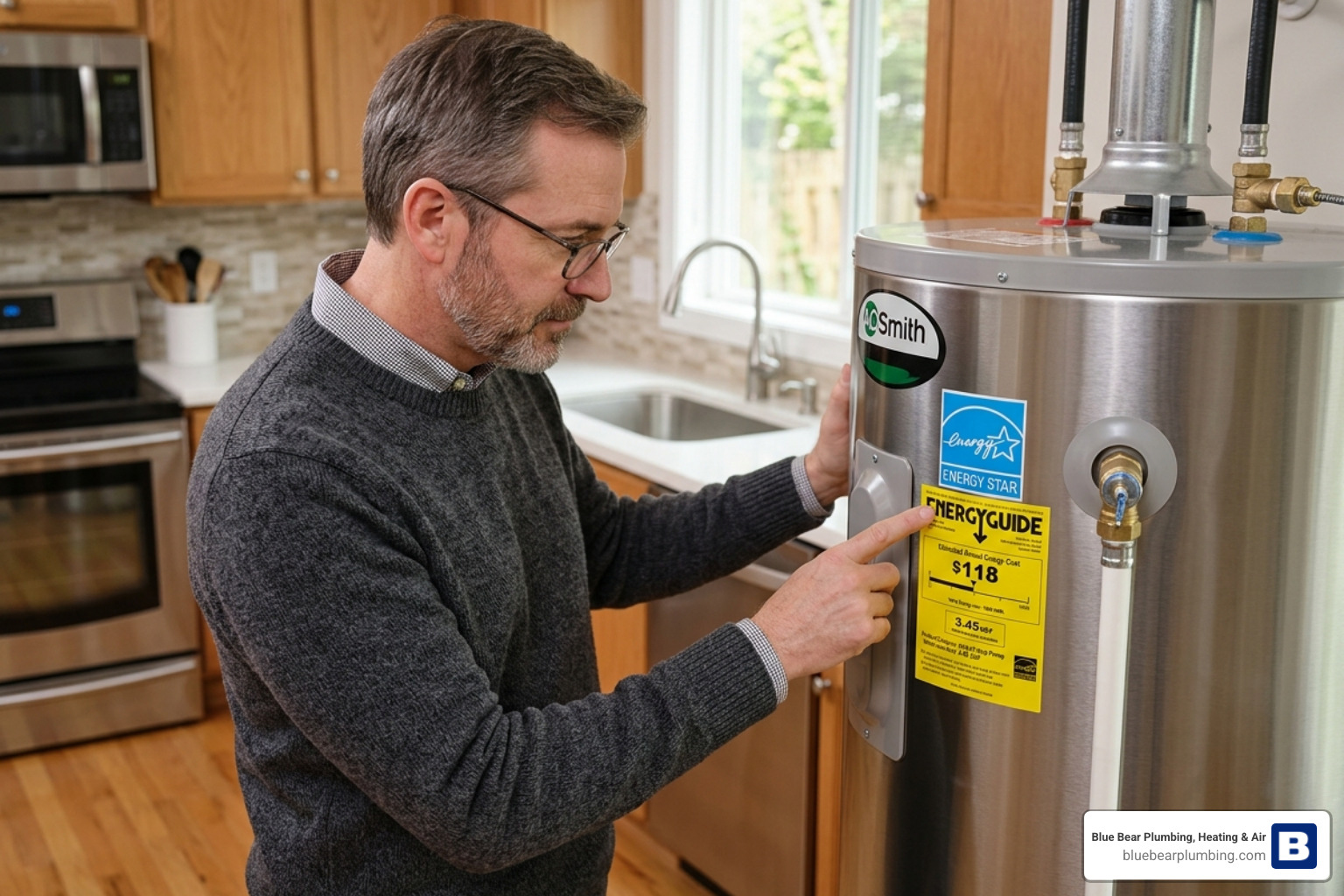
When we walk into a basement in Quincy or a utility closet in Braintree, the first thing we look at is the yellow EnergyGuide label. These labels are the “nutrition facts” of your home’s mechanical systems. However, the acronyms can be dizzying. To understand efficiency ratings explained for homeowners, we have to break down the big four: SEER2, AFUE, HSPF2, and UEF.
Efficiency Ratings Explained for Homeowners: Cooling and Heating
Heating and cooling account for the lion’s share of your home’s energy consumption. In Massachusetts, we need systems that can handle both the humid summer heat and the sub-zero winter nights.
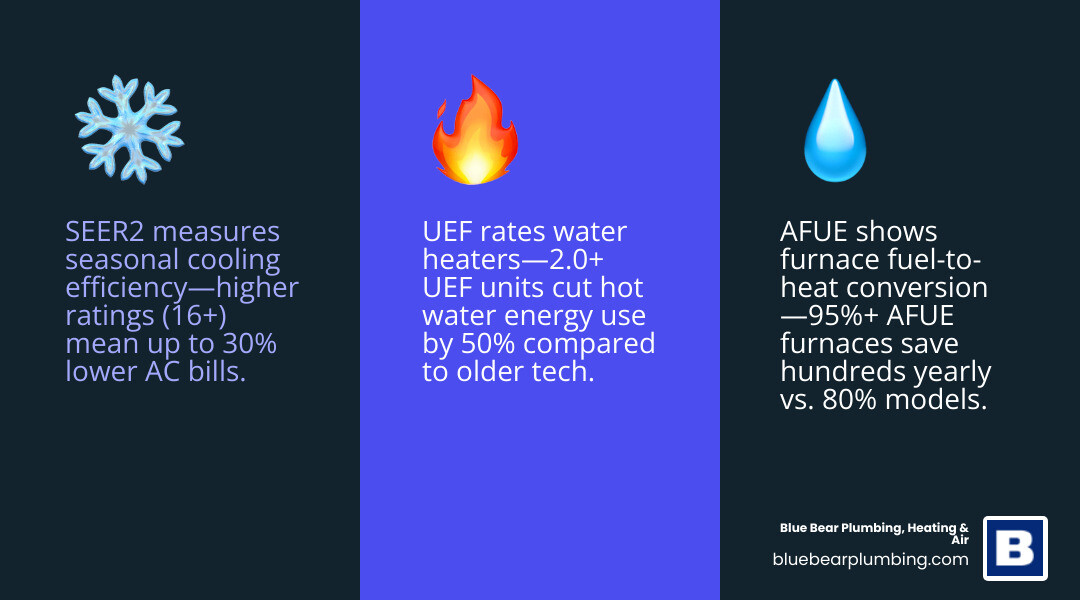
- SEER2 (Seasonal Energy Efficiency Ratio): This measures how efficiently your air conditioner or heat pump cools your home over an entire season. It is calculated by dividing the total cooling output (in BTUs) by the total electricity used (in watt-hours). As of 2023, the minimum SEER rating for the northern half of the U.S. is 14. Upgrading from an old SEER 9 unit to a modern SEER 14 unit can reduce your cooling energy consumption by more than 35%. If you’re paying $100 a month in cooling costs, that’s a $35 monthly saving just from the upgrade.
- AFUE (Annual Fuel Utilization Efficiency): This is the gold standard for furnaces and boilers. It measures the percentage of fuel that is actually converted into usable heat for your home. A 90% AFUE furnace converts 90% of its fuel into heat, while the other 10% escapes through the chimney or vents. High-efficiency units today reach between 90% and 98.5% AFUE.
- HSPF2 (Heating Seasonal Performance Factor): This is specific to heat pumps. It measures the total heat output provided over the heating season divided by the total electricity consumed. Post-2023 standards require a minimum HSPF of 8.8.
When deciding whether it’s time for an upgrade, you should consider the repair vs. replace HVAC Massachusetts dilemma. If your system is over 15 years old, it likely uses outdated refrigerants. Knowing what the R-22 phase-out means for your home is crucial, as repairing these older, inefficient units is becoming increasingly expensive. Modern systems also feature variable-speed compressors, which allow the unit to run at lower, more efficient speeds for longer periods, rather than constantly cycling on and off at full blast.
Efficiency Ratings Explained for Homeowners: Water Heating Metrics
Water heating is the second-highest energy expense for the average family, often accounting for nearly 20% of the energy bill. This is where the Uniform Energy Factor (UEF) comes in.
UEF replaced the older “Energy Factor” (EF) metric back in 2017 to provide a more accurate reflection of real-world usage. It measures the ratio of energy used to heat water versus the energy wasted.
- Traditional water heaters usually have UEF ratings between 0.63 and 0.95.
- ENERGY STAR certified heat pump water heaters are “record-breakers,” with UEF ratings ranging from 3.3 to 4.1. This means they are 330% to 410% efficient because they move heat rather than creating it.
When comparing models, you also need to look at First Hour Delivery (FHD). This tells you how much hot water the unit can provide in its first hour of operation starting with a full tank. This ensures that even a highly efficient unit can keep up with your family’s morning shower routine.
Many of our customers are switching to tankless models for their endless hot water and high efficiency. Exploring tankless water heater benefits is a great way to see if these high-UEF units fit your lifestyle. Plus, with the 2023 HVAC installation tax credits Massachusetts still being a major factor in 2026, these upgrades are more accessible than ever.
Understanding the Building Envelope and Whole-Home Certifications
You can have the most efficient HVAC system in the world, but if your “building envelope”—the walls, windows, and roof—is leaky, you are essentially throwing money out the window.
Windows, Doors, and Insulation
When looking at windows and doors, the NFRC (National Fenestration Rating Council) label is your best friend. It provides four key numbers:
- U-Factor: This measures the rate of non-solar heat loss. For Massachusetts homeowners, a lower U-Factor is better because it means the window is better at keeping your heat inside during the winter.
- SHGC (Solar Heat Gain Coefficient): This measures how much solar radiation comes through the glass as heat. In our climate, you want a balance; you want some heat gain in the winter but not so much that you’re baking in the summer.
- Visible Transmittance (VT): This measures how much natural light comes through. A higher VT means more daylighting, which can reduce your need for artificial lighting.
- Air Leakage: This indicates how much air will move through the window assembly. Lower numbers mean a tighter seal.
We often recommend starting with Mass Save energy audits to identify exactly where your home is losing energy. Often, adding insulation with a high R-Value (the measure of thermal resistance) to your attic is the single most cost-effective way to improve your home’s overall efficiency.
Whole-Home Efficiency Standards
If you are building a new home or doing a major renovation in towns like Hingham or Duxbury, you’ll likely hear about the HERS Index (Home Energy Rating System).
- A HERS score of 100 represents a “standard” home built to 2006 codes.
- A score of 0 represents a Net Zero Energy Home, which produces as much energy as it consumes.
- Every 1-point decrease in the HERS Index corresponds to a 1% reduction in energy consumption compared to the 2006 benchmark.
Other certifications include:
- ENERGY STAR Certified Homes: These are at least 10% more efficient than standard code-built homes, though they average about 20% improvement.
- ENERGY STAR NextGen: Launched recently, this is the strictest standard, focusing on electrification, induction cooking, and “smart grid” capabilities.
- LEED (Leadership in Energy and Environmental Design): A global point-based system for green building.
- DOE Zero Energy Ready Home: These homes are so efficient that a small solar array can offset most or all annual energy consumption.
Understanding these standards can provide great tips for reducing your fall heating bills by showing you how a holistic approach—combining appliances, insulation, and smart technology—creates a truly efficient home.
Maximizing Real-World Efficiency in Your Massachusetts Home
Ratings are calculated in a lab under “ideal conditions.” In the real world—specifically in the variable climate of the South Shore—your actual efficiency depends on several factors that aren’t on the sticker.
- Professional Installation: A unit that is poorly installed can lose up to 30% of its rated efficiency. Proper refrigerant charging and airflow settings are critical.
- Manual J Sizing: Bigger is not better. An oversized HVAC system will “short-cycle,” turning on and off constantly. This uses more energy, creates more wear and tear, and fails to dehumidify your home. We insist on using Manual J calculations to ensure your system is perfectly sized for your square footage and insulation levels.
- Duct Sealing: Leaky ducts can account for up to 35% of energy loss in a forced-air system. Sealing these with mastic or specialized mesh ensures the air you paid to heat or cool actually reaches your living room.
- Maintenance: Regular maintenance can reduce your heating and cooling costs by 5% to 10%. Something as simple as changing your air filter every three months keeps static pressure low and efficiency high.
- System Age: If you are unsure about your current performance, checking your HVAC system age replacement schedule can help you decide if it’s time to stop pouring money into an old unit.
Frequently Asked Questions
What is a good SEER2 rating for Massachusetts homes?
In Massachusetts, the federal minimum is 14 SEER2. However, for our climate, we generally recommend a “sweet spot” of 16 to 18 SEER2. This provides a great balance between the upfront cost of the equipment and the long-term energy savings. If you live in a particularly humid area near the coast, higher SEER2 units often come with better humidity control features that significantly improve comfort.
How does UEF differ from the old Energy Factor (EF)?
The old EF was measured under very basic conditions that didn’t always reflect how families actually use hot water. The Uniform Energy Factor (UEF) uses a “Simulated Use Test” that categorizes water heaters into “usage bins” (very small, low, medium, and high). This allows you to compare two water heaters that are actually designed for the same amount of daily work, giving you a much more accurate prediction of your actual energy costs.
Does a high efficiency rating guarantee lower utility bills?
Not necessarily. Think of an efficiency rating like the “miles per gallon” (MPG) on a car. If you have a hybrid that gets 50 MPG but you drive it with the parking brake on and the windows down at 90 mph, you won’t get that 50 MPG. In a home, “driving with the brake on” is having poor insulation, leaky ducts, or a system that was never properly sized or installed. To see the savings promised by the rating, you need a holistic approach that includes air sealing and professional maintenance.
Conclusion
Navigating efficiency ratings explained for homeowners doesn’t have to be a headache. By focusing on the key metrics like SEER2, AFUE, and UEF, and understanding how they interact with your home’s “envelope,” you can make choices that pay dividends for years to come.
At Blue Bear Plumbing, Heating & Air, we take pride in being more than just a service company; we are your local energy partners. Whether you’re in Norwell, Natick, Quincy, or anywhere across the South Shore, our licensed and experienced technicians are here to help you interpret these numbers and find the perfect fit for your home. We believe in transparent communication and upfront pricing, ensuring that your journey toward a more efficient home is as smooth as possible.
Don’t let your energy dollars disappear into thin air. From preventative maintenance to high-efficiency installations, we have the expertise to keep your home comfortable and your bills manageable. Contact Blue Bear Plumbing, Heating & Air for a home efficiency consultation today, and let’s make your Massachusetts home a model of modern efficiency.

Contact Us Today

Routine maintenance is vital for the longevity of your plumbing, heating, and air conditioning systems. Sign up for our Blue Care Maintenance Plan for annual service and exclusive membership benefits, including:
- Priority scheduling
- Waived service fee during normal business hours
- 10% discount on service calls
- 3% discount on new installations
- Two-year parts and labor warranty on new equipment