




The High Price of Cheap Repairs and How to Avoid It
HVAC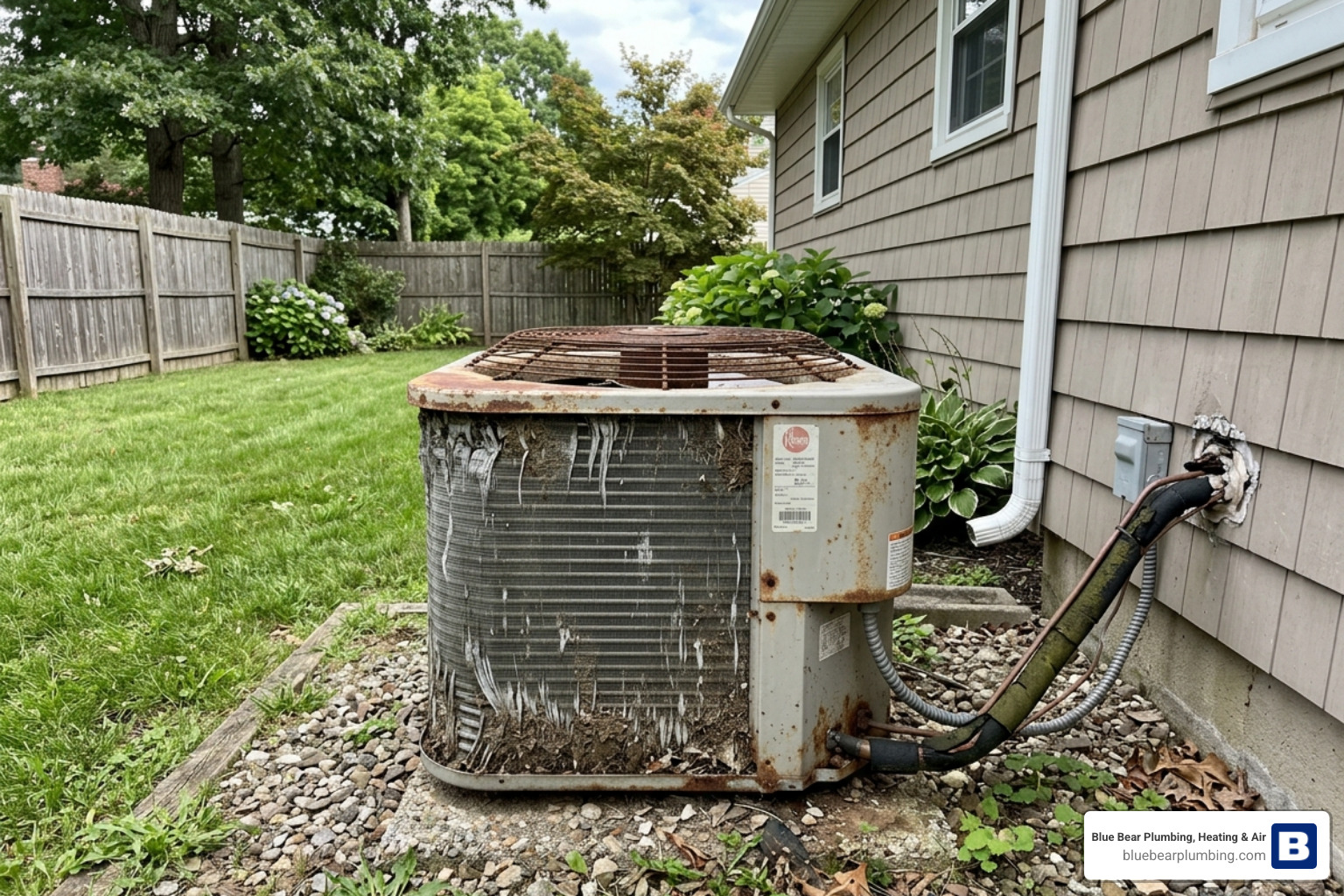
Industry Rules of Thumb for HVAC Decisions
The cost of repairing old hvac vs buying new system is one of the most stressful financial decisions a homeowner can face — especially when your system gives out on the hottest day in July or the coldest night in January. Here is a quick breakdown to help you decide:
Quick Answer: Repair or Replace?
| Situation | Recommendation |
|---|---|
| System is under 10 years old, repair is minor | Repair |
| System age × repair cost exceeds $5,000 | Replace |
| Repair cost exceeds 50% of a new system’s price | Replace |
| System uses R-22 (Freon) refrigerant | Replace |
| System is 15+ years old, any repair over $500 | Replace |
| System is under warranty, isolated failure | Repair |
There is a common mindset among homeowners: if it is still running, leave it alone. The problem is that “still running” and “running well” are two very different things — and the gap between them often costs more than most people realize. An aging HVAC system does not fail all at once. It drains your wallet slowly, one repair at a time, until the day it finally gives out and leaves you making a panicked decision in extreme temperatures.
This article walks you through exactly how to compare your options so you can make a clear-headed, financially sound choice — before that moment arrives.
I’m Marc Provenzano, Marketing Manager at Blue Bear Plumbing, Heating & Air, and after working closely with our team of licensed technicians serving South Shore Massachusetts homeowners, I have seen how understanding the cost of repairing old hvac vs buying new system can save families thousands of dollars in avoidable repairs. Let’s break down the numbers so you can stop guessing and start planning.
When you are staring at a repair quote that feels a bit too high, it is easy to let emotion take over. You might feel a sense of loyalty to your old unit because “it’s been a tank for twelve years,” or you might feel a sudden urge to scrap the whole thing out of frustration. To help our neighbors in places like Norwell and Quincy stay objective, we rely on a few industry-standard “rules of thumb” that take the guesswork out of the equation.
The $5,000 Rule
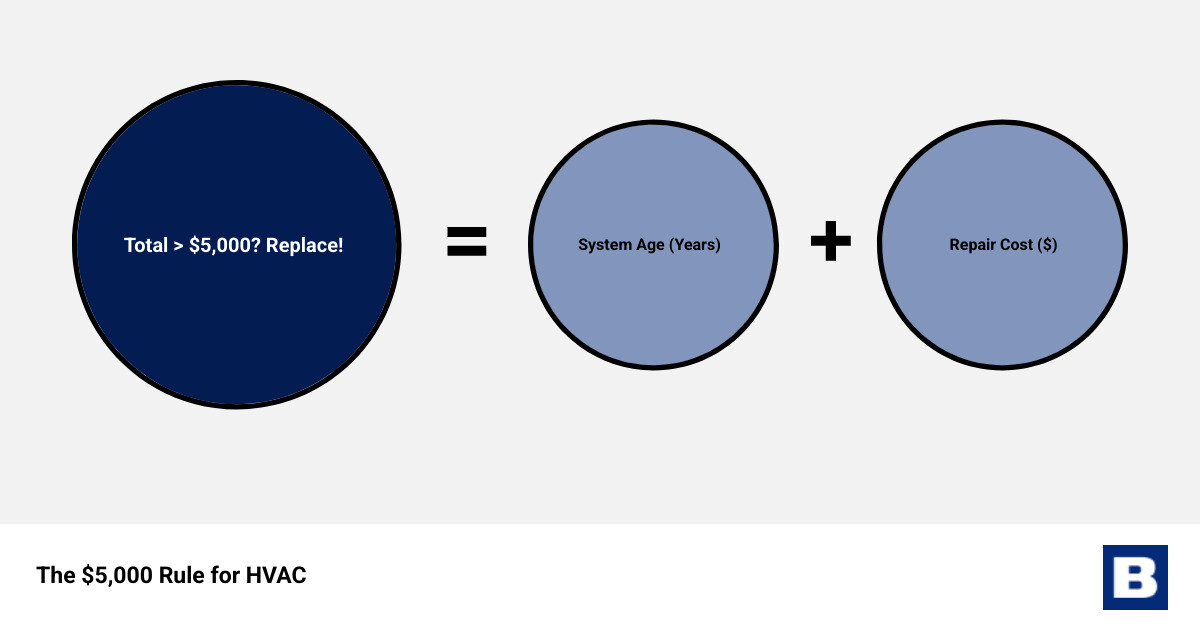
This is perhaps the most famous calculation in the HVAC world. It is simple math: multiply the age of your equipment by the estimated repair cost. If the resulting number is more than $5,000, the data suggests that replacement is the more economical choice.
For example, if you have a 12-year-old system in Natick that needs a $500 repair, your score is 6,000. Since that is over 5,000, you are likely entering a “repair spiral” where one fix leads to another. Conversely, a 6-year-old system needing that same $500 repair scores 3,000, making the repair a smart investment.
The 50% Rule
Another reliable metric is the 50% Rule. If a single repair cost exceeds 50% of the price of a brand-new system installation, we almost always recommend replacement. This is because a major repair on an old unit does not reset the clock on the rest of the components. You might fix the compressor today, but the fan motor or the control board could still be 15 years old and ready to quit.
The Frequency Factor
We also look at how often we are visiting your home. If you have needed more than two unscheduled repairs in the last 24 months, your system is sending you a message. These “nickel and dime” repairs often mask a deeper systemic failure. When we discuss Repair vs. Replace: HVAC in Massachusetts, we emphasize that peace of mind has a value that doesn’t always show up on a single invoice.
Evaluating the Cost of Repairing Old HVAC vs Buying New System
To truly understand the cost of repairing old hvac vs buying new system, you have to look beyond the immediate out-of-pocket expense. A repair is a one-time cost, but an old, inefficient system is a recurring monthly expense.
Since the 2023 update to SEER2 (Seasonal Energy Efficiency Ratio) standards, the baseline for efficiency has moved significantly. If your current unit was installed in 2012, it might have a SEER rating of 10 or 13. Modern units often start at 14.3 or 15.2 SEER2 and can go much higher. This difference isn’t just a technicality; it represents a massive reduction in the amount of electricity required to keep your home comfortable.
When we help homeowners How to Decide Between HVAC Repair and Replacement Without Losing Your Cool, we analyze the “Total Cost of Ownership.” This includes:
- The immediate repair quote.
- Projected energy bills over the next five years.
- The likelihood of future repairs.
- The lack of warranty coverage on an aging unit.
A new system comes with a manufacturer’s warranty (often 10 years or more), meaning your repair costs for the next decade could effectively be zero.
Analyzing the cost of repairing old hvac vs buying new system for Massachusetts homeowners
Living on the South Shore or in South Boston brings unique challenges that impact HVAC longevity. If you live in a coastal community like Hingham, Cohasset, or Scituate, salt air is a major factor. Salt is highly corrosive and can eat away at the delicate aluminum fins on your outdoor condenser much faster than it would in an inland town like Natick or Holliston.
Furthermore, our Massachusetts climate is notorious for high humidity. A modern high-efficiency system is much better at dehumidification than older models. While an old unit might reach the temperature you set on the thermostat, it often leaves the air feeling “clammy.” Upgrading can solve these comfort issues while lowering your bills. There are many Things to Think About When You Want to Replace Your HVAC System, and local climate impact is near the top of that list.
Why the cost of repairing old hvac vs buying new system changes after 15 years
Most central HVAC systems have a functional lifespan of 10 to 15 years. Once a system hits that 15-year mark, it enters its “late-life” stage. At this point, the internal components have undergone thousands of heating and cooling cycles. Metal expands and contracts, electrical connections loosen, and moving parts wear down.
In this stage, even a “minor” repair can be a bad investment. If your 17-year-old furnace in Braintree needs a $600 part, you are essentially paying to keep an obsolete, inefficient machine on life support. We often find that HVAC System Age and Replacement are directly linked; past year 15, the probability of a major component failure (like the heat exchanger or compressor) increases by nearly 70%.
Technical Red Flags: When Repairs Become Terminal
Some repairs are just “wear and tear,” like replacing a capacitor or a contactor. These are common, relatively affordable, and usually worth doing if the system is healthy. However, some failures are considered “terminal” for an older unit.
The Refrigerant Crisis (R-22 and R-410A)
If your system was manufactured before 2010, it likely uses R-22 refrigerant (Freon). The EPA phased this out entirely in 2020. Because it is no longer produced, the cost to “recharge” a system with a leak has skyrocketed. In May 2026, finding reclaimed R-22 is both difficult and incredibly expensive. If an R-22 system has a leak, the cost of repairing old hvac vs buying new system almost always leans toward replacement.
Even R-410A, which replaced R-22, is currently being phased down in favor of newer, more eco-friendly refrigerants like R-454B. Repairing a 12-year-old R-410A system that has a major leak is becoming a “sunk cost” scenario.
Cracked Heat Exchanger
In a furnace, a cracked heat exchanger is a non-negotiable safety issue. It can allow carbon monoxide to leak into your home’s air supply. Because the heat exchanger is the “heart” of the furnace, replacing it is labor-intensive and expensive. On a system over 10 years old, we almost always recommend a full replacement to ensure your family’s safety.
Failed Compressor
The compressor is the most expensive part of your outdoor AC unit. If it fails on a unit that is out of warranty, you are looking at a repair that is often 50% or more of the cost of a new outdoor unit. When you consider What Does a New HVAC Installation Include?, such as a new warranty and matched efficiency, replacing just the compressor on an old unit rarely makes sense.
Long-Term Value: Efficiency, Tax Credits, and Home Resale
One of the most compelling reasons to choose replacement is the financial assistance available to Massachusetts homeowners. Between federal incentives and local programs like Mass Save, the upfront cost of a new system can be significantly offset.
Energy Savings Comparison
The following table illustrates the potential annual savings for a typical 2,500-square-foot home in the South Shore area when upgrading from an older, inefficient system.
| Old System Rating | New System Rating (SEER2) | Estimated Annual Savings |
|---|---|---|
| 10 SEER | 16 SEER2 | $400 – $700 |
| 10 SEER | 20+ SEER2 | $800 – $1,200 |
| 80% AFUE (Gas) | 96% AFUE (Gas) | $300 – $500 |
Incentives and Rebates
In 2026, the Inflation Reduction Act continues to provide substantial federal tax credits for high-efficiency heat pumps and AC units. Additionally, Massachusetts residents often have access to generous rebates through utility programs. We stay up to date on 2023 HVAC Installation Tax Credits in Massachusetts (and the updated 2026 versions) to help our clients maximize their returns.
Home Marketability
If you are planning to sell your home in a competitive market like Milton or Hingham, a 15-year-old HVAC system is a red flag for buyers. It often leads to requests for “closing credits” or demands for replacement after a home inspection. Installing a new, high-efficiency system not only boosts your home’s value but also gives potential buyers confidence that they won’t face an emergency repair immediately after moving in.
For those concerned about the upfront investment, we offer various Financing Options for Your Home Systems to turn a large one-time cost into a manageable monthly payment that is often partially offset by your energy savings.
Frequently Asked Questions about HVAC Replacement
What is the $5,000 rule for HVAC?
The $5,000 rule is a decision-making formula where you multiply the age of your HVAC unit by the estimated cost of the repair. If the total exceeds 5,000, it is generally more cost-effective to replace the unit rather than fix it. For example, a 10-year-old unit needing a $600 repair (10 x 600 = 6,000) should be replaced.
Is it worth repairing a system that uses R-22 refrigerant?
In almost all cases, no. R-22 (Freon) has been phased out, and the cost of the refrigerant alone can be staggering. Furthermore, a system using R-22 is likely at least 15 years old, meaning other major components are also nearing the end of their lifespan.
How much can I save on utility bills with a SEER2 upgrade?
Homeowners upgrading from a 10 SEER unit to a modern 16 SEER2 or higher system can typically see a reduction in cooling costs of 20% to 50%. In the Massachusetts climate, this can add up to several hundred dollars in savings every year.
Conclusion
Deciding between the cost of repairing old hvac vs buying new system doesn’t have to be a gamble. By using objective measures like the $5,000 Rule and considering the long-term impact of energy efficiency and refrigerant phase-outs, you can make a choice that protects both your home’s comfort and your bank account.
At Blue Bear Plumbing, Heating & Air, we are committed to helping our neighbors throughout the South Shore — from the historic Colonials of Hingham to the busy neighborhoods of South Boston. Whether you are in Norwell, Quincy, or Natick, our team provides the integrity and upfront pricing you need to make the right call for your family.
Don’t wait for a total system failure to start the conversation. We can help you evaluate your current system’s health and provide a clear roadmap for the future. Schedule your High-Mileage HVAC Checkup today and let us help you keep your cool, no matter what the Massachusetts weather throws your way.
Contact Us Today

Routine maintenance is vital for the longevity of your plumbing, heating, and air conditioning systems. Sign up for our Blue Care Maintenance Plan for annual service and exclusive membership benefits, including:
- Priority scheduling
- Waived service fee during normal business hours
- 10% discount on service calls
- 3% discount on new installations
- Two-year parts and labor warranty on new equipment