



Stop Overpaying for HVAC with the Right Service Model
HVAC
Deciding Between Membership Plans and Pay-Per-Visit Service
Making the right membership plan vs pay per visit comparison for your home’s essential systems is key to comfort and peace of mind. Homeowners in Norwell, Natick, Quincy, and the surrounding South Shore communities of MA often face a common dilemma: how to best manage their HVAC and plumbing service. Do you pay for maintenance and repairs as they come up, or commit to a recurring plan? This choice impacts your budget, the reliability of your systems, and your overall home functionality. Understanding the pros and cons of each model is crucial to stop overpaying and ensure your home stays in top shape.
For proactive home care and reliable service, explore our Blue Care Priority Plan or Contact Us directly for immediate assistance.
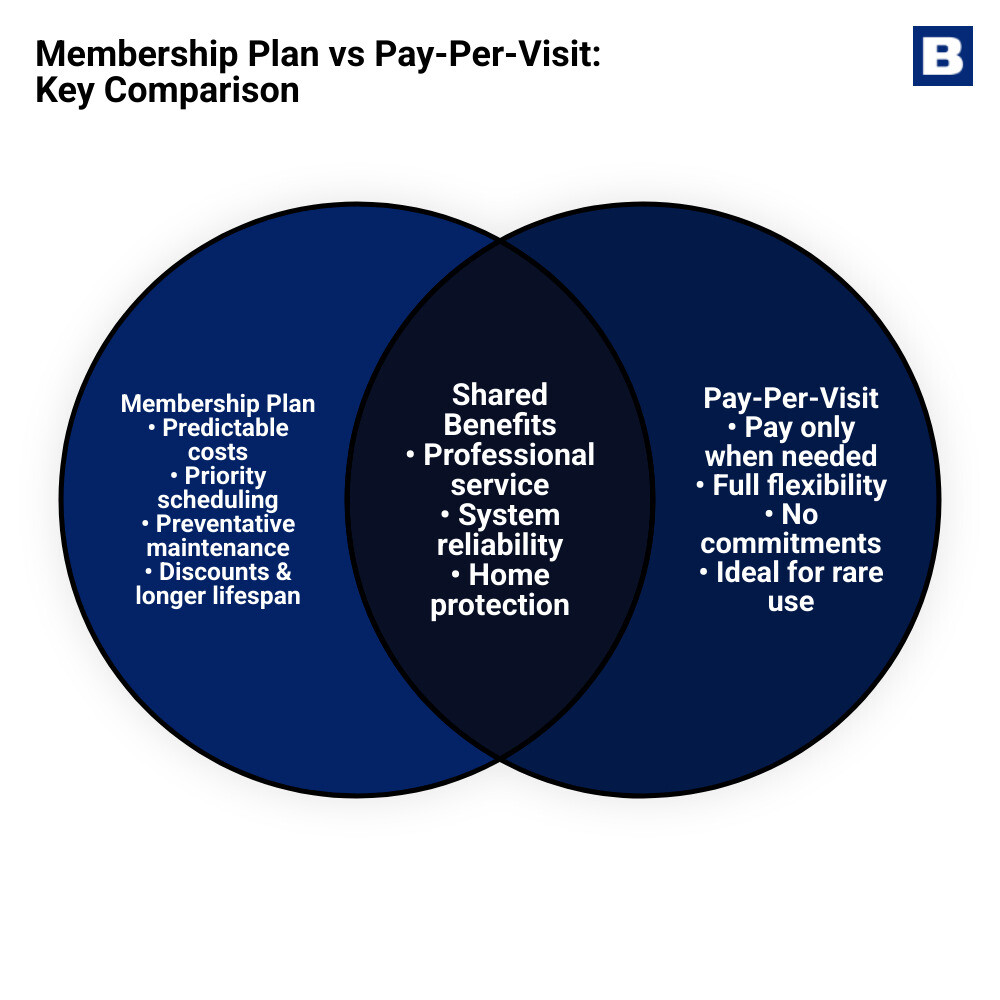
Here’s a quick look at the main differences:
- Membership Plan: Offers scheduled, preventative maintenance, often with predictable monthly or annual costs. Benefits typically include priority scheduling, discounts on repairs, and a longer equipment lifespan due to regular care. It’s ideal for homeowners seeking consistency and long-term peace of mind.
- Pay-Per-Visit: You pay only when you need a service or repair. This model provides flexibility and no long-term commitment. It’s suitable for those with infrequent service needs or who prefer to address issues only as they arise.
As Marketing Manager at Blue Bear Plumbing, Heating & Air, I’ve seen how understanding the membership plan vs pay per visit comparison empowers homeowners. My passion is translating complex service models into clear choices that build trust and long-term value for our community.
Membership Plan vs Pay Per Visit Comparison: Key Differences
When we look at the landscape of home maintenance in April 2026, the way we handle our plumbing and HVAC systems has evolved. The primary difference between these two models lies in the relationship between the homeowner and the service provider.
A membership plan, like our Blue Care Priority Plan, is built on a foundation of preventative care. It’s a proactive approach where we partner with you to catch small issues before they become catastrophic floods or mid-winter furnace failures. In contrast, the pay-per-visit model is inherently reactive. You call us when something breaks, and we come out to fix that specific issue.
For businesses, memberships generate predictable recurring revenue, which allows us to staff appropriately and ensure we always have a technician ready for our members. For you, this translates to priority scheduling. When a heatwave hits Norwell or a cold snap freezes pipes in Quincy, members move to the front of the line.
Another key difference is the service history. Members benefit from a comprehensive digital paper trail. We know exactly when your water heater was last flushed and when your AC filters were swapped. In a pay-per-visit scenario, the service history is often fragmented, making it harder to diagnose recurring “ghost” issues in your plumbing or HVAC system.
| Feature | Membership Plan | Pay-Per-Visit |
|---|---|---|
| Approach | Proactive / Preventative | Reactive / Episodic |
| Scheduling | Priority Response | Standard Wait Times |
| Cost Structure | Predictable Recurring Payments | Variable Per-Incident Fees |
| Maintenance | Included / Scheduled | Customer-Initiated |
| Discounts | Repair & Install Discounts | Full Retail Rates |
| Relationship | Long-term Partnership | Transactional |

Why a membership plan vs pay per visit comparison matters for consistency
Consistency is the “secret sauce” of home maintenance. Research in behavioral psychology, such as studies from Stanford, suggests it takes an average of 66 days to build a habit. While you might not be “building a habit” of fixing pipes, we are building a habit of system health.
When you opt for a membership, you are automating the responsibility of maintenance. In towns like Natick, where seasonal shifts can be brutal on HVAC systems, routine inspections are the only way to guarantee system longevity. Without a plan, it’s easy to forget that biannual checkup. You’re busy, the kids have practice, and suddenly three years have passed without your boiler being serviced.
A membership ensures that those routine checks happen like clockwork. This consistency reduces “friction”—the mental hurdles that discourage us from doing things that are good for us (or our homes). Just as a gym membership encourages you to show up because you’ve already committed, a plumbing membership encourages you to keep your home in peak condition.
Evaluating membership plan vs pay per visit comparison for long-term value
When evaluating the membership plan vs pay per visit comparison, we have to look beyond the immediate invoice. We look at “Lifetime Value” and “Break-Even Analysis.”
Think of it like the classic “Home Gym vs. Commercial Gym” debate. A home gym requires a larger upfront investment but saves thousands over a decade. Similarly, while a membership involves a recurring commitment, the cumulative savings from avoided emergency fees, discounted repairs, and extended equipment life often result in a break-even point within the first year or two.
In Quincy, we see many older homes where plumbing systems are reaching the end of their functional lifespan. A membership plan provides property protection. By having a licensed technician perform regular High Mileage HVAC Checkup or plumbing inspections, we can extend the life of your equipment by years. Replacing a furnace or a main sewer line is a major capital expense; deferring that cost through consistent maintenance is a massive win for your long-term household budget.
The Psychological and Practical Benefits of Plumbing Memberships
There is a psychological phenomenon called “loss aversion.” Humans generally feel the pain of losing something more than the joy of gaining something. In home services, this manifests as the “fear of the unknown.” What if the pipe bursts while I’m on vacation? What if the AC dies on the hottest day of July?
A membership provides “peace of mind,” which is a practical benefit disguised as a psychological one. Knowing you have a dedicated team in Norwell or Natick who already knows your home’s layout and system quirks reduces the mental load of homeownership.
Furthermore, memberships tap into “identity reinforcement.” When you sign up for a plan, you aren’t just a customer; you are a “Member.” This shift in identity often leads to better home care overall. You become the homeowner who stays ahead of the curve, rather than the one constantly putting out fires.
Practical benefits often include:
- Loyalty Rewards: Many plans allow you to accumulate “loyalty dollars” that can be applied to future system replacements.
- Transferable Benefits: If you sell your home in the South Shore MA area, your membership can often be transferred to the new owners, adding a tangible selling point to your property.
- Comprehensive Inspections: These aren’t just quick “looks.” They are multi-point safety checks that ensure your family is safe from carbon monoxide leaks or water damage.
When Pay-Per-Visit is the Right Choice for Your Property
While we are big believers in the membership model, we also recognize that pay-per-visit has its place. It’s about autonomy and flexibility.
If you are a new homeowner in South Boston and you aren’t yet sure who you want to work with long-term, pay-per-visit is a great way to “test the waters.” It allows you to evaluate a company’s professionalism, punctuality, and quality of work without any strings attached.
Pay-per-visit might also be the right choice if:
- You have very infrequent needs: If you live in a brand-new condo with state-of-the-art systems and minimal usage, you might feel that a full membership is more than you need right now.
- Budget Constraints: If your monthly budget is extremely tight and you prefer to take the risk of higher episodic payments rather than a small, predictable monthly fee, pay-per-visit offers that low-commitment path.
- Short-term Residency: If you plan on moving out of the area in a few months, a long-term membership might not make sense for your specific timeline.
However, keep in mind that the “cost of flexibility” is often higher in the long run. Without the preventative aspect, you are more likely to face emergency situations where you pay full retail rates and potentially higher dispatch fees.
Frequently Asked Questions about Service Models
How does client usage frequency impact the choice between models?
Usage frequency is the biggest driver in this decision. If you have a large family in a house with three bathrooms and a complex HVAC system, your “utilization rate” is high. More water is moving, more air is being filtered, and there are more points of potential failure. In this scenario, a membership is almost always the more cost-effective choice because the likelihood of needing service is high.
Conversely, if you live alone in a small apartment and travel frequently, your systems aren’t working as hard. While maintenance is still necessary, the “volume” of service you’ll need is lower. We generally recommend that if you find yourself calling a plumber or HVAC tech more than once a year, you are already in the “membership zone” for savings.
What are effective hybrid models for home maintenance?
Some homeowners prefer a middle ground. Effective hybrid models can include:
- Tiered Memberships: Choosing a “Bronze” or “Silver” level that provides the basic inspections and priority status without all the bells and whistles of a “Platinum” plan.
- Session Packs: While more common in the fitness industry, some service providers offer “pre-paid” blocks of service hours.
- Add-on Services: Maintaining a basic membership for your HVAC but choosing pay-per-visit for smaller plumbing tasks like a leaky faucet or a slow drain.
At Blue Bear Plumbing, Heating & Air, we find that a tiered approach—like our Blue Care Priority Plan—allows homeowners to customize their coverage based on their specific property needs and comfort level.
How do retention rates differ between these two models?
Data across the service industry shows a massive difference in customer loyalty and retention between the two models. Pay-per-visit “drop-in” customers have much lower retention rates—often around 24% monthly in similar industries—because the relationship is purely transactional.
Membership models, however, often see annual retention rates of 70% or higher. This is because the model fosters relationship building. We aren’t just a voice on the phone; we are the technicians you know by name who come to your home in Norwell or Natick twice a year. This trust leads to stable habits and a better-functioning home environment.
Conclusion
Choosing between a membership and pay-per-visit shouldn’t feel like a gamble. It’s about aligning your service model with your lifestyle and your home’s needs. If you value predictability, priority, and the long-term health of your property, a membership plan is the clear winner. If you prefer total autonomy and have very low service needs, pay-per-visit offers the flexibility you crave.
At Blue Bear Plumbing, Heating & Air, our local expertise and licensed technicians are dedicated to serving our neighbors in Norwell, Natick, Quincy, and throughout the South Shore. We believe in integrity and upfront communication, regardless of which model you choose.
Ready to stop worrying about your home’s “what-ifs”? Join the Blue Care Priority Plan today and experience the difference that professional, proactive care can make. Whether you need a simple drain cleaning or a full HVAC overhaul, we are here to provide the reliable solutions you deserve.



Contact Us Today

Routine maintenance is vital for the longevity of your plumbing, heating, and air conditioning systems. Sign up for our Blue Care Maintenance Plan for annual service and exclusive membership benefits, including:
- Priority scheduling
- Waived service fee during normal business hours
- 10% discount on service calls
- 3% discount on new installations
- Two-year parts and labor warranty on new equipment