




In-Depth Guide to How Hydronic Radiant Heating Works
HVAC
What Is Hydronic Radiant Heating and How Does It Work?
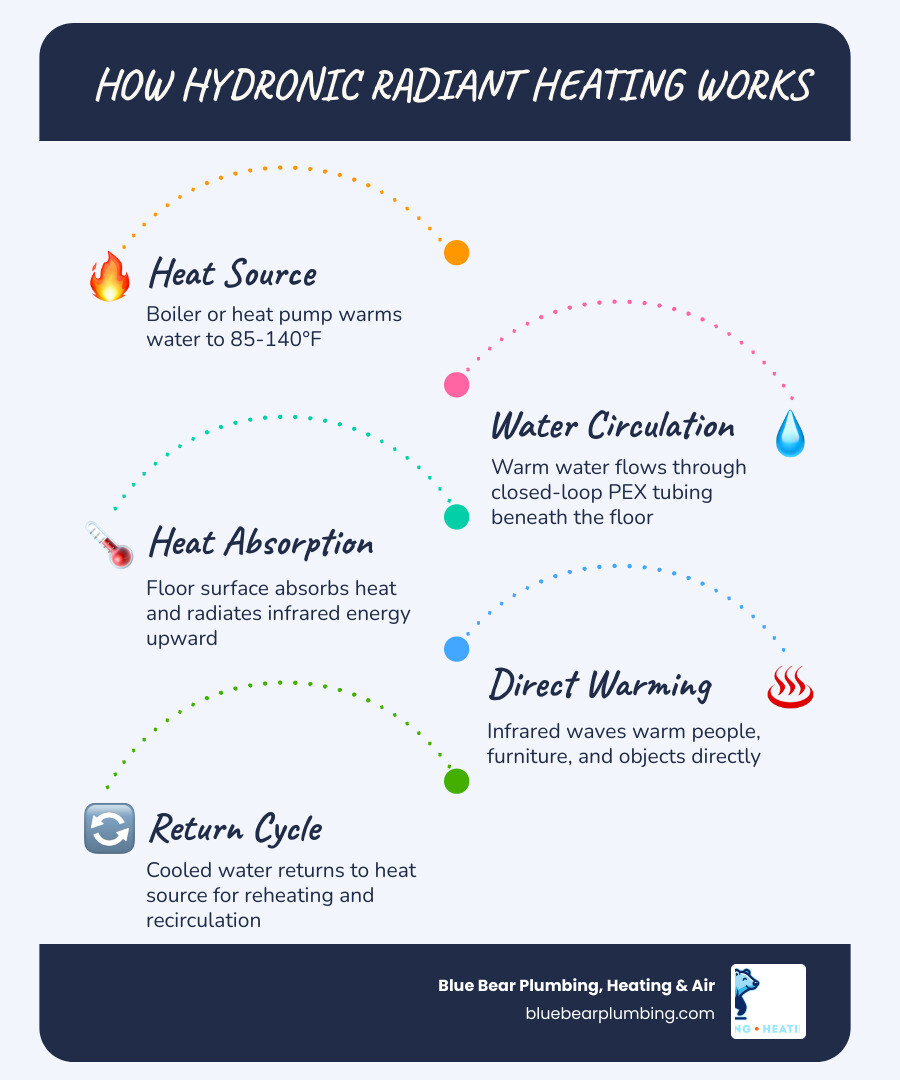
How hydronic radiant heating works comes down to one elegant idea: heat the floor, not the air. Here’s a quick breakdown:
- A heat source (boiler, heat pump, or combi-boiler) warms water to a low operating temperature — typically between 85°F and 140°F.
- Warm water circulates through a closed loop of flexible PEX tubing installed beneath your floor.
- The floor surface absorbs the heat and radiates it upward as infrared energy, warming people, furniture, and objects directly.
- Cooled water returns to the heat source to be reheated and recirculated.
- Zone controls and a manifold let you set different temperatures in different rooms independently.
The result is steady, even warmth from the ground up — no blowing air, no cold drafts, and no hot-and-cold cycling.
On a cold Massachusetts morning, there’s a real difference between stepping onto a freezing tile floor and stepping onto one that’s gently, consistently warm. That’s not magic — it’s physics. Unlike a forced-air furnace that blasts heated air through ducts and loses a significant portion of that energy along the way, a hydronic radiant system delivers heat directly to the surfaces you live on. Because water transports heat approximately 3,500 times more effectively than air, it takes far less energy to move warmth from the source to your living space. The system runs quietly, keeps humidity levels stable, and produces no airborne dust or allergens — making it one of the most comfortable and efficient ways to heat a home.
Whether you’re building new or exploring retrofit options for an existing South Shore home, understanding how this technology works is the first step toward making a smart heating decision. And if you’re wondering whether now is the right time to make a change, our guide on when it’s time to turn on the heat in your home is a great place to start.
I’m Marc Provenzano, Marketing Manager at Blue Bear Plumbing, and I’ve spent years working alongside our licensed technicians to translate the ins and outs of systems like how hydronic radiant heating works into clear, useful guidance for homeowners just like you. In this guide, we’ll walk you through everything — from the core mechanics and key components to installation methods and flooring compatibility — so you can make a confident, informed decision for your home.
How Hydronic Radiant Heating Works: The Core Mechanics
To understand how hydronic radiant heating works, it helps to look at how we normally heat our homes. Standard forced-air systems rely on convection. They blow hot air out of registers, which quickly rises to the ceiling, cools down, and sinks back to the floor. This creates a highly uneven temperature profile: your feet remain cold while the air above your head is overly warm.
Hydronic systems turn this process on its head by utilizing the superior thermal properties of water and the natural physical principles of radiant heat transfer. If you’re looking for other smart ways to optimize your home’s setup, check out these tips for reducing your fall heating bills.
The Science of How Hydronic Radiant Heating Works
At the heart of hydronic radiant heating is thermal radiation—the same type of warmth you feel when stepping from the shade into direct sunlight on a crisp autumn afternoon. The air temperature hasn’t changed, but your body instantly absorbs the infrared waves emitted by the sun.
In a hydronic system, heated water flows through tubes beneath your floor. This heat is transferred through the floor covering via conduction (direct contact). Once the floor surface is warm, it emits gentle infrared waves that travel through the room. These waves do not heat the air directly; instead, they warm the solid objects they strike—including you, your furniture, and the walls.
Because concrete, stone, and tile possess high thermal mass, they act like a “heat battery.” They absorb large amounts of heat and release it slowly and steadily over time, maintaining a highly stable indoor climate with minimal temperature fluctuations.
Step-by-Step: How Hydronic Radiant Heating Works in Your Home
The physical path of heat in a hydronic loop is incredibly efficient:
- Generation: The boiler or heat pump warms the water to the precise temperature required for your specific floor structure.
- Distribution: A high-efficiency circulator pump pushes the warm fluid from the heat source to a centrally located distribution manifold.
- Circulation: The manifold splits the water into individual, continuous loops of PEX tubing running under the floors of different rooms.
- Radiation: As the water flows through the loops, it transfers its thermal energy to the floor assembly, which radiates the heat upward.
- Return: The cooled water flows back to the manifold and returns to the heat source to begin the closed-loop cycle again.
Key Components of a Hydronic System
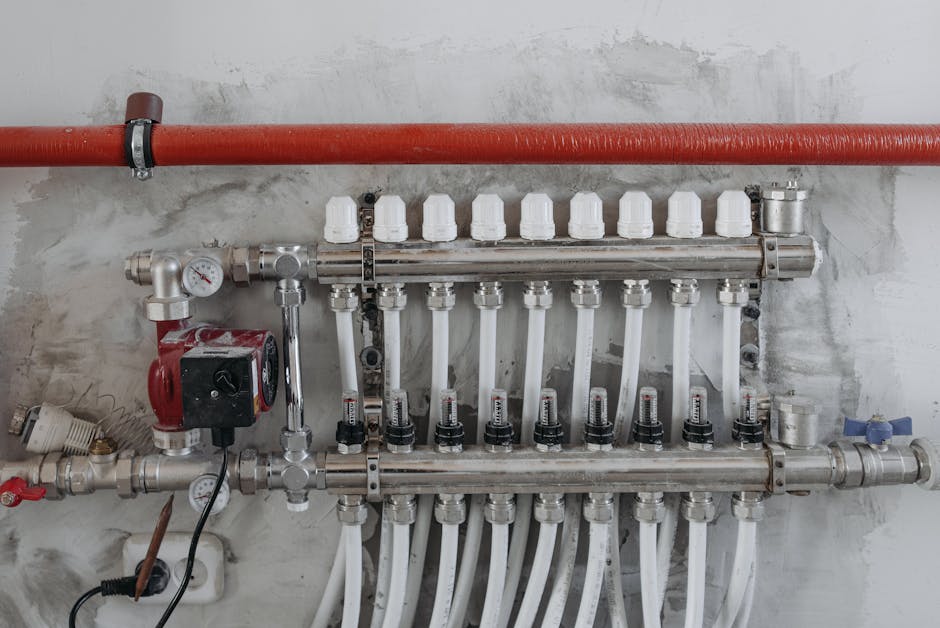
A hydronic radiant floor system is remarkably quiet and hidden from view, but behind the scenes, a small network of high-performance components works in perfect harmony to keep your home comfortable. Understanding these parts is essential, especially if you ever need to troubleshoot or know what to do if the heat goes out during a severe New England winter storm.
Heat Sources: Boilers, Heat Pumps, and Combi-Boilers
The beauty of a hydronic system is its versatility. Unlike forced-air furnaces, which are locked into a single fuel type, a hydronic system can utilize almost any heat source:
- High-Efficiency Condensing Boilers: These modern systems extract extra heat from water vapor in the combustion exhaust, often achieving efficiency ratings over 95% AFUE.
- Hydronic Heat Pumps: Air-to-water or geothermal water-to-water heat pumps are incredibly efficient because they move existing heat rather than creating it. They pair naturally with radiant floors because radiant systems operate at lower water temperatures (85°F to 110°F) where heat pumps are most efficient.
- Combi-Boilers: These compact units handle both your home’s space heating and your domestic hot water, saving valuable square footage in utility closets.
- Alternative Energy Sources: Hydronic systems can easily integrate with solar thermal panels or wood-fired boilers, allowing you to offset your fossil fuel consumption.
Distribution: PEX Tubing, Manifolds, and Pumps
Once the water is heated, it must be safely and precisely routed throughout your home. This is handled by three critical components:
- PEX Tubing: Cross-linked polyethylene (PEX) is the industry standard for radiant piping. It is incredibly flexible, durable, resistant to scale and chlorine, and features an oxygen barrier to prevent system corrosion. Properly installed PEX loops can easily last for several decades.
- The Distribution Manifold: Think of the manifold as the traffic controller of your heating system. It connects the main hot water supply line to the individual PEX loops. Equipped with flow meters and balancing valves, it ensures that each loop receives the exact amount of water needed to heat its designated zone.
- Circulator Pumps and Zone Valves: Modern electronically commutated motor (ECM) circulator pumps are the muscle of the system, pushing the water through the loops. They use up to 75% to 90% less electrical energy than older, standard pumps. Zone valves open and close in response to individual room thermostats, providing precise, localized temperature control.
If you want to ensure these components remain in top shape before the cold weather sets in, follow our 10 steps to prepare your heating system for the cold season.
Wet vs. Dry Installation Methods
When planning a hydronic radiant floor system, one of the most critical decisions is choosing between a wet and a dry installation. This choice dictates how the PEX tubing is physically integrated into your home’s structure, which directly impacts the system’s thermal response time and how much weight your subfloor must support.
| Feature | Wet Installation (Embedded) | Dry Installation (Plate/Panel) |
|---|---|---|
| Heat Transfer Medium | Concrete slab or gypsum overpour | Aluminum plates or wood panels |
| Thermal Mass | Extremely high (slow to heat, slow to cool) | Low to moderate (faster response time) |
| Water Temperature | Lower (85°F to 105°F) | Slightly higher (110°F to 130°F) |
| Weight | Very heavy (requires structural support) | Lightweight (ideal for wood frame builds) |
| Best For | New construction, slab-on-grade, basements | Retrofits, second-floor additions, remodels |
Wet Installation (Embedded Systems)
A wet installation is the traditional method. The PEX tubing is fastened directly to concrete reinforcing mesh or stapled to insulation boards, and then embedded within a thick concrete foundation slab or covered with a lightweight gypsum underlayment (gyp-crete) poured over a wooden subfloor.
Because the concrete completely surrounds the tubing, it acts as a massive thermal battery. It takes longer to heat up initially, but it provides incredibly stable, long-lasting warmth. This method is highly recommended for slab-on-grade homes, basements, and new construction projects with robust structural framing designed to support the heavy concrete load.
Dry Installation (Plate and Panel Systems)
In a dry installation, the PEX tubing is run through air spaces or attached to wood panels beneath or above the subfloor without being encased in concrete. Because air is a poor conductor of heat, dry systems rely on aluminum heat-diffusion plates or prefabricated grooved panels lined with aluminum foil. The aluminum quickly grabs the heat from the PEX tubing and spreads it laterally across the floor.
Dry systems have a much faster response time because they don’t have to warm up hundreds of pounds of concrete. They are lightweight, add very little height to your floors, and are the perfect solution for remodeling historic homes, retrofitting existing structures, or installing radiant heat on upper floor levels.
Flooring Compatibility and Heat Transfer
A common question we hear from homeowners in the South Shore is whether they can use their favorite flooring materials with radiant heat. The short answer is yes—but you must account for the thermal conductivity and R-value (thermal resistance) of each material.
Best Performers: Tile and Stone
Ceramic tile, porcelain tile, and natural stone are the absolute best floor coverings for hydronic radiant heating. They have high thermal conductivity, meaning they let heat pass through to the room rapidly. They also possess excellent thermal storage capacity, helping to maximize the overall efficiency of your system. They don’t expand or contract with temperature changes, making them completely immune to cracking or warping from the heat.
Wood, Laminate, and Carpet Considerations
Other materials can be paired with radiant heat quite successfully, provided you follow a few best practices:
- Engineered Hardwood: This is highly recommended over solid hardwood. Engineered wood is constructed in cross-grain layers, making it far more stable and less prone to shrinking, cupping, or gapping when exposed to temperature changes.
- Solid Hardwood: If you choose solid wood, narrow, quarter-sawn or rift-sawn planks are preferred because they handle moisture and temperature swings better than wide, plain-sawn boards.
- Laminate and Luxury Vinyl Tile (LVT): Most modern laminates and high-quality LVT products are approved for radiant heating, but you must ensure the system’s floor sensor limits the surface temperature to the manufacturer’s recommended threshold (usually around 85°F).
- Carpet: Carpet acts as an insulator. While you can use it, you should select a thin, low-pile carpet with a dense, flat rubber pad rather than a thick foam pad. Keeping the total R-value of the carpet and pad under 2.5 ensures the heat can still rise effectively into your living space.
Benefits of Hydronic Radiant Floor Heating
For homeowners navigating the unpredictable coastal winters of Massachusetts, hydronic radiant heating offers a suite of lifestyle and efficiency benefits that traditional forced-air systems simply cannot match. For a deeper dive into regional heating strategies, check out our Seasonal Heating Guide Massachusetts.
- Unmatched Energy Efficiency: Because water carries heat so effectively, hydronic radiant systems are highly efficient compared to standard forced-air systems. Additionally, because there are no ducts, you completely eliminate duct losses, which can account for up to 30% of a home’s energy waste.
- Superior Indoor Air Quality: Forced-air systems blow air through dusty ducts, circulating pollen, pet dander, and mold spores throughout your home. Radiant systems operate silently and without fans, making them an absolute game-changer for family members who suffer from allergies or asthma.
- True Room-by-Room Zoning: Hydronic manifolds make it incredibly easy to set up independent heating zones. You can keep your bedrooms cool for sleeping while warming up the kitchen and master bathroom floors, ensuring you only heat the rooms you’re actually using.
- Long-Term System Longevity: While a standard forced-air furnace typically has a lifespan of 10 to 25 years, a high-quality hydronic radiant floor system can easily last up to 40 years or more with basic, routine boiler maintenance.
Frequently Asked Questions
How does hydronic radiant heating differ from electric radiant heating?
The primary difference is the heating medium. Hydronic systems circulate heated fluid through PEX tubing, whereas electric systems use high-resistance cables or mesh mats that generate heat when electrical current passes through them.
Electric systems are highly responsive and thin, making them great for small, single-room remodels (like a small guest bathroom). However, they require significant electrical energy to run as a whole-house heating source. Hydronic systems require a larger initial installation footprint but are far more energy-efficient to operate for whole-house heating.
Can hydronic radiant heating be used for cooling?
Yes, but it requires careful engineering. A hydronic system can run chilled water through the same PEX tubing network to absorb sensible heat from the home. However, because cold floors can cause moisture in the air to condense, radiant cooling systems must be paired with a dedicated outdoor air system (DOAS) or a dehumidification system to manage the latent humidity load and keep your home comfortable and dry.
What is the typical lifespan of a hydronic radiant system?
The PEX tubing embedded in your floors is incredibly durable and is designed to last 50 years or more. High-efficiency boilers and hydronic heat pumps generally last 15 to 25 years, which is significantly longer than standard forced-air furnaces. With annual professional maintenance, a hydronic system represents an incredibly reliable, multi-decade investment in your home.
Conclusion
Understanding how hydronic radiant heating works reveals why it remains the gold standard for home comfort and energy efficiency. By heating your floors directly, these systems eliminate drafts, reduce allergens, and provide cozy, zoned warmth that matches how the human body naturally experiences comfort.
At Blue Bear Plumbing, our friendly, local team is dedicated to providing high-quality workmanship, attentive customer care, and honest, transparent communication. Whether you are building a new home, planning a major renovation, or simply looking to upgrade your existing heating system in the South Shore or MetroWest area, we are here to help.
From Norwell and Quincy to Natick and beyond, our licensed technicians can design and install a custom hydronic system tailored perfectly to your home. Contact us today at bluebearplumbing.com to schedule your consultation and take the first step toward a warmer, more comfortable winter!



Contact Us Today

Routine maintenance is vital for the longevity of your plumbing, heating, and air conditioning systems. Sign up for our Blue Care Maintenance Plan for annual service and exclusive membership benefits, including:
- Priority scheduling
- Waived service fee during normal business hours
- 10% discount on service calls
- 3% discount on new installations
- Two-year parts and labor warranty on new equipment