




The Complete Guide to Battery Backup Sump Pump Benefits
Plumbing
Why Battery Backup Sump Pump Benefits Matter for Massachusetts Homeowners
The battery backup sump pump benefits for homeowners in Massachusetts are hard to overstate — especially when a nor’easter or summer thunderstorm knocks out power at the exact moment your basement needs protection most. Here’s a quick look at what a battery backup sump pump actually does for you:
Key Benefits at a Glance:
- Flood protection during power outages — keeps pumping even when the grid goes down
- Automatic activation — switches on without any action from you
- Mechanical failure backup — kicks in if your primary pump burns out or its float switch gets stuck
- Mold prevention — stops standing water before the 24-48 hour mold growth window kicks in
- Extra pumping capacity — works alongside your primary pump during heavy water inflow
- Peace of mind — smart systems send real-time alerts to your phone
Here’s why this matters right now: weather-related power outages from 2014 to 2023 were nearly double those recorded from 2000 to 2009, according to Climate Central. And without power for just five minutes, more than 90 gallons of floodwater can fill your home — rising past 1,000 gallons within an hour. Your primary sump pump runs on electricity, which means it goes silent at the worst possible moment unless a backup system is in place.
I’m Marc Provenzano, Marketing Manager at Blue Bear Plumbing, Heating & Air, and I’ve spent considerable time working alongside our licensed plumbing team to understand the real-world battery backup sump pump benefits that protect South Shore homeowners every storm season. In the sections below, I’ll walk you through everything you need to know — from how these systems work to choosing the right battery size for your home.
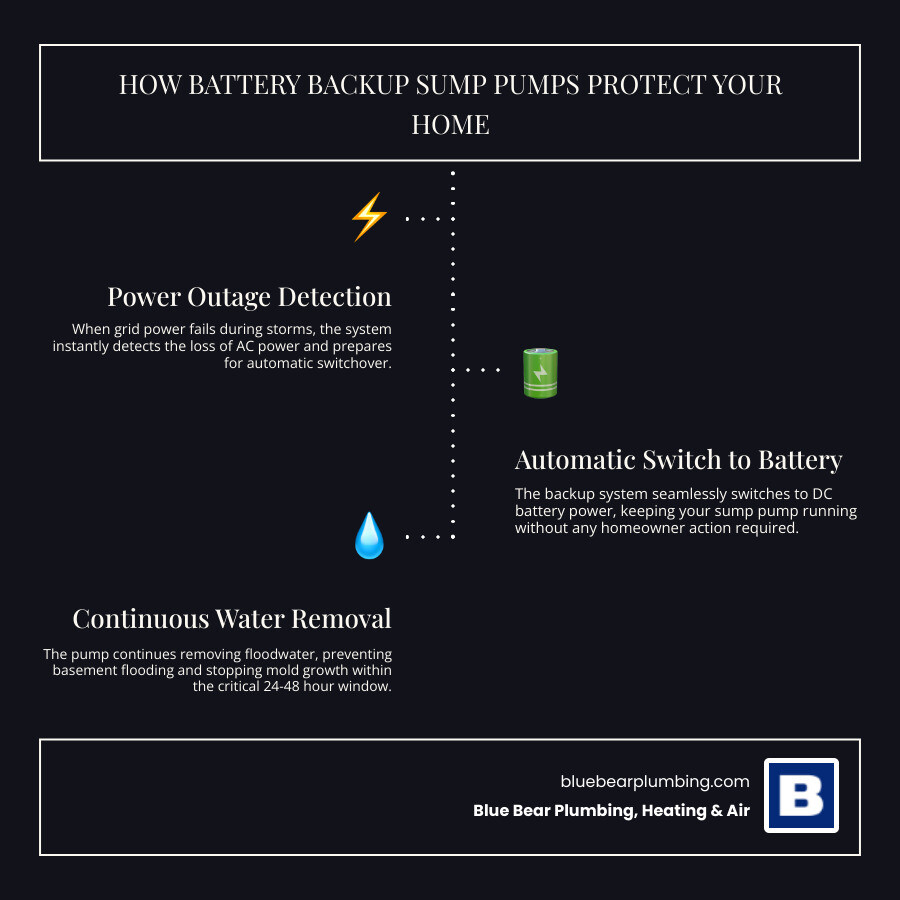
How a Sump Pump Battery Backup Works and Why It Is Essential
To fully appreciate the peace of mind these systems offer, it helps to understand exactly what happens inside your sump pit when a storm rolls through the South Shore.
A standard residential sump pump relies entirely on your home’s electrical grid. When heavy rains saturate the soil around your foundation, water flows into the sump pit, raising the float switch. Once the switch reaches a designated height, your primary pump turns on, sending the water safely away from your home through a discharge pipe.
But what happens when a severe storm knocks out the local power grid?
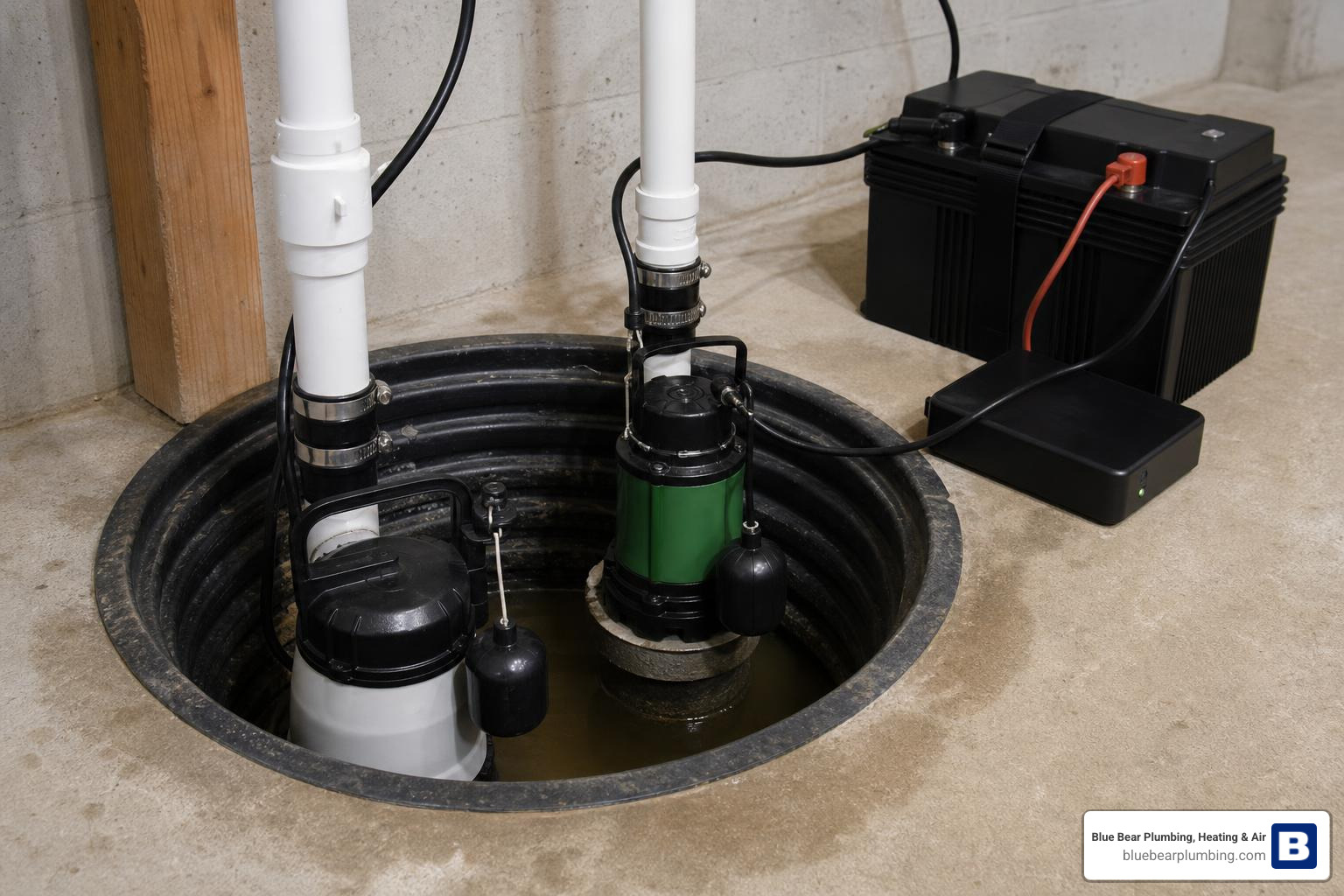
Without a secondary power source, your primary pump goes silent. Water continues to fill the pit, quickly overflowing onto your basement floor. This is where a battery backup system steps in.
There are two primary configurations for battery backup systems:
- The Auxiliary DC Backup Pump: This is the most common setup. A secondary, smaller pump (powered by direct current, or DC) is installed in the sump pit slightly higher than your primary AC-powered pump. If the power goes out, or if the primary pump fails mechanically, the water level will rise to reach the auxiliary pump’s float switch. This triggers the backup system to draw power from a dedicated heavy-duty battery bank, keeping the water moving out of your home.
- The AC/DC Power Inverter System: Instead of using a second pump, this system utilizes your existing primary pump. It connects your primary pump to an inverter and a battery bank. When utility power is lost, the inverter automatically converts DC battery power into AC power, allowing your primary pump to continue running at its full, original capacity.
Regardless of the configuration, the transition is entirely automatic. You do not need to be home to flip a switch or connect a generator. The system constantly monitors the incoming electrical current; the moment it detects a drop in voltage or a primary pump failure, the backup system engages instantly. This automatic switchover is your home’s ultimate fail-safe during grid failures, providing continuous, uninterrupted protection when you need it most.
Top Battery Backup Sump Pump Benefits for Massachusetts Homeowners
Living on the South Shore or in South Boston means dealing with highly unpredictable coastal weather. From sudden spring downpours to heavy winter snowmelt, our basements are constantly under threat from rising water tables. Investing in a backup system delivers several crucial battery backup sump pump benefits that safeguard your property, health, and finances.
Flood and Water Damage Prevention
The most immediate benefit is preventing catastrophic flooding. Basement water damage is incredibly costly to repair, often requiring professional water extraction, drywall replacement, and structural drying. By keeping your sump system active during a power outage, you avoid these massive headaches entirely.
Mold and Mildew Prevention
Fungus and mold are highly opportunistic. They can begin to grow and colonize damp surfaces within just 24 to 48 hours after a flooding event. Once mold takes hold in your basement carpet, drywall, or framing, remediation becomes a complex and expensive process. A battery backup ensures that water never has the chance to pool, keeping your indoor air quality safe and healthy.
Mechanical Failure Fail-Safe
Power outages aren’t the only reason basements flood. Primary sump pumps are mechanical devices with a limited lifespan (typically around 10 years). They can burn out, experience clogged intake screens, or suffer from a stuck float switch. A dual-pump backup system acts as a mechanical fail-safe, stepping in to take over the workload even if the power is fully on but the primary pump has failed.
Dual-Pump Pumping Capacity
During extreme weather events, the volume of water rushing into your sump pit can occasionally overwhelm a single pump. High-quality battery backup systems are designed to work in tandem with your primary unit. If the water rises faster than your primary pump can handle, the backup pump’s float switch will be triggered, running both pumps simultaneously to double your overall pumping capacity.
Key Battery Backup Sump Pump Benefits: Protection Against Mechanical Failures
While power outages get the most attention, mechanical failures are incredibly common. Sump pits are naturally dirty environments. Over time, dirt, gravel, and household debris can wash into the basin. This debris can easily clog the intake screen of your primary pump, starving it of water and causing the motor to overheat and burn out.
Another frequent point of failure is the float switch. Because submersible pumps vibrate slightly while running, they can shift inside the pit. This movement can cause the mechanical float switch to pin itself against the rough concrete wall of the basin, wedging it in the “off” position.
A backup pump is installed on a separate bracket, usually positioned several inches higher in the pit, and operates on its own independent float switch. This design ensures that if the primary pump is physically jammed, clogged, or electrically dead, the rising water will simply trigger the secondary unit. This redundant layer of protection is a cornerstone of the battery backup sump pump benefits that keep homes dry even when mechanical components wear out.
Key Battery Backup Sump Pump Benefits: Smart Alerts and Remote Monitoring
Modern plumbing technology has brought incredible convenience to home maintenance. Today’s high-quality battery backup systems often feature smart integration, allowing you to monitor your basement’s safety from anywhere in the world.
With Wi-Fi connectivity, these smart systems connect directly to your home network. Through a mobile app, you can receive real-time alerts for critical events, such as:
- Power outages: Know instantly when your home has lost utility power and the system has switched to battery power.
- High water alarms: Receive a notification if the water level in the pit has reached the backup pump, indicating the primary pump is overwhelmed or has failed.
- Battery health updates: Get proactive alerts if the battery voltage drops, if the charger fails, or if the battery is approaching the end of its useful life.
- Pump performance data: Track how often your pump cycles during a heavy storm.
Many of these smart systems also perform automatic, weekly self-testing diagnostics. The system will briefly run the backup pump to verify that the motor, impeller, and electrical circuits are functioning perfectly. If any anomaly is detected, it alerts you immediately—giving you plenty of time to schedule a professional inspection before the next big storm hits.
Comparing Backup System Types and Choosing the Right Battery
When selecting a backup system, it is important to weigh the differences between the available technologies. Below is a comparison of the three primary backup methods:
| Feature | Battery-Powered Backup | Water-Powered Backup | Combination Sump Pump Unit |
|---|---|---|---|
| Power Source | 12V Deep-Cycle Battery | Municipal Water Pressure | AC Outlets + 12V Battery |
| Runtime | Limited by battery capacity (several days intermittent) | Unlimited (as long as municipal water flows) | Dual capability (unlimited AC / limited battery) |
| Pumping Capacity | 800 to 2,000+ GPH | Lower rates (approx. 800-1,000 GPH) | Highest (both pumps can run at once) |
| Water Source Compatibility | Works with any home | Municipal water only (No well water) | Works with any home |
| Installation Complexity | Moderate | High (requires tapping into main water line) | Moderate to High (replaces entire existing pump) |
| Maintenance Needs | Low to Moderate (periodic battery checks) | Low (no battery to replace) | Moderate (replaces both pumps and battery) |
Choosing the Right Battery Technology
The battery is the heart of your backup system, and choosing the right chemistry and capacity is essential for reliable performance. Standard car batteries are designed for quick, high-current bursts to start an engine and are completely unsuitable for sump pumps. Instead, you must use a deep-cycle battery designed for sustained, long-term power discharge.
There are three main battery types used in residential backup systems:
- Flooded Lead-Acid (Wet Cell): These are the most traditional and affordable deep-cycle batteries. However, they require hands-on maintenance. You must check the fluid levels twice a year and top them off with distilled water to prevent the plates from drying out. They generally last 3 to 5 years.
- Absorbed Glass Mat (AGM): AGM batteries are widely considered the gold standard for residential basements. They are completely sealed, maintenance-free, and highly resistant to the humid conditions of a sump pit area. They have a longer lifespan, typically lasting 4 to 7 years.
- Lithium-Ion (LiFePO4): While they represent a higher initial investment, lithium-ion batteries offer incredible longevity (often lasting 8 to 15 years) and a very high cycle count. They are lightweight, highly efficient, and maintain stable voltage throughout their discharge cycle.
Understanding Amp-Hour (Ah) Ratings and Maintenance
Batteries are rated in Amp-Hours (Ah), which indicates how much electrical current they can deliver over a 20-hour period. Standard capacities range from 40Ah to 120+ Ah.
As a general guideline for intermittent pump operation during a storm:
- A 40Ah battery provides approximately 32 hours of protection.
- An 84Ah battery provides approximately 68 hours of protection.
- A 120Ah battery provides approximately 96 hours of protection.
To ensure your battery is always ready to perform, we recommend performing basic maintenance every six months. This includes checking the battery voltage with a voltmeter (it should read between 12.3 and 13+ volts statically) and cleaning the battery terminals with a baking soda and water solution to remove any corrosive buildup.
Frequently Asked Questions About Sump Pump Backups
How long will a sump pump battery backup run during a power outage?
The runtime of a battery backup depends heavily on the size of the battery (its Ah rating) and how frequently the pump needs to cycle. Under continuous, non-stop pumping conditions, a standard 75Ah to 120Ah battery will typically run for 7 to 12 hours.
Fortunately, sump pumps rarely need to run continuously. During a typical storm, the pump operates intermittently (cycling on for 10-15 seconds every few minutes). Under these normal, intermittent conditions, a fully charged deep-cycle battery can easily provide 2 to 4 days of continuous flood protection.
Can I add a battery backup to my existing sump pump?
Yes! You do not necessarily have to buy an entirely new sump pump system to enjoy these benefits. Standalone battery backup systems can be retrofitted and added to most existing, high-quality primary sump pumps.
During a retrofit installation, our team will mount the backup control unit and battery box on the wall near your sump pit, install the secondary pump slightly higher in the existing basin, and tie the discharge pipe into your existing line using a high-quality check valve. We will always perform a comprehensive compatibility check and structural assessment of your existing pit to ensure there is adequate physical space for both units to operate without interference.
Is a water-powered backup better than a battery backup?
Water-powered backup pumps are a unique alternative because they do not use electricity or batteries. Instead, they use the physical pressure of your municipal water supply to create a vacuum that sucks water out of the sump pit.
While they offer the incredible benefit of unlimited runtime, they have strict limitations. They require strong, consistent municipal water pressure (typically a minimum of 40 PSI) and cannot be used in homes that rely on well water, because well pumps stop working during a power outage. Additionally, they use about two gallons of fresh city water for every one gallon of sump water they pump, which can result in a very high water bill during an extended storm. For most Massachusetts homeowners, a battery-powered system remains the most practical and efficient choice.
Conclusion
When a severe storm rolls through South Boston or the South Shore, the last thing you want to worry about is whether your basement is actively flooding. Investing in a professional battery backup system is the single most effective way to ensure your home remains dry, safe, and mold-free, no matter how long the power grid remains offline.
At Blue Bear Plumbing, Heating & Air, our friendly, local team is dedicated to providing high-quality plumbing workmanship and attentive customer care. We serve homeowners throughout the South Shore with upfront pricing, integrity, and reliable home comfort solutions. Whether you need a brand-new combination system installed, a backup retrofitted to your current pump, or routine preventative maintenance, we are here to help.
Don’t wait for the next major storm to test your home’s defenses. Schedule expert sump pump services in the South Shore with our licensed team today!

Contact Us Today

Routine maintenance is vital for the longevity of your plumbing, heating, and air conditioning systems. Sign up for our Blue Care Maintenance Plan for annual service and exclusive membership benefits, including:
- Priority scheduling
- Waived service fee during normal business hours
- 10% discount on service calls
- 3% discount on new installations
- Two-year parts and labor warranty on new equipment